Sir George Paget Thomson succeeded Callender in 1932. Thomson was a Nobel Laureate for his discovery of electron diffraction by crystals (and other substances) which meant that an electron’s motion could be described by the mathematics of wave mechanics. His father, J. J. Thomson, was also a Nobel Laureate, recognised for his work on electrons as particles whose motion could, in the circumstances of his investigations, be described by Newtonian mechanics.
G. P. Thomson, during his Physics Department headship, initially established an electron diffraction research group.
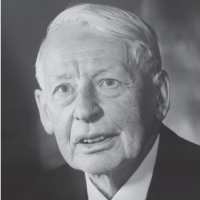
G. P. Thomson was (until he retired, to become master of Corpus Christi College, Cambridge) virtually the only professor in the Physics Department. He arranged to do work on uranium to investigate the possible neutron chain reaction. Throughout the early 1940s, his research interests in electron diffraction continued, but this work was eventually halted as uranium research became classified and was transferred away from Imperial College.
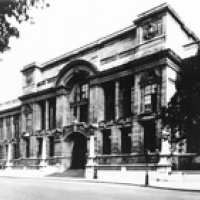
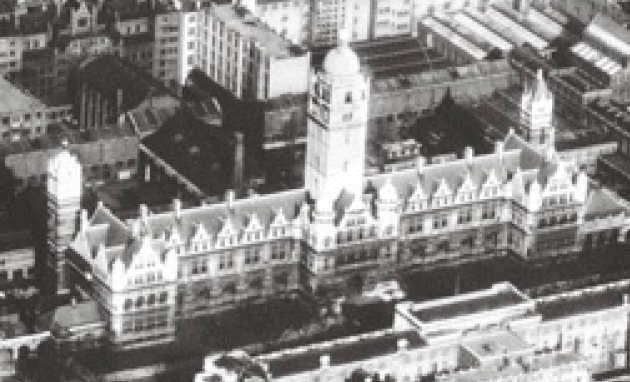
The RCS building was outwardly symmetrical, with the Chemistry side extending towards Exhibition Road and the Physics side extending towards Queens Gate. The building stood on the south side of the Imperial Institute Road, then an ordinary through-road for traffic between Queens Gate and Exhibition Road. The Imperial Institute building faced the north side of the RCS building with what is now known as the Queens Tower facing the entrance of the RCS building. The Imperial Institute Building was also symmetrical about the Queens Tower with two smaller towers at each end of the building. It functioned as a museum demonstrating various aspects of the British Empire and included a free cinema along with other amenities.
Tunnels originally constructed after the Great Exhibition of 1851 for the Imperial Institute’s heating systems, were still in use, and very convenient for avoiding the rain. One tunnel emerged somewhere in the vicinity of the ground on which the new Physics building was to be erected as a first-class steel frame building. The tunnel network - now closed off - criss-crosses campus, running beneath Exhibition Road to reach Southside and Prince’s Gardens.
 Work on the new Physics building began in the early 1950s, roughly coinciding with Patrick M S Blackett's arrival as the new Head of Department in 1953. Physics continued in the old RCS building till the completion of the new Physics building in 1961. The new Physics building subsequently became the Blackett Laboratory.
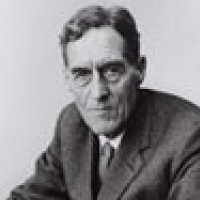 Peerage.
After Blackett’s retirement from Departmental headship he was replaced by Sir Clifford Charles Butler, the first of the system of rotating “heads” each one for a period of about 5 years. The Rector effectively appointed each new head. This system evolved over the following decades, reflecting the continued growth and increasing complexity of one of the world's leading physics departments.
Based on a text by Dr. N. D. Lisgarten