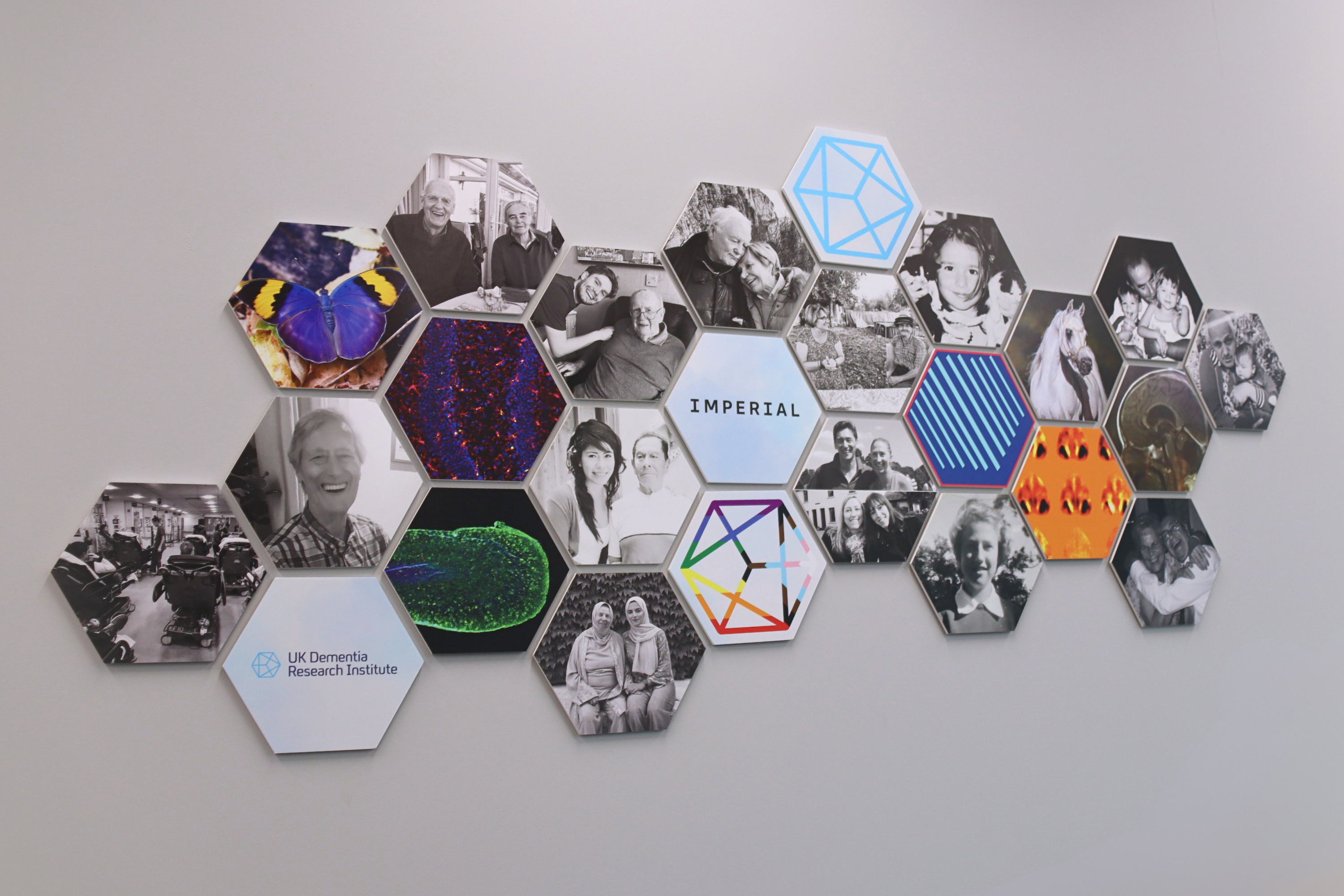
On Level 7 of the White City Sir Michael Uren Hub, we have a photo wall to show who we are and what motivates our science. Each photo is in a hexagonal frame to match the UK DRI logo, and they are placed in a honeycomb pattern. The images are shown below, accompanied by a paragraph explaining what they all mean to members of our team.
Motivations Dec
Motivations New

"I hope to de-stigmatise dementia in Jordan."
Dana
"My grandmother, once a very active woman, started showing dementia symptoms in 2021. Slowly her memory began to decline, and she was diagnosed with Parkinson’s and Alzheimer’s diseases. Throughout the years, her symptoms have worsened but her passion and love for life are still prominent today. She is always smiling, laughing at our jokes and every now and then when she recognises me her eyes light up and she says a phrase in Arabic that translates to “The only person more treasured than a daughter is a daughter’s daughter”.
Alzheimer’s disease is not talked about or researched much in Jordan, which left my family feeling confused, devastated and helpless as my grandmother’s memory declined. At the UK DRI I am learning how to support my grandmother better everyday, and in turn I am teaching the rest of my family. I hope, by contributing to uncovering the basis of neurodegenerative disorders in my research, that there can be a cure soon, and that I can increase understanding and de-stigmatise dementia in Jordan."

"My grandfather Vladimir has been one of the most profound influences on my life and scientific journey."
Anastasia
When I was born, he became a constant presence: teaching me to read, sharing his love for encyclopedias, and turning science, history, and nature into stories and games. Long before I started school, we were exploring the world together through books and questions. But more than anything, he taught me how to think, how to be curious, and how to believe in myself. His quiet perseverance and unwavering encouragement gave me the confidence to pursue science as a vocation, not just a subject. Even now, during my PhD, I think of him often – of his determination, his humility, and his belief that one could always go further."

"My grandfather Thanasis knew how to enjoy life better than anyone I have ever known."
Tatiana
"He didn’t believe in doing anything halfway, he laughed loudly, ate well, stayed out all night if that’s where the fun was, and he loved big, especially when it came to his family. He lived like life was a celebration: big, warm, and full of stories. But after he was diagnosed with dementia, little by little, the things he loved, the very things that made him who he was, began to slip away. Now, I put my best foot forward every day to help build a future where no one has to lose the parts of themselves that make them feel truly alive."

"As a child I loved studying insects and natural history, a passion I got from my father. He and I used to go onto the South Downs near Brighton where I grew up and we made a small collection of the butterflies and moths found there. This was my first introduction to biology, and what made me first interested in studying biochemistry and zoology, and ultimately neuroscience. I still have this hobby of natural history today. The picture of the butterfly is one I took in Tanzania." Bill

"My brother was diagnosed with a brain tumour when he was little and as a 5-year old, I was fascinated by his recovery post-surgery. I spent hours with him throwing and catching balls, learning colours and building legos. Many years later, I decided to learn more about how brains work and how the black hole in the back of my brothers brain where the tumour was removed influenced his life." Anna
Quotes

"My mother-in-law is an internationally recognised artist and equestrian. Throughout her life, she has combined her two passions and featured here is my favourite painting of hers, of one of her Arabian horses (she had 20 when we met!). Her dementia diagnosis was devastating for all the family – as it is for every family. For years she could only be found in either the stables or her studio, but the cruel tragedy is that she struggles now to paint. The work of the UK DRI gives me hope – research will help improve the lives of people living with and affected by dementia." Jennifer

"My grandfather was diagnosed with Parkinson's disease two years before passing away. I wish I would have known how to support him better or how to improve his life's quality. I like thinking that by being involved in Dementia research I am somehow helping to tackle the disease; one day every country in the world will have an action plan and a globally accepted treatment that will help families to cope with such devastating diseases." Diana

"I am motivated not only by the thrill of discovery but also by the meaningful and lasting positive impact that our findings could ultimately have on society. Every new insight offers the possibility to improve lives, shape future technologies, and deepen our understanding of ourselves. It's a tremendous privilege to study a system as profoundly mysterious as the human brain with its intricate networks, molecular processes, and remarkable capacity for adaptation. Engaging with such an extraordinary subject reminds me why research matters and why this work is so rewarding." Sam

"When it all gets a bit too much, I think of this super shy little girl that liked books (and cats!). I was always told that to succeed in anything, I had to be more outspoken and social. Remembering how far we've come could be the best motivation sometimes!" Marianna

"As a young person, I found it difficult to understand my grandfather's mental decline, as he was someone who was characterised above all by his intelligence and empathy. He suffered from vascular dementia for almost 10 years. My PhD is therefore dedicated to gaining a better understanding of the vascular component in dementia." Kevin

"My first supervisor and Post Doc I worked with encouraged me to become a Lab Manager!" Megan
Quotes

"The photo is of my grandparents Mario and Irene, who are both living with dementia, from one of the last trips they did together before both deteriorating in their condition. They have been a been a big inspiration for my work – I love them dearly and I hope we can improve the detection, treatment and outcomes for people with dementia in the future." Julia

"Growing up I was fascinated by the medical world and the idea of solving complex problems. Later this curiosity turned to the brain and the interaction between its innate immune system – microglia – and the parenchyma particularly with regards to neurodegenerative and neuropsychiatric disorders. I think my younger self would be ‘mind blown’ to think that I now get to look directly into the brains of real people every day and investigate important questions with cutting edge technologies. This image shows a section of Alzheimer diseased brain stained for nuclei (blue), astrocytes (green), amyloid plaques (yellow) and microglia (red) using the spatial transcriptomics platform – GeoMx." Emily

"I chose to upload a photo of my mum and grandpa taken in the village where I grew up. My mum, in her late 50s, has been diagnosed with a rare form of dementia, while my grandpa, now in his 80s, shows signs of sporadic Alzheimer's disease. Despite these challenges, my mum remains the strongest and most determined person I know." Carola

"I am inspired by our brain's immune cells change in Dementia and how we can stimulate their return towards beneficial activity for the brain." Sophie

"Working in the UK DRI at Imperial gives me a rare opportunity to use both my professional experience and academic understanding to work on a subject very close to my heart. My grandpa, David, had vascular dementia. He was a great man - I hope to be like him one day, and I know for sure that despite his disease he was still very proud of who I've grown up to be." Josh

