| Researcher | Principal Investigator |
|---|---|
| Elias Rabbat |
Corrosion in metallic pipelines is a major industrial concern, yet existing guided-wave inspection technologies provide only qualitative screening and are unable to deliver the quantitative wall-thickness maps required for accurate condition assessment. As a result, no existing non-destructive method currently satisfies the industrial need for high-resolution, long-range, and quantitative imaging of pipeline corrosion.
In this project we develop and implement a geometric full waveform inversion (GFWI) framework tailored to guided waves in cylindrical structures. The method formulates the defect reconstruction problem as an iterative adjustment of the pipe’s outer-wall geometry within a finite element (FE) model, using residual wavefields obtained from a 40-element torsional-mode ultrasonic ring. We have derived the full adjoint-based geometric gradient, integrated it into an explicit time-domain FE solver, and demonstrated accurate reconstruction of a range of numerically simulated corrosion profiles. The technique has also been applied to experimental data acquired from a pipe containing a CNC-machined defect, showing promising agreement between reconstructed and true geometries.
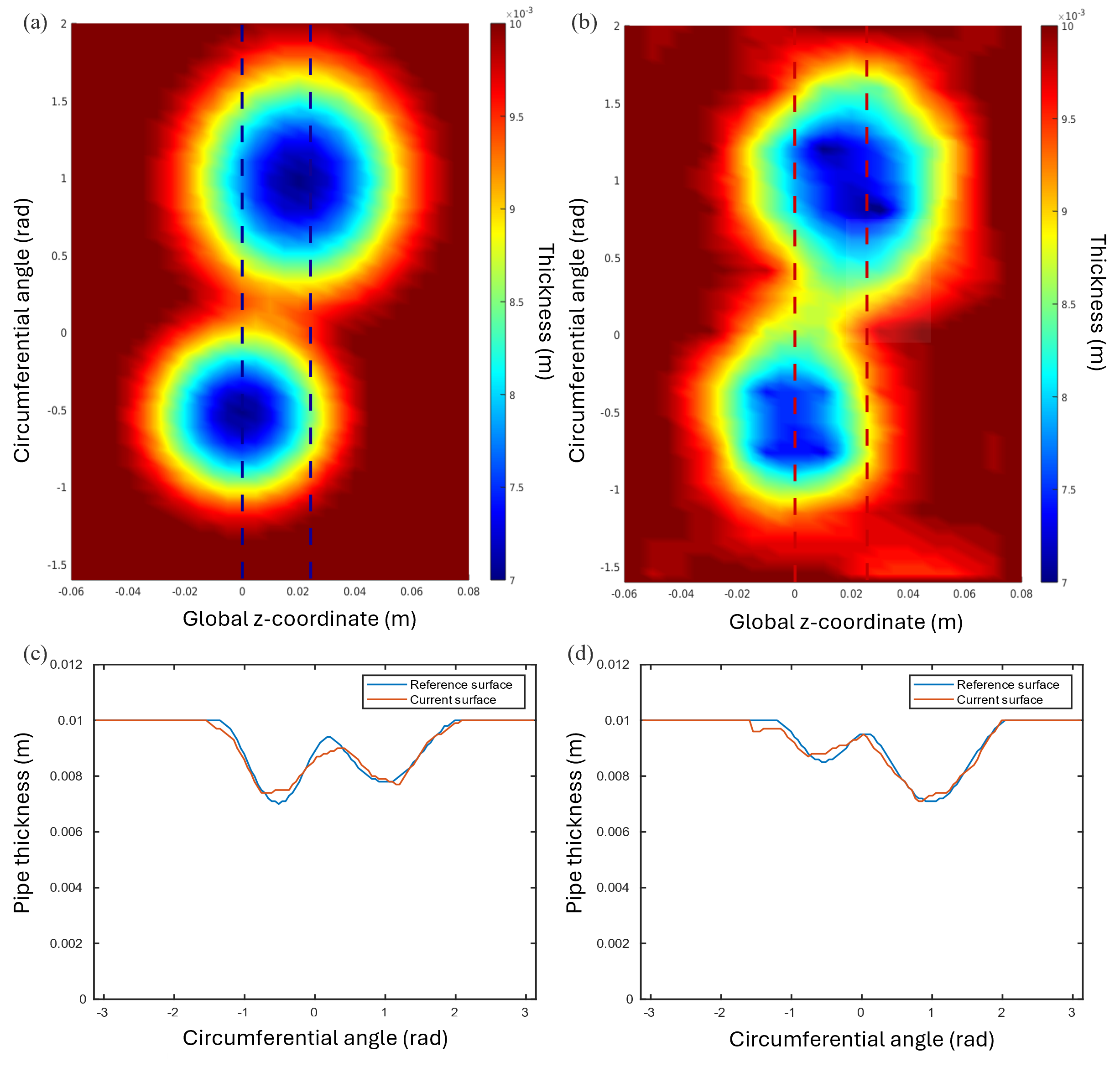
Figure showing the recovery of a double Hann defect from simulated data at 30 kHz with an SNR of 35 dB after 40 GFWI iterations. (a) True defect profile. (b) Reconstructed profile using T(0,1) mode reflection-based inversion. (c) Transverse thickness cut at z = 0 m. (d) Transverse thickness cut at z = 0.025 m.