Root tip regeneration
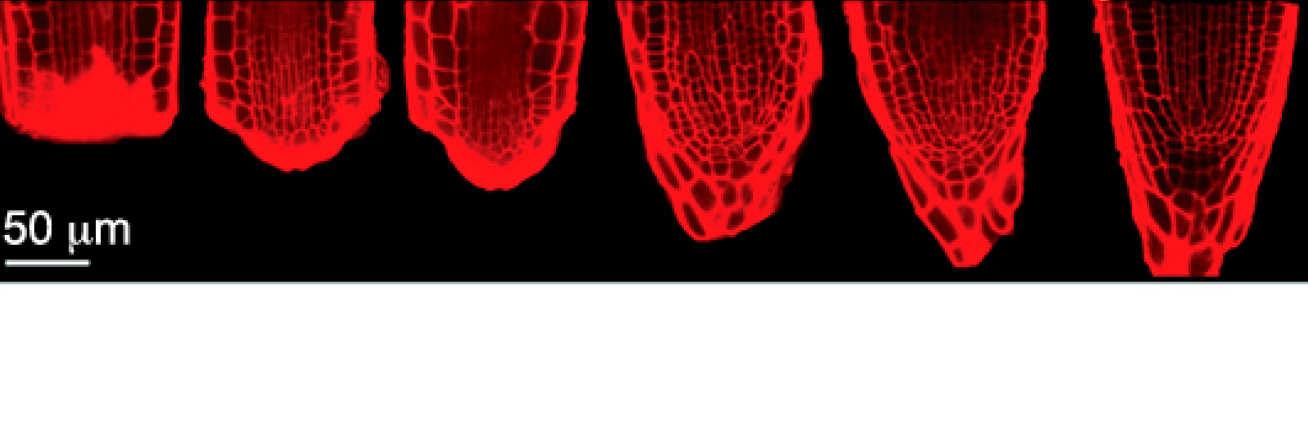
We adopt root tip regeneration in Arabidopsis (Fig 1) as a model system to study plant tissue self-organisation. The long-term goal is to infer universal effective theories about the emergence of order in multicellular systems.
The main approach is to combine standard molecular genetics methods with novel live imaging setups and quantitative assays, to dissect the molecular and physical mechanisms regulating tissue self-organization.
Callus regeneration
A second model system used to address fundamental questions in plant tissue regeneration is callus, a mass of rather undifferentiated tissue that can be induced in vitro and is part of widely used microproagation methods.
Main questions
- Does the tissue reorganisation depend on well-defined organisers (instructive) or merely on local cell-cell interactions (true self-organisation)?
- What is the role of bioelectric patterns in tissue regeneration?
- How is plant tissue regeneration affected by external perturbations, e.g. electric fields?
- What are the genetic, epigenetic and physical mechanisms regulating and constraining tissue regeneration in plants?
- How does organ regeneration differ from other examples of post-embryonic organogenesis?
- How can such morphological dynamics be quantitated and mathematically analysed?
- Can tissue self-organisation be controlled and enhanced in plants?