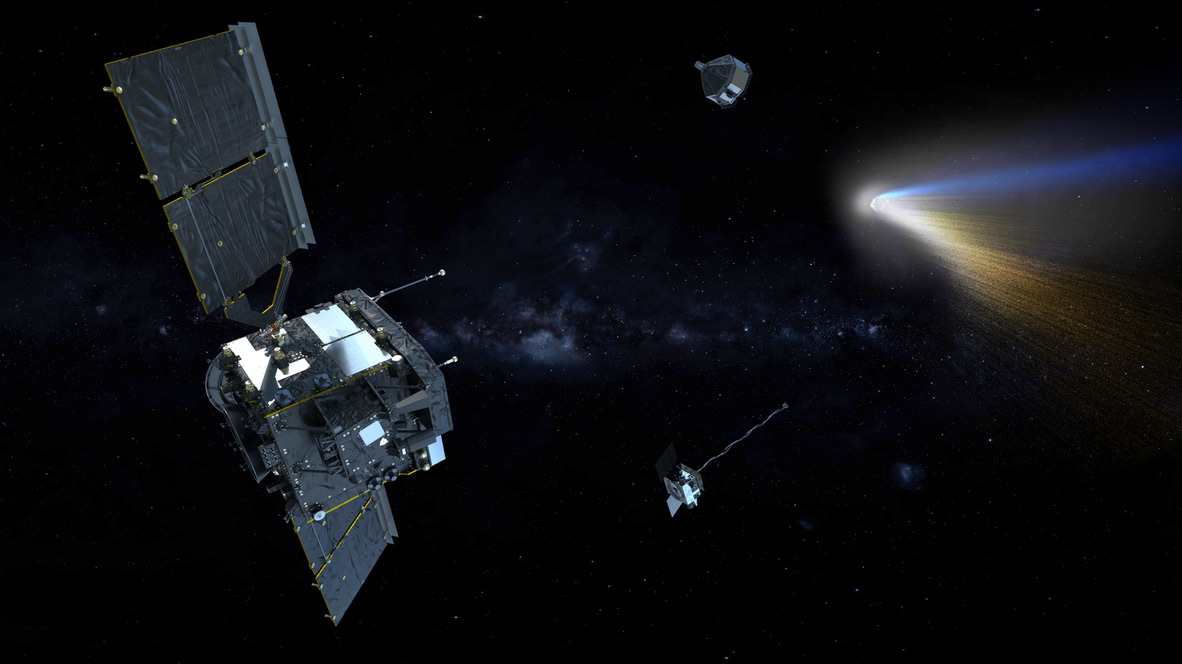
Comet Interceptor is an exciting multi-spacecraft mission that will be launched before its target is known!
The target is expected to be a dynamically-new comet which will be penetrating into the inner Solar System (inwards of the orbit of the asteroid belt) for the first time. The other originality of the mission is its multi-point capability: it will be deploying three spacecraft, mother spacecraft A (ESA), and probes B1 (JAXA) and B2 (ESA), to characterise the pristine comet and its interaction with the space environment.
Beside cameras, magnetometers are the only instrument present on all three spacecraft, fully exploiting the multi-point capability offered by Comet Interceptor. At Imperial, we are responsible for the magnetometer onboard probe B2, which is the spacecraft to get the closest to the comet.
Comet Interceptor will wait in space at the Sun-Earth Lagrange point L2 until a dynamically-new comet is identified on its first-ever way into the inner Solar System. At this point, Comet Interceptor will set off to flyby the comet, and make new discoveries about its properties. Such pristine comets are messengers from the dawn of the Solar System and will shed lights on how it formed.
Comets are fascinating objects. They may have brought water and building blocks of life to Earth. They also constitute an amazing plasma laboratory: the gas sublimated from their nucleus escapes to space and becomes partially ionised. Our research at Imperial focuses on the always-evolving cometary plasma and its dynamic interaction with the space environment driving auroral emissions.
Learn more? A comprehensive review on the mission was recently published in Space Science Reviews.
News: Imperial instrument marks key milestone for ESA Comet Interceptor mission
Comet Interceptor
- Initial Selection June 2019
- Phase 0 initial study phase completed December 2019
- Mission adopted: June 2022
- Current status: Instrument flight models getting finalised and delivered to the Prime Contractor. The magnetometer on Probe B2, instrument led by Imperial, was part of the first instrument delivered to the mission in May 2026!
- Planned launch date: Late 2028/Early 2029
The mission’s primary science goal is to characterise, for the first time, a dynamically-new comet, including its surface composition, shape, and structure, the composition of its gas coma (partially ionised), and its interaction with the space environment. Such comets are the most pristine objects in the Solar System, having not evolved since their birth, about 4.6 billion years ago when the Solar System formed.
Beside cameras, magnetometers are the only instrument present on all three spacecraft, hence fully exploiting the multi-point capability of Comet Interceptor and offering the first opportunity:
- to assess the 3D structure of magnetic boundaries, such as the bow shock and the diamagnetic cavity, resulting from the interaction of the solar wind with the cometary plasma
- to disentangle time versus space in evaluating the energy transfer through waves generated and propagating across the different interaction regions.
At Imperial College London, we are leading the FluxGate Magnetometer (FGM) on probe B2. It is part of the Dust, Field & Plasma (DFP) suite which is including sensors on board spacecraft A and probe B2. The DFP consortium, led by CBK, Poland, gathers instrument teams from Austria, France, Germany, Italy, Czech Republik, Sweden, and the UK.
The FGM-B2 team at Imperial is composed of:
- Marina Galand - Lead
- Emanuele Cupido - Instrument Manager and Thermal & Mechanical Lead
- Chris Carr - EMC Lead and Engineering Oversight
- Irene Ruiz Rodriguez - Instrument Engineer
The FGM-B2 activity includes a major hardware component from IWF, The Space Research Institute at Graz in Austria.
Arnaud Beth, a cometary plasma expert, is a selected member of the Comet Interceptor Working Group (WG) focusing on the “Far Environment” of the comet.
PhD students Pete Stephenson, Zoë Lewis and Victor Steinwand have also contributed to cometary science in support to Comet Interceptor.