A Centre for Complexity Science Seminar by Ortwin Hess.
A long-standing challenge for large-area semiconductor lasers is taming the inherent and notoriously complex (frequently chaotic) spatio-temporal dynamics in edge-emitting [1] and vertical-cavity surface emitting [2] semiconductor lasers [3]. General wisdom and most strategies proposed and technologically applied to date all seek to reduce the level of complexity by reducing the number of lasing modes, for example by optical injection, delayed [4] or delayed structured and filtered optical feedback [5] or, more recently, through super-symmetry in semiconductor laser arrays [6]. Based on a radically different strategy involving fighting laser chaos with quantum-chaotic or nano-disordered cavities we have recently shown that near-field and quantum chaos on the nanoscale leads to disorder which disrupts the formation of self-organized structures such as filaments that would normally lead to instabilities [7].
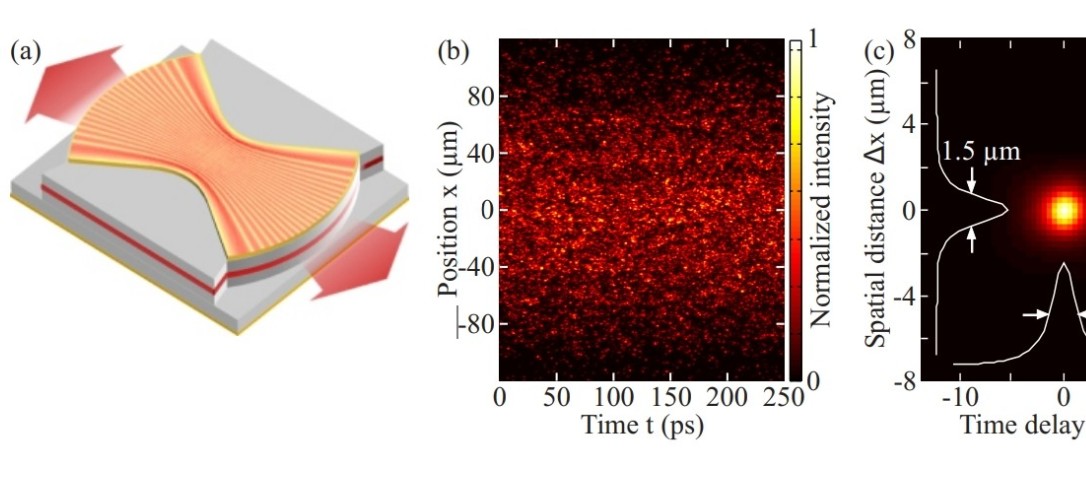
The talk will give an overview of the foundations and development of theoretical approaches and experiments to simulate and understand the complex spatio-temporal near-field and quantum dynamics of large-area semiconductor lasers. We will outline how microscopic and dynamic materials-based simulations are the basis for an interpretation of the complex dynamics [3]. We will discuss the recently introduced strategy of using quantum-chaotic or nano-disordered cavities such that near-field and quantum chaos on the nanoscale leads to disorder which disrupts the formation of self-organized structures such as filaments that would normally lead to instabilities [7]. Based on these principles we will further present an innovative approach for ultrafast parallel quantum noise ‘harvesting’ by spatio-temporal many-mode and quantum chaotic lasing dynamics in semiconductor lasers forming the basis for a new paradigm for greatly accelerated quantum random bit generation [8].
References
[1] I. Fischer, O. Hess, W. Elsäßer, and E. Göbel, Complex Spatio-Temporal Dynamics in the near-Field of a Broad-Area Semiconductor Laser, EPL 35, 579 (1996).
[2] O. Hess, Spatio-Spectral Dynamics and Spontaneous Ultrafast Optical Switching in VCSEL Arrays, Opt. Express, OE 2, 424 (1998).
[3] E. Gehrig and O. Hess, Spatio-Temporal Dynamics and Quantum Fluctuations in Semiconductor Lasers (Springer Science & Business Media, 2003).
[4] C. Simmendinger, D. Preißr, and O. Hess, Stabilization of Chaotic Spatiotemporal Filamentation in Large Broad Area Lasers by Spatially Structured Optical Feedback, Opt. Express, OE 5, 48 (1999).
[5] N. Gaciu, E. Gehrig, and O. Hess, Control of Broad-Area Laser Dynamics with Delayed Optical Feedback, in Handbook of Chaos Control (John Wiley & Sons, Ltd, 2008), pp. 427–453.
[6] M. P. Hokmabadi, N. S. Nye, R. El-Ganainy, D. N. Christodoulides, and M. Khajavikhan, Supersymmetric Laser Arrays, Science 363, 623 (2019).
[7] S. Bittner, S. Guazzotti, Y. Zeng, X. Hu, H. Yılmaz, K. Kim, S. S. Oh, Q. J. Wang, O. Hess, and H. Cao, Suppressing Spatiotemporal Lasing Instabilities with Wave-Chaotic Microcavities, Science 361, 1225 (2018).
[8] K. Kim, S. Bittner, Y. Zeng, S. Guazzotti, O. Hess, Q. J. Wang, and H. Cao, Massively Parallel Ultrafast Random Bit Generation with a Chip-Scale Laser, Science 371, 948 (2021).