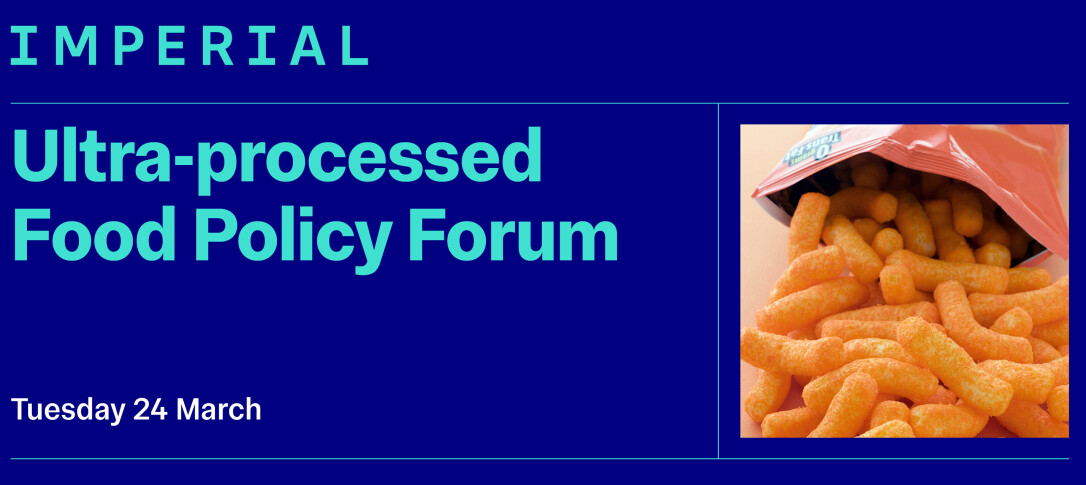
Assessing the science and advancing regulatory and policy responses to ultra-processed foods
The Ultra-processed Food Policy Forum is convening world-leading scientists, politicians, policymakers and civil society representatives at Imperial College London. Together, they will discuss the latest scientific evidence on ultra-processed foods (UPFs) and explore the scope for effective, evidence-based regulatory and policy responses to their growing dominance in people’s diets and their impacts on health.
The Forum is jointly organised by the Centre for Health Economics & Policy Innovation at Imperial Business School, the Imperial School of Public Health, and the Imperial Policy Forum.
Building on Imperial’s conference on the case for government action on UPFs, held in November 2024, this year’s Forum will focus on accelerating progress towards a more robust, science-based policy agenda. As governments worldwide intensify efforts to address the expanding role of UPFs in diets, high-quality research is increasingly central to shaping policies that are both effective and sustainable.
Momentum for action in the UK and internationally has continued since the 2024 Imperial event. A series of papers published in The Lancet in November 2025 marked a turning point, providing a strong framework for bridging science and policy.
Calls for regulation in the 2024 UK House of Lords report on food, diet and obesity, alongside the ongoing House of Commons inquiry into food and weight management, as well as emerging policy discussions at European Union level, reflect increasing attention to UPFs in the public debate on food, nutrition and health.
The Ultra-processed Food Policy Forum will showcase policy approaches from across the globe, providing policymakers, researchers and civil society with comparative insights and practical lessons for future action.
Attendance update
Due to exceptionally high demand and limited venue capacity, all in-person places at the Ultra-processed Food Policy Forum have now been allocated. We received significantly more applications than the venue can accommodate.
Registration remains open for online attendance via livestream, and we warmly encourage those interested in the discussion to join remotely. The livestream will provide full access to the conference sessions and discussions.
For those attending online who are based in London, there will also be an opportunity to meet speakers and participants at the evening networking reception at Imperial College London.
Agenda
09:00 – Registration
09:30 – Welcome and Introduction
Prof. Franco Sassi – Director, Centre for Health Economics & Policy Innovation, Imperial Business School
Prof. Peter Haynes – Provost and Deputy President, Imperial College London
Moderator: Sheila Dillon
09:45 – Keynote: UPFs and health – the state of the evidence
Prof. Carlos Monteiro – University of São Paulo
10:15 – The case for action: New evidence on the health impacts of UPFs
Dr. Mathilde Touvier – INSERM
Prof. Ashley Gearhardt – University of Michigan
Dr. Sam Dicken – UCL
11:30 – Break
11:45 – How to make UPF policies work: The direction of policy research in the UK
Prof. Adam Briggs – NIHR
Dr. Eszter Vamos – Imperial
Prof. Antonieta Medina-Lara – Exeter
Prof. Franco Sassi – Imperial
12:30 – UPF policy developments in the Americas and Europe
Dr. Kremlin Wickramasinghe – WHO
Dr. Fabio Gomes – PAHO
13:00 – Lunch
14:00 – What is needed to implement effective UPF policy approaches
Dr. Mathilde Touvier – INSERM
Dr. Austin Frerick – Yale
Dr. Vicky Sibson – First Steps Nutrition Trust
Dr. Magdalena Muc – Open University
15:00 – Break
15:15 – UPF Politics and policy: opportunities and barriers
Discussant: Dr. Dolly van Tulleken
Baroness Walmsley – House of Lords
Ben Coleman – MP for Chelsea and Fulham
16:00 – Keynote: Changing the food system for healthier diets
Henry Dimbleby
16:25 – Final Comments
Prof. Franco Sassi
16:30 – Conference Close
16:30 – Networking Drinks (open to all)
19:00 – Networking Dinner (by invitation)
Speaker Profiles
- Welcome and Introduction
- Keynote: UPFs and Health – The State of the Evidence
- The Case for Action: New Evidence on the Health Impacts of UPFs
- How to Make UPF Policies Work: The Direction of Policy Research in the UK
- UPF Policy Developments in the Americas and Europe
- What Is Needed to Implement Effective UPF Policy Approaches
- UPF Politics and Policy: Opportunities and Barriers
- Keynote: Changing the Food System for Healthier Diets
Prof. Franco Sassi – Director of the Centre for Health Economics & Policy Innovation at Imperial Business School, Imperial College London, and one of the world’s leading experts in health taxes and the economics of non-communicable disease policy. His research spans taxation, regulation, and the economic evaluation of public health interventions, with a particular focus on diet, obesity, and the food environment.
Prof. Peter Haynes – Provost and Deputy President of Imperial College London, one of the UK’s most prominent scientific institutions. A computational physicist by training, he leads Imperial’s academic and research strategy and represents the College’s commitment to translating scientific excellence into societal impact.
Sheila Dillon – Journalist and broadcaster, Sheila Dillon has presented BBC Radio 4’s The Food Programme for over two decades, making her one of the UK’s most influential voices on food, farming, and nutrition policy. She has consistently used the programme to examine the political and public health dimensions of the food system, including early and sustained coverage of ultra-processed foods.
Prof. Carlos Monteiro – Emeritus Professor of Nutrition and Public Health at the University of São Paulo and founder of the USP Centre for Epidemiological Studies in Health and Nutrition, Prof. Monteiro coined the term “ultra-processed foods” and developed the NOVA food classification system, which groups foods according to the extent and purpose of industrial processing. NOVA has since become the global standard for UPF research and underpins the growing international evidence base linking UPF consumption to obesity, type 2 diabetes, cardiovascular disease, and premature mortality.
Dr. Mathilde Touvier – Research Professor and Director of the Nutritional Epidemiology Research Team (EREN) at INSERM, France, Dr. Touvier is the principal investigator of the NutriNet-Santé cohort study — one of the world’s largest and most detailed long-term studies of diet and health, with over 180,000 participants. Her team has produced some of the most influential evidence linking ultra-processed food consumption and food additives to cancer, cardiovascular disease, type 2 diabetes, and mental health outcomes, and she is a co-author of the landmark 2025 Lancet Series on UPFs.
Prof. Ashley Gearhardt – Professor of Psychology at the University of Michigan and founder of the Food and Addiction Science and Treatment (FAST) Lab, Dr. Gearhardt is the world’s leading researcher on ultra-processed food addiction. She developed the Yale Food Addiction Scale — now translated into over ten languages and cited thousands of times — and has published compelling neurobiological and behavioural evidence that certain UPFs can trigger addictive processes comparable to those seen with alcohol and tobacco. She has testified before both the US Senate and House of Representatives on UPF addiction.
Dr. Sam Dicken – Research Fellow at the UCL Centre for Obesity Research and the Department of Behavioural Science & Health, Dr. Dicken’s work focuses on the health impacts of ultra-processed food consumption, with a particular emphasis on weight, cardiometabolic outcomes, and the mechanisms linking UPF to disease. He was first author of the landmark 2025 randomised crossover trial published in Nature Medicine, which found that participants lost twice as much weight on a minimally processed diet compared to a nutritionally matched ultra-processed diet.
Prof. Adam Briggs – Professor of Public Health at the University of Southampton and Director of the NIHR Public Health Research Programme, Prof. Briggs leads the national research agenda in public health evidence generation. A medically trained public health physician with a DPhil in public health economic modelling, his research spans the cost-effectiveness of dietary interventions, health policy evaluation, and non-communicable disease prevention — including co-investigation of the NIHR-funded evaluation of the UK Soft Drinks Industry Levy.
Dr. Eszter Vamos – Senior Clinical Lecturer in Public Health Medicine at Imperial College London and head of the Public Health Policy Evaluation Unit within the School of Public Health. Her research focuses on the epidemiology of chronic disease, the prevention of type 2 diabetes and cardiovascular disease, and the evaluation of major public health policies. She has published extensively on the health impacts of ultra-processed food consumption, including landmark analyses from the EPIC cohort.
Prof. Antonieta Medina-Lara – Senior Lecturer of Public Health Economics at the University of Exeter. A health economist with expertise in applied micro-econometrics, decision modelling, and stated preference methods, she has led and contributed to numerous UK and international research projects — including EU-funded and DFID programmes — spanning a wide range of disease areas and countries across Africa, Europe, and Latin America. Her recent work on food policy includes research into the drivers of food choice and the health impacts of food environment interventions such as takeaway management zones, making her a leading voice on the economics of healthier food systems.
Prof. Franco Sassi – Director of the Centre for Health Economics & Policy Innovation at Imperial Business School, Imperial College London, and one of the world’s leading experts in health taxes and the economics of non-communicable disease policy. His research spans taxation, regulation, and the economic evaluation of public health interventions, with a particular focus on diet, obesity, and the food environment.
Dr. Kremlin Wickramasinghe – Regional Advisor (Nutrition, Physical Activity, Obesity) at the WHO European Office for the Prevention and Control of NCDs. With a research background in public health nutrition and food policy, he has worked extensively on the development and monitoring of evidence-based food policies across WHO member states, including front-of-pack labelling, dietary guidelines, and the regulation of ultra-processed plant-based foods.
Dr. Fabio Gomes – Regional Advisor on Nutrition at the Pan American Health Organization (PAHO), the WHO regional body for the Americas. He has been a central figure in translating the scientific evidence on ultra-processed foods into policy action across Latin America — a region that has led the world in UPF regulation, including mandatory warning labels, restrictions on marketing to children, and school food policies in Brazil, Chile, and Mexico.
Dr. Mathilde Touvier – Research Professor and Director of the Nutritional Epidemiology Research Team (EREN) at INSERM, France, Dr. Touvier is the principal investigator of the NutriNet-Santé cohort study — one of the world’s largest and most detailed long-term studies of diet and health, with over 180,000 participants. Her team has produced some of the most influential evidence linking ultra-processed food consumption and food additives to cancer, cardiovascular disease, type 2 diabetes, and mental health outcomes, and she is a co-author of the landmark 2025 Lancet Series on UPFs.
Dr. Austin Frerick – Fellow of the Thurman Arnold Project at Yale University and author of Barons: Money, Power, and the Corruption of America’s Food Industry, one of the most acclaimed books of 2024. An agricultural and antitrust policy expert with experience at the US Department of Treasury and Congressional Research Service, Dr. Frerick investigates how corporate consolidation across the food supply chain has shaped the modern food environment, concentrating power in the hands of a small number of companies and structuring markets in ways that drive UPF consumption and undermine public health.
Dr. Vicky Sibson – Director of First Steps Nutrition Trust, the UK’s leading independent public health nutrition charity focused on diet and nutrition from pre-conception to age five. A public health nutritionist with an MSc from the London School of Hygiene & Tropical Medicine and a PhD from University College London, Dr. Sibson began her career in international humanitarian nutrition and has been a tireless advocate for stronger regulation of commercial baby and infant foods — including the UK’s first report applying the NOVA classification to foods marketed for infants and young children.
Dr. Magdalena Muc – Research Fellow at The Open University, Faculty of Wellbeing, Education and Language Studies. Dr. Muc is an expert on the marketing of unhealthy foods to children, with a particular focus on digital media environments, monitoring methods, and policy enforcement. She has collaborated closely with the WHO European Office and the European Union’s Best-ReMaP Joint Action to develop international protocols for monitoring unhealthy food marketing to children across multiple countries.
Dr. Dolly van Tulleken – Policy consultant and visiting researcher at the MRC Epidemiology Unit, University of Cambridge, where she completed her PhD and postdoctoral position specialising in the history and political processes of government obesity and food policy in England. She is founder of Dolitics, a consultancy supporting evidence-based food policy change, and co-authored Nourishing Britain: A Political Manual for Improving the Nation’s Health with Henry Dimbleby — a practical guide to food policy reform based on interviews with 20 former Prime Ministers and Health Secretaries.
Baroness Walmsley –Life Peer and former Chair of the House of Lords Food, Diet and Obesity Committee, which published its landmark 2024 report Recipe for Health: A Plan to Fix Our Broken Food System. A longstanding champion of evidence-based public health policy in Parliament, Baroness Walmsley led the committee’s wide-ranging inquiry into the role of UPFs and HFSS products in the UK diet, recommending bold legislative action including mandatory health targets for the food industry and reforms to food labelling and marketing.
Ben Coleman – Member of Parliament for Chelsea and Fulham, elected in 2024. Ben Coleman has been a vocal parliamentary advocate for stronger government action on food and health, and sits on the House of Commons Food and Weight Management inquiry. He represents a constituency with significant health inequality, and brings a frontbench political perspective to the debate on how UPF policy can be advanced through the current Parliament.
Henry Dimbleby – Food entrepreneur, co-founder of the Leon restaurant group, and the architect of the independent National Food Strategy — the most comprehensive independent review of the English food system in 75 years. His 2021 strategy report called for radical reform of the food environment, including taxes on salt and sugar, and has shaped much of the subsequent UK policy debate on diet and UPFs. He co-authored Nourishing Britain with Dr. Dolly van Tulleken, and remains one of the most influential voices in the UK food policy landscape.