PLEASE NOTE:
- This seminar is IN PERSON ONLY in room RSM 2.28, Second Floor, Royal School of Mines at Imperial’s South Kensington campus.
- Click here for the South Kensington campus map.
GUEST SPEAKER:
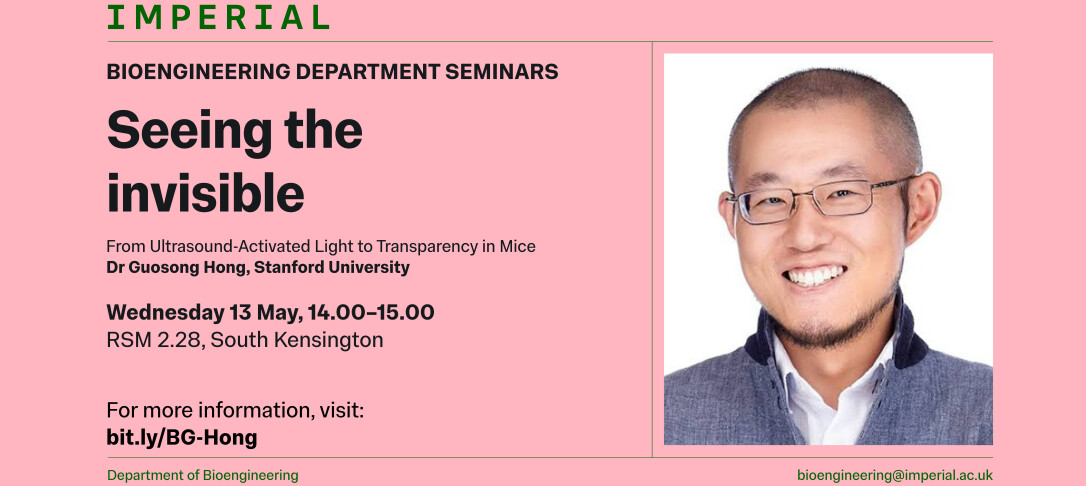
Dr Guosong Hong, Assistant Professor of Materials Science and Engineering, Stanford University
TALK TITLE:
Seeing the Invisible: From Ultrasound-Activated Light to Transparency in Mice
ABSTRACT:
Light plays a central role in science, shaping both how we study living systems and how we perceive the world around us. As we observe in daily life, light has difficulty penetrating living biology tissue, mainly because of scattering and absorption. This limitation hampers the use of light in biological research, often necessitating invasive procedures such as tissue sectioning, insertion of optical fibers or endoscopes, and surgical removal of overlying structures (e.g., craniotomy) to modulate and image biological activity using light microscopy.
To address these challenges, my lab has developed several methods for deep-tissue light delivery and optical imaging. First, we leveraged defect engineering to synthesize trap-controlled mechanoluminescent materials as an ultrasound-scanning in vivo light source. When formulated as colloids, these materials can be delivered intravenously and emit light locally at the ultrasound focus. This approach enables on-demand and dynamically programmable light emission patterns at substantial tissue depths in a noninvasive manner, facilitating a wide range of light-based applications in live animals by harnessing the deep-tissue penetration of focused ultrasound.
Furthermore, we recently developed a new approach to achieve optical transparency in live animals by leveraging the Kramers-Kronig relations in absorbing dye molecules, which enables effective modulation of the refractive index within biological tissues. We demonstrated that tissues in living rodents can be rendered optically transparent in a reversible and repeatable manner through the application of these dye molecules.
I will conclude my talk by envisioning an invisible future — one in which advances in physics, chemistry, and materials science transform biological imaging and light-based therapies.
BIOGRAPHY:
Dr Guosong Hong received his PhD in chemistry from Stanford University in 2014 and then carried out postdoctoral studies at Harvard University. Dr Hong joined Stanford Materials Science and Engineering and the Neurosciences Institute as an assistant professor in September 2018.
His research at Stanford aims to develop and apply novel optical and electronic materials for minimally invasive brain interfacing.
He is a recipient of the NIH Pathway to Independence (K99/R00) Award, the MIT Technology Review ‘35 Innovators Under 35’ Award, the Science PINS Prize for Neuromodulation, the NSF CAREER Award, the Walter J. Gores Award for Excellence in Teaching, the Rita Allen Foundation Scholars Award, the Camille Dreyfus Teacher-Scholars Award, ETH Zürich Materials Research Prize for Young Researchers, the Presidential Early Career Award for Scientists and Engineers (PECASE), the Vilcek Prize for Creative Promise in Biomedical Science, the SPIE Inaugural Biophotonics Discovery Impact of the Year Award, the Sloan Research Fellowship, and the Maximizing Innovation in Neuroscience Research (MIND) Prize. He has also recently been elected to the College of Fellows of the American Institute for Medical and Biological Engineering (AIMBE).