This is in-person only event. The event will be followed by the Q&A with the speaker.
About the Talk
A large part of the UK’s current economic difficulties arise from the fact that its major cities outside London underperform, with productivity levels in second-tier city regions like Greater Manchester, the West Midlands, and the Glasgow City Region remaining below the UK average. In connection with these regional disparities in economic performance, the attention of policy makers has been drawn to the fact that levels of public and private research and development in these cities is below average, and recent policy initiatives, such as the previous government’s “Innovation Accelerator” Pilot, and the current government’s “Local Innovation Partnership Fund”, have sought to address this.
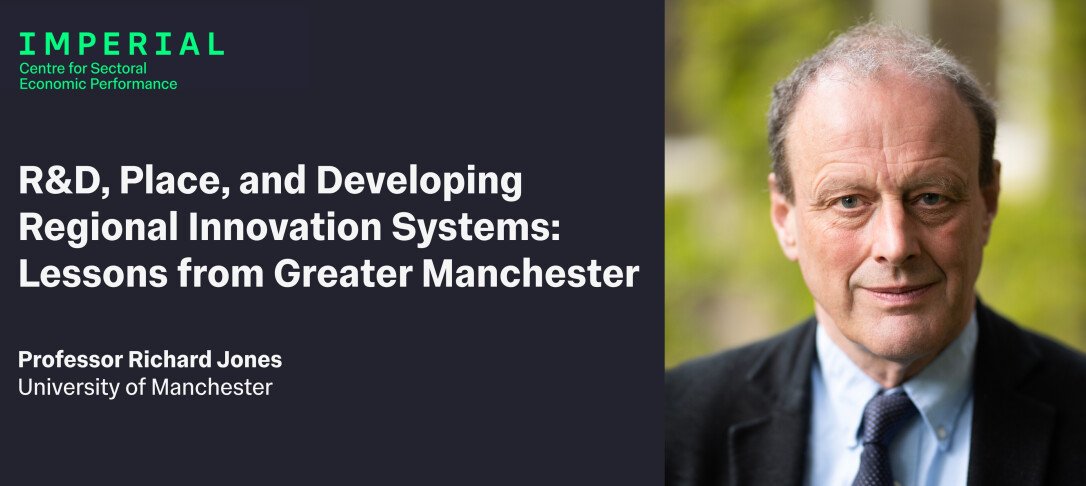
In this talk, Professor Jones will reflect on the experience of Greater Manchester’s Mayoral Combined Authority in building and implementing an innovation strategy aligned with the city region’s wider economic and social goals. Among the factors that have emerged as being important in this enterprise are:
- Coherent, evidence-based, and enduring local industrial strategy, identifying and supporting sectoral clusters with growth potential,
- Local political buy-in, with strong governance and connection with wider policy levers in areas like skills, transport and planning,
- Partnership working across public and private sectors, including connections with capital markets,
- Integration with wider regional and national innovation systems,
- Strong relationships with central government and its agencies.
Professor Jones will discuss some of the successes, and some of the tensions that emerge, in such efforts to build stronger city-region innovation systems.
Speaker’s Bio
Richard Jones is an experimental soft matter physicist with a long standing interest in innovation policy and regional economic growth; he was, until September 2025, Vice-President for Regional Innovation and Civic Engagement, at the University of Manchester, where he is currently Emeritus Professor of Materials Physics and Innovation Policy.
His first degree and PhD in Physics both come from Cambridge University and following postdoctoral work at Cornell University, USA, he was a lecturer at the University of Cambridge’s Cavendish Laboratory. He was a Professor of Physics at the University of Sheffield from 1998, moving to Manchester in 2020.
In 2006 he was elected a Fellow of the Royal Society, in recognition of his work in the field of polymers and biopolymers at surfaces and interfaces and in 2009 he won the Tabor Medal of the UK’s Institute of Physics for his contributions to nanoscience.
He is the author of more than 190 research papers, and three books, Polymers at Surfaces and Interfaces (with Randal Richards, CUP 1999), Soft Condensed Matter, (OUP 2002), and Soft Machines: Nanotechnology and Life (OUP 2004).
He was Pro-Vice-Chancellor for Research and Innovation at Sheffield from 2009 to 2016, was a member of EPSRC Council from 2013 – 2018, and chaired Research England’s Technical Advisory Group for the Knowledge Exchange Framework. He was a member of the Sheffield/Manchester Industrial Strategy Commission, and was a Co-I of the ESRC funded Productivity Institute. He has written extensively about science and innovation policy, for example in the recent reports “The Missing Four Billion: making research and development work for the whole UK” (with Tom Forth, NESTA 2020) and “Science and innovation policy for hard times: an overview of the UK’s Research and Development landscape” (The Productivity Institute, 2022).
In Greater Manchester, he was the Independent Science Advisor to Innovation GM, a public-private partnership bringing together business, the GM Combined Authority and GM’s universities with the goal of developing Greater Manchester’s innovation ecosystem to help level up communities, generate the solutions needed to achieve net zero, and create the conditions for more businesses in more places to benefit from global exporting and inward investment.