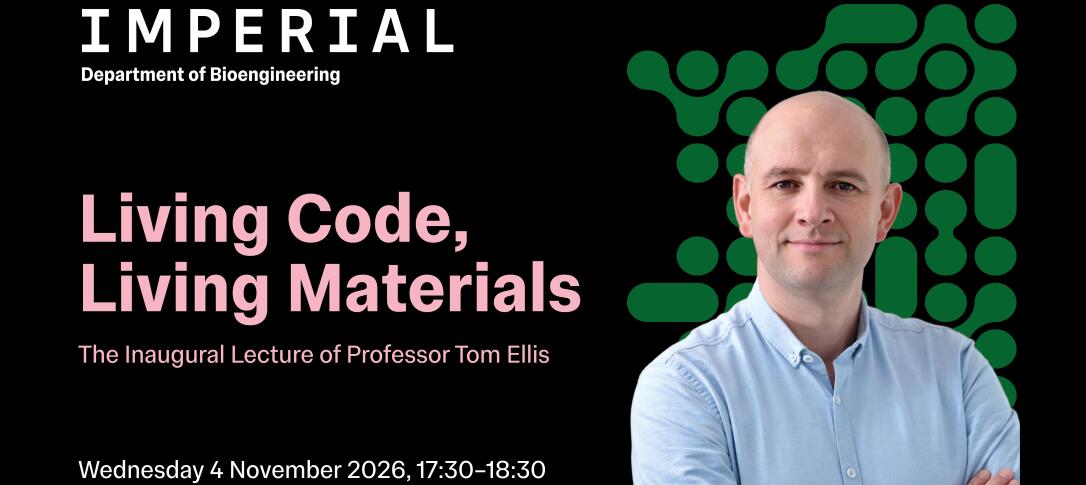
Discover how Professor Tom Ellis is rewriting DNA to programme microbes to grow sustainable materials and help build a bio-based future.
Living Code, Living Materials: How Synthetic Biology is Rewriting the Future
Abstract:
Science has focused on reading the code of life to understand how living organisms work, but today, bioengineers are writing that code. Over the past two decades, research at Imperial College London has helped pioneer the shift from observing biology to actively designing it. By rewriting DNA in organisms like yeast and bacteria, we can transform simple microbes into programmable micro-factories. Rather than relying on petroleum-based plastics or resource-intensive manufacturing, we can now engineer living cells to grow sustainable, self-repairing materials, from custom fabrics to functional patches, directly from kombucha microbes and sugar.
This talk explores how combining synthetic biology with materials engineering is opening a new frontier: Engineered Living Materials. Looking ahead, we predict that programming nature will revolutionise sustainable manufacturing, food production, and smart infrastructure, paving the way for a bio-based future where we partner with nature to grow what we need.
Biography:
Tom Ellis is Professor of Synthetic Genome Engineering in the Department of Bioengineering at Imperial College London. For 16 years, his research group at Imperial has pioneered international efforts in synthetic biology, focusing on rewriting DNA to reprogram cells to address global challenges in health, sustainability, and manufacturing. His lab has moved to chromosome-scale writing and is spearheading the emerging field of Engineered Living Materials by programming safe microbes to grow sustainable fabrics and functional bio-composites. Professor Ellis is a Fellow of the Royal Society of Chemistry and works broadly to advance bioengineering for a sustainable future.