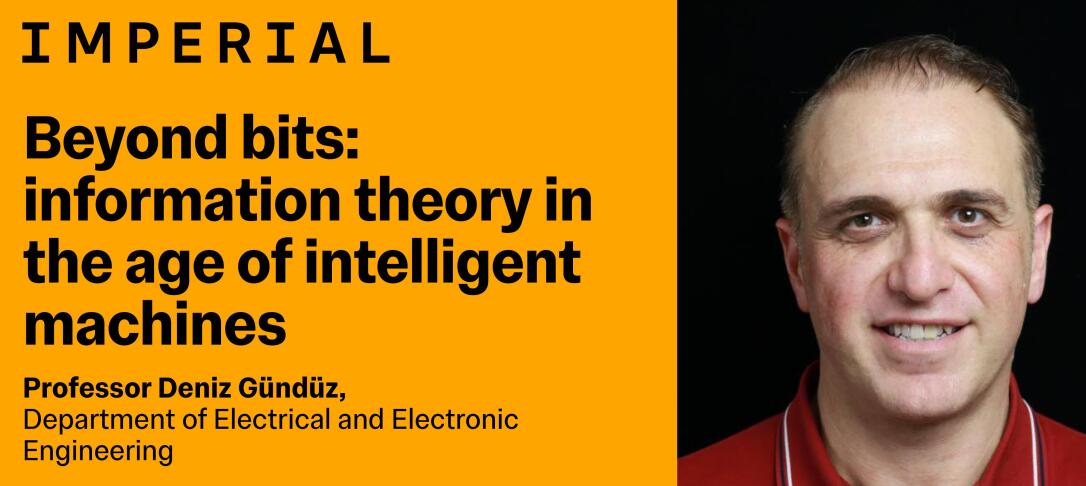
The ‘bit’ transformed how we compress, transmit and store information. But as more information is produced by machines, for machines, do the same rules still apply?
Professor Deniz Gündüz, Professor in Information Processing, explores how information theory can help answer questions emerging in the age of intelligent machines.
Please register to attend in person. A live stream link for online attendance is available here.
We look forward to seeing you on Wednesday 11 November!
Imperial Inaugurals are term-time lectures that celebrate our newest professors, recognising their academic journey and showcasing their research.
Abstract
In 1948, Claude Shannon established a mathematical theory for modelling and quantifying information: how much a source can be compressed, and how much of it a noisy channel can carry. Those limits turned communication from a craft into a science, and everything digital: the Internet, mobile telephony, data storage, has since been built around them. Shannon also gave us the ‘bit’: common currency of the information age, which let compression, transmission, computation and security be treated as four separate problems, solved by different engineers.
Soon, most of the information crossing our networks will be produced by intelligent machines, for other intelligent machines. How will billions of them communicate with each other: must they agree on a language in advance, or can they learn one? And do those old boundaries still make sense, when a network can compute, a compressor can learn, and the whole chain from sensor to decision can be trained as one?
Biography