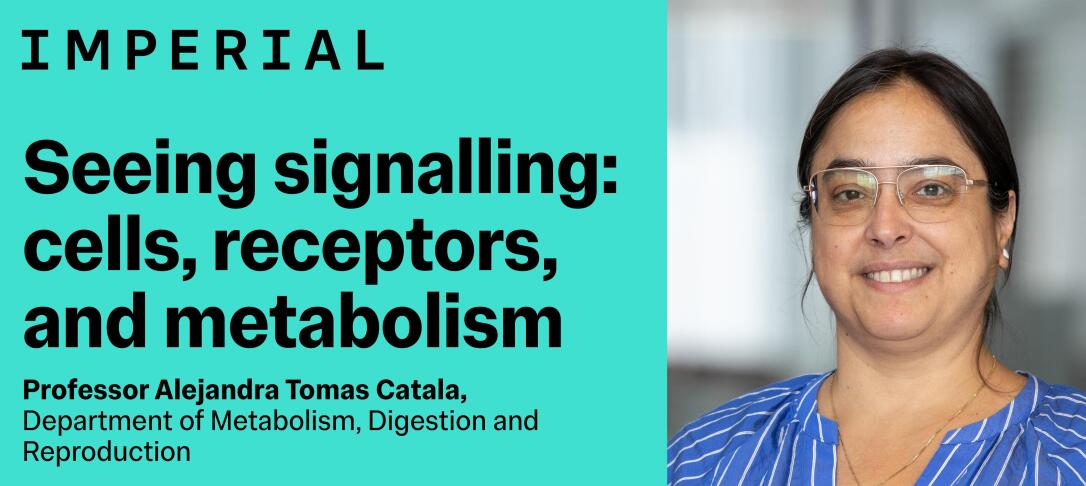
Trillions of cells constantly sense and respond to the world around them, but how do we see these hidden processes in action?
Professor Alejandra Tomas Catala, Professor of Cell Biology, reveals how new technologies are helping us understand the signals that regulate metabolism, and what they could mean for tackling diseases such as diabetes.
Please register to attend in person. A live stream link for online attendance is available here.
We look forward to seeing you on Wednesday 18 November!
Imperial Inaugurals are term-time lectures that celebrate our newest Professors, recognising their academic journey and showcasing their research.
Abstract
Every moment of our lives, trillions of cells are making decisions. They sense nutrients, hormones, and signals from their surroundings, interpreting this information to regulate growth, energy use, and survival. These cellular conversations underpin everything from healthy development to disease responses. Yet many of the most important signalling processes occur on scales invisible to the naked eye, raising a fundamental question: how can we observe how cells “see” and respond to the world around them?
Advances in molecular biology, imaging, and quantitative approaches have transformed our ability to uncover these hidden processes. By revealing how receptors detect signals and how cells translate them into functional responses, researchers are uncovering the mechanisms that maintain health and the pathways that become disrupted in disease, including in metabolic disorders such as diabetes. Understanding these processes is not only deepening our knowledge of fundamental cell biology but also creating new opportunities for therapeutic intervention.
Professor Alejandra Tomas Catala is a Professor of Cell Biology at Imperial College London. Her research focuses on the signalling pathways that regulate the function of cells with critical roles in human metabolism. In her inaugural lecture, she will explore how cells detect and interpret molecular signals, the technologies that allow us to visualise these processes in unprecedented detail, and what these discoveries reveal about the regulation of metabolic health and disease.
Drawing on examples from her own research and developments across the wider field, she will discuss receptors, intracellular signalling networks, metabolic regulation, and the future of imaging-based approaches for understanding cell function and developing new treatments.
Biography
Professor Alejandra Tomas is a Professor of Cell Biology and Head of Section of Cell Biology and Functional Genomics at the Dept of Metabolism, Digestion and Reproduction, Imperial College London. Her research leverages advanced molecular cell biology and multiomic strategies to uncover novel regulators and signalling modalities for the glucagon receptor family of class B1 GPCRs. By integrating insights from high resolution microscopy, pharmacology, genetics, and structural biology, her group has identified new pathways and approaches to modulate receptor signalling, offering opportunities to optimise their therapeutic potential in metabolic diseases such as obesity, diabetes, and MASLD.