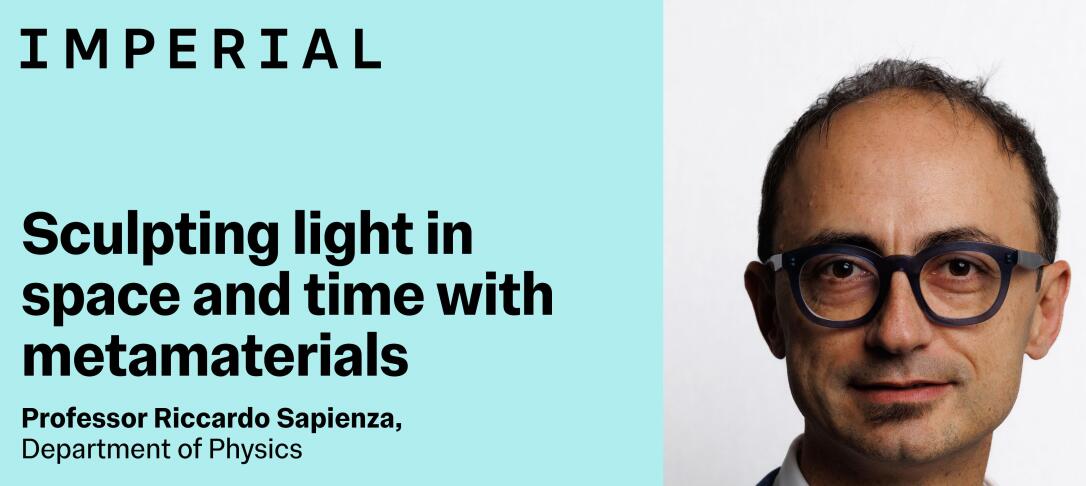
What happens when we manipulate light not just in space, but in time? Discover how light waves from the past and future can interact with Professor Riccardo Sapienza, Professor of Physics.
Please register to attend in person. A live stream link for online attendance is available here.
We look forward to seeing you on Wednesday 7 October!
Imperial Inaugurals are term-time lectures that celebrate our newest Professors, recognising their academic journey and showcasing their research.
Abstract
Light powers the global internet, enables deep-space and medical imaging, and sustains life on Earth. But how do we actually control the flow of something so fast and intangible? For centuries, traditional optics relied on the simple curved surfaces of glass lenses. Today, the modern science of light is driven by metamaterials, nanostructured materials with optical properties not found in nature, which have already given us ultra-thin lenses, miniaturized photonic devices, and unconventional lasers that perform artificial-intelligence computations.
But what happens when we manipulate light not just in space, but in time? Can we make light waves from the past and the future interact? The answer, surprisingly, is yes.
In this lecture, Riccardo Sapienza will trace our first steps toward spatio-temporal control of light, including our recent experiments demonstrating double-slit diffraction in time and the scattering of light from superluminal modulations (synthetic, of course, so relativity is not broken!). He will close by looking ahead to what intertwining space and time could unlock: from dynamic holograms to entirely new paradigms for analogue computing.
Biography
Riccardo Sapienza is Professor of Physics and Vice-Dean for Research of the Faculty of Natural Sciences at Imperial College London, where he is also Joint Director of the Centre for Plasmonics and Metamaterials. His research explores how light interacts with nanostructured matter, spanning optical metamaterials, unconventional lasing, and neuromorphic photonic computing. He is co-founder and co-CTO of the spin-out RAYD Technologies, which translates this research into practice.
He earned his PhD jointly from the Laboratory for Nonlinear Spectroscopy (LENS) in Florence and the École Normale Supérieure (ENS) in Paris, and held postdoctoral positions at the Institute of Materials Science (ICMM-CSIC) in Madrid and ICFO – the Institute of Photonic Sciences in Barcelona. He was on the faculty of King’s College London before joining Imperial in 2017.