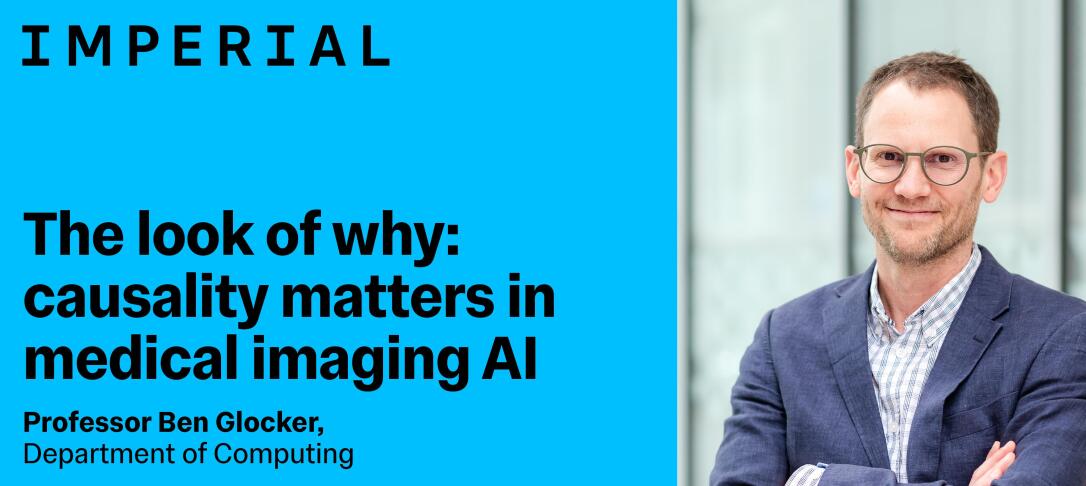
Join Professor Ben Glocker, Professor in Machine Learning for Imaging, to discover how causality could help make medical imaging AI safer, fairer and more reliable.
Please register to attend in person. A live stream link for online attendance is available here.
We look forward to seeing you on Wednesday 14 October!
Imperial Inaugurals are term-time lectures that celebrate our newest Professors, recognising their academic journey and showcasing their research.
Abstract
Artificial intelligence is transforming medical imaging, promising more accurate diagnosis, earlier detection of disease, and better clinical decision-making. But the path from research prototype to trusted clinical tool remains difficult. AI systems can silently fail when new data differs from the data on which they were trained. Changes in patient populations, imaging protocols, and healthcare settings across geographic regions can cause distribution shifts that undermine the reliability, robustness, and fairness of AI predictions.
In this inaugural lecture, Professor Ben Glocker explores why causality matters for understanding when AI works and when it fails. He will discuss the role of ‘what-if’ reasoning and the use of the latest causal generative models to create realistic counterfactual images that can stress-test AI systems, expose blind spots, and mitigate bias. Ultimately, causality may be the missing ingredient that turns medical imaging AI from a promising technology into a life-saving reality.
Biography