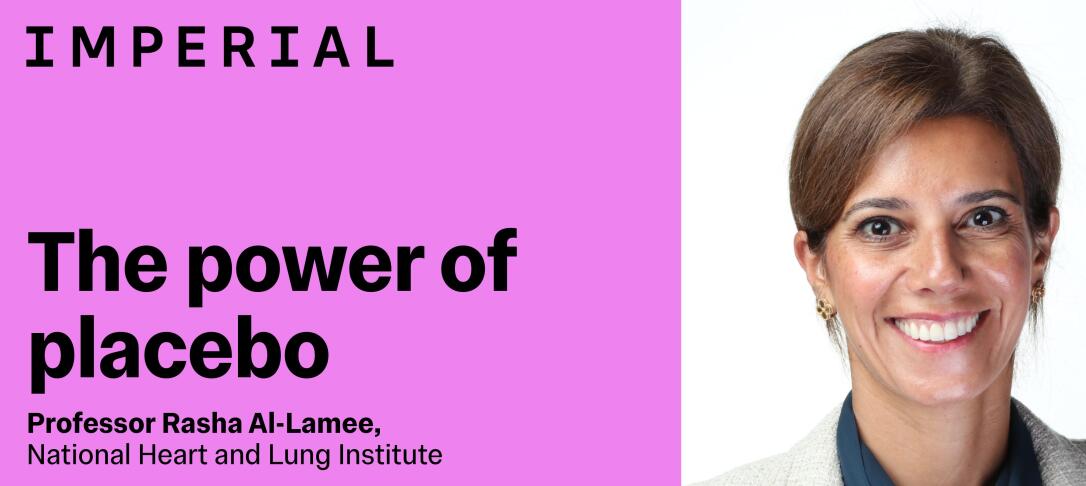
What happens when a medical procedure is put to the placebo test?
Professor Rasha Al-Lamee, Clinical Professor of Cardiology at the National Heart and Lung Institute, explores the surprising results of the first placebo-controlled trial of coronary stenting for angina, the questions it raised about what drives symptom relief, and how a negative clinical trial led to positive changes.
Please register to attend in person. A live stream link for online attendance is available here.
We look forward to seeing you on Wednesday 9 December!
Imperial Inaugurals are term-time lectures that celebrate our newest Professors, recognising their academic journey and showcasing their research.
Abstract
We hold drugs to the highest standard. Before a medicine reaches patients, it must outperform placebo in a randomised controlled trial. Medical procedures have largely escaped that same scrutiny. When placebo-controlled trials of medical procedures are performed, the results are often unexpected.
Angina is a symptom. It is subjective, variable, and shaped by what a patient expects will happen to them. It is therefore susceptible to the placebo effect when treated by drugs or procedures. Our group ran the first placebo-controlled trial of coronary stenting for angina: ORBITA. The results were surprising and caused shockwaves across the global cardiology community. While the findings were not what many wanted to hear, they led to a much wider discussion about the value of placebo control and the impact that these trials might have on medical practice.
From ORBITA came many more questions about angina. Which medications and procedures work best? What drives symptom relief? How large are the placebo and physical components of our treatments? And importantly, who benefits most?
Disappointing results and the acknowledgement of the placebo effect are not always a reason to abandon procedures. They lead us to consider placebo a scientific phenomenon and an important part of the delivery of good medical care. This is the story of how a negative clinical trial led to positive outcomes on how we study the impact of medical procedures and where we place the minimum bar for new and established interventions.
Biography
Professor Rasha Al-Lamee is an Interventional Cardiology Consultant at Imperial College Healthcare NHS Trust and Professor of Cardiology at the National Heart and Lung Institute within Imperial College London. She is a British Heart Foundation intermediate clinical research fellow and clinical trialist with expertise in stable coronary artery disease, coronary intervention, invasive physiology and invasive intravascular imaging.
She leads a research group with a focus on clinical trials that impact the care of patients with cardiovascular disease. She designed and led the only placebo-controlled trials of coronary angioplasty, ORBITA and ORBITA-2, published in The Lancet and the New England Journal of Medicine respectively. She was also the chief investigator of the ORBITA-COSMIC trial, published in The Lancet, ORBITA-STAR, published in JACC and ORBITA-FIRE, published in Circulation. She led The Lancet commission on atherosclerotic heart disease, is currently leading the ORBITA-MOON and ORBITA-SOLAR trials, and is actively involved in the development and recruitment for many multi-centre international clinical trials.
She is a deputy editor at JACC, a deputy director and head of the second year of Medicine at Imperial College London and co-lead of the cardiovascular theme of the Imperial NIHR Biomedical Research Centre.