The Future of Food: Innovations for a healthier, more resilient planet
Applications for this summer school are now closed.
Course key facts
-
Date
19 - 31 July 2026
Duration
2 weeks
-
Credits
Non credit bearing
-
Format
In-person
Fee
£2,950
-
Location
On Campus (South Kensington)
Overview
Food is at the heart of some of the greatest challenges of our time: climate change, health, biodiversity loss, and global food security. The way we produce, process and consume protein is central to solving them.
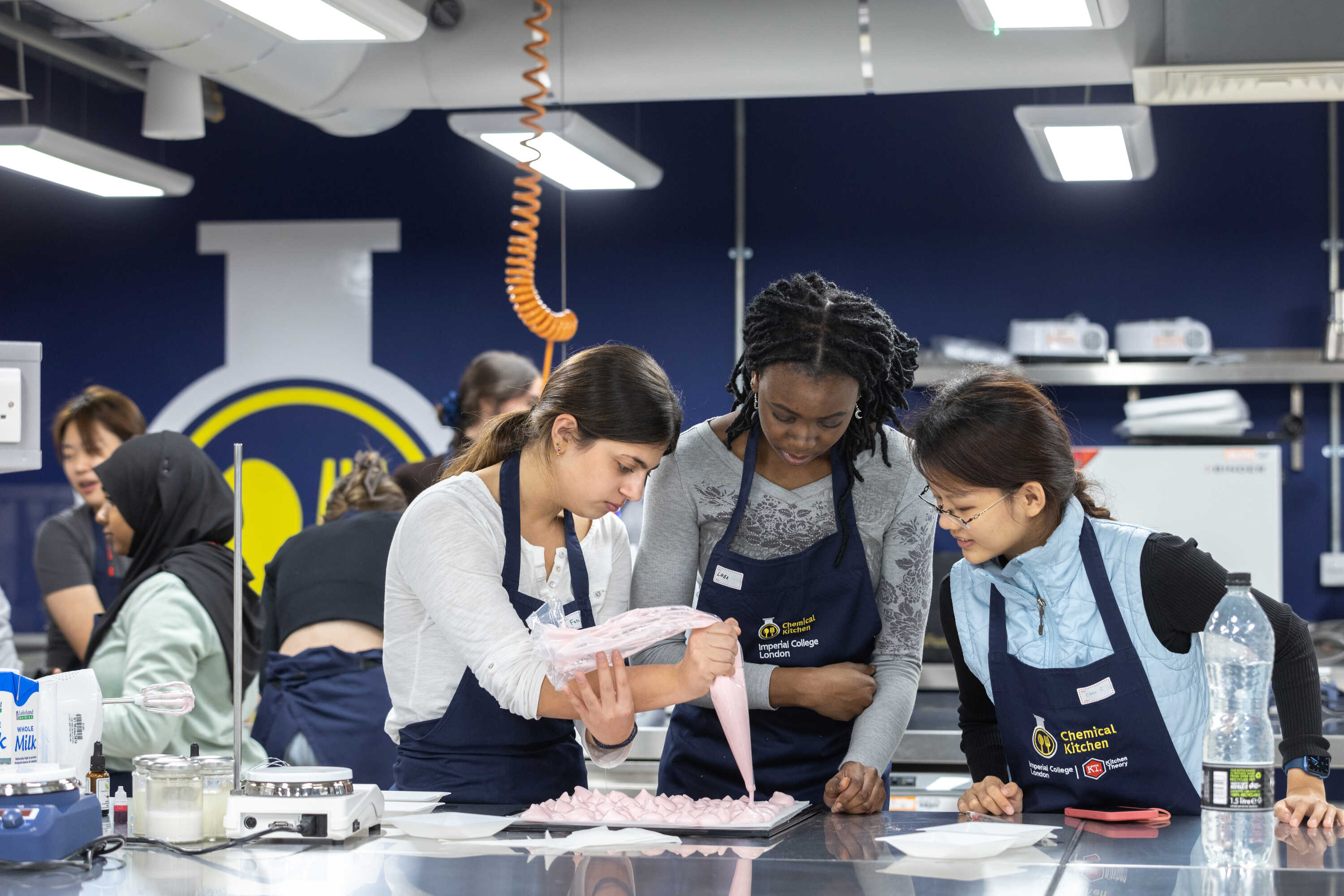
This Summer School explores sustainable proteins, alternative food systems, and the science behind future foods. Students will learn through a unique blend of bioengineering, chemistry, gastronomy, and hands-on experimentation in Imperial’s Chemical Kitchen, combined with lectures, workshops, and real-world case studies led by the Bezos Centre for Sustainable Protein.
On completion of this summer school, students will be able to:
- Understand the science and innovation landscape of sustainable proteins.
- Be able to apply critical thinking and problem-solving to real-world food challenges.
- Gain hands-on experience in lab and gastronomy settings.
- Develop skills in data analysis, storytelling, and pitching solutions.
- Experience team-based learning and international collaboration.
- Be inspired to pursue careers or further study in this fast-growing field.
/prod01/channel_3/media/images/landscape-3000X2000/0065_LLL-Youtube-Thumbnail-templates_01_04_Imperial-Blue.jpg)
Discover what you'll learn in the heart of London
Gain a strong understanding of what the future of food looks like so you can play a role in making a food system that’s more sustainable, healthy and secure.
Learning journey
Food is at the centre of today’s biggest challenges; from climate change to global nutrition and rethinking how we produce and use protein is key to creating a sustainable future.
In this fast‑paced two‑week Summer School, you’ll dive into the science and innovation reshaping the food world. From sustainable proteins to future‑focused food systems, you’ll learn through a lively mix of bioengineering, chemistry, gastronomy, and hands‑on sessions in Imperial’s Chemical Kitchen. Experts from the Bezos Centre for Sustainable Protein will guide you through cutting‑edge research, real‑world case studies, and creative experimentation.
60 contact hours spread over two weeks covering lectures, in-class exercises, workshops, project work, social activities and relevant visits. Classes will be delivered on weekdays.
Students will be allocated to small groups for in-class exercise work which will be delivered through team-based learning with supervision. The final project will be presented in teams to a panel of experts on the last day of the programme. A prize will be awarded to the team with the best project.
The entire programme will be taught in English.
- Combination of lectures, workshops, lab-based activities, gastronomy sessions, and group projects.
- Supervision from leading academics in Bioengineering, Chemistry, and Food Systems.
- Guest lectures from industry, start-ups, and policy leaders in alternative proteins.
- Final team project presentation to a panel of academic and industry experts.
Course details
All students are expected to be studying an undergraduate degree, preferably in the final two years of their undergraduate studies, in any STEMMB subject discipline.
English requirements:
All students are required to have a good command of English, and if it is not their first language, they will need to satisfy the College requirement as follows:
- A minimum score of IELTS (Academic Test) 6.5 overall (with no less than 6.0 in any element) or equivalent.
- TOEFL (iBT) 92 overall (minimum 20 in all elements)
Students will be asked to bring along their computer for project work.
Students will receive a Imperial College London certificate of attendance on successful completion of this programme and a prize will be awarded to the best project team.
Each student will also receive a document for their project marks.
Course instructors

Rodrigo Ledesma-Amaro
Professor in Engineering Biology, Director of the Bezos Centre for Sustainable Protein and the UKRI Microbial Food HubProfessor Ledesma-Amaro is an expert in microbial food and synthetic biology, leading one of the largest precision fermentation laboratories in Europe. His research focuses on developing microbial systems to produce valuable compounds, such as food ingredients, from renewable sources, driving innovation in sustainable bioproduction and biotechnology. He will be joined by colleagues from the Department of Bioengineering, whose expertise spans systems biology, bioprocess engineering, microbial physiology, and sustainable food innovation. Together, the teaching team brings a wealth of experience in translating cutting-edge science into real-world applications, offering students a unique insight into the future of food and biotechnology.

Jakub Radzikowski
Culinary Education Designer (Senior Teaching Fellow), Department of ChemistryDr Radzikowski combines a PhD in Molecular Biology with culinary training from Le Cordon Bleu and experience in Michelin-starred restaurants. He first leveraged this hybrid expertise at Imperial College London to co-create the Chemical Kitchen project, an innovative educational program teaching science and technology skills through gastronomy. His work has since scaled to focus on radical industrial innovation; as Chief Science Officer at Kaikaku.ai, he applies AI, robotics, and automation to the food sector, while simultaneously leading the Gastronomy Impact Unit at the Bezos Centre for Sustainable Protein. The programme will be led by the Bezos Centre for Sustainable Protein (Department of Bioengineering) and The Chemical Kitchen (Department of Chemistry), with contributions from: Leading Imperial College London academics. Industry partners (biotech start-ups, global food companies, investors). Policy, safety and regulatory experts.
Contact us
If you have any questions about the Future of Food Summer School, or any of our other programmes please contact our Continuing Professional Development team.
Continuing Professional Development
Summer Schools Team
- Email: cpd@imperial.ac.uk