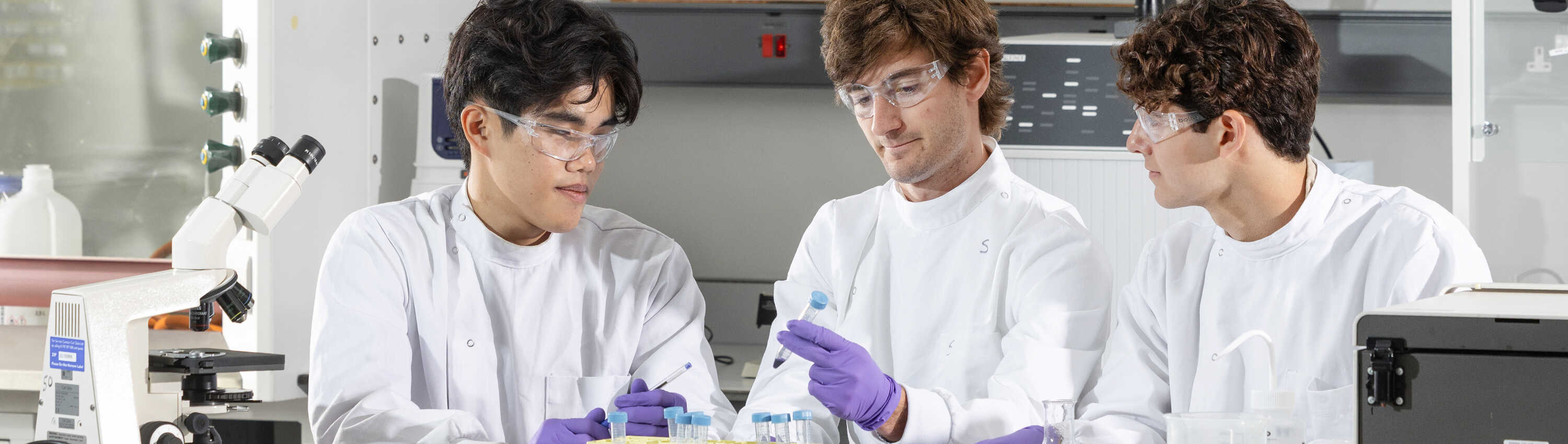
Chemistry at Imperial combines an innovative, interdisciplinary curriculum, with comprehensive practical chemistry training, through a wide range of laboratory-based activities. These are designed to help students link concepts from across different topics, to build confidence in data analysis and experiment design, and to develop their problem-solving skills.
Our wide choice of degree programmes and module options, means you have a high level of flexibility to follow your own interests and career goals through opportunities including overseas study, a year in industry or research, and combined studies in the Imperial College Business School.
Undergraduate practical work is supported by state-of-the-art facilities at our teaching hub in South Kensington, and in the Molecular Sciences Research Hub (MSRH) on our White City Innovation Campus. Final-year undergraduate projects and some lectures will take place at White City. A free return shuttle bus service is available from our South Kensington Campus.
Discover courses in the Department of Chemistry in our undergraduate prospectus.
Admissions process and entry requirements
We welcome applications through UCAS for all of our BSc and MSci Chemistry degree programmes. Please see below for detailed information about our admissions process, entry requirements, and answers to frequently asked questions.
Accordion widget: Admissions processes
- What do you look for in an application?
- Admissions process and interviews
- Interviews and Offers
- Inclusive and contextual admissions
Your predicted grades should at least meet our minimum entry requirements, and we prefer students to be taking Biology, Physics, Further Maths or Economics alongside Chemistry and Maths, as this combination provides a more comprehensive scientific training overall. Other third subjects are only considered under limited circumstances. You can find further details in the Education and Exams section below.
What should I include in the personal statement?
Your personal statement should be an honest, reflective statement about you and your motivation to study chemistry at university level. Your personal statement should convey a strong enthusiasm and commitment towards studying Chemistry.
How you choose to convey this in your answers to the three questions is entirely your choice, and we accept that your motivations might not solely include your learning in chemistry, but your other subjects too, and any extra-curricular activities, hobbies or interests.
You can also discuss links between Chemistry and your other subjects and how Chemistry links to and can help tackle wider global issues that you may be interested in. You can mention relevant experiences or opportunities you have had, whatever books, journals and websites you have read, podcasts you have listened to, or video channels you follow. Remember to ask about what has been important and valuable to you and why. Importantly, discuss what you have learned from these experiences, and how they have developed your skills.
Your motivation and interests are unique to you, consequently we know that every personal statement will necessarily be different and individual.
Do I need to have done a work experience placement? Is an EPQ or IPQ helpful to my application?
Extended project qualifications (EPQ), international project qualifications (IPQ) and work experience can contribute significantly towards developing your skills. However they do not offer any intrinsic advantage to applicants on their own. We do not use them to shortlist candidates for interview, as we recognise that these opportunities are not available to every student. Additionally, we do not accept them as part of a formal offer, nor can we make adjusted offers based on performance in an EPQ, IPQ, or work experience. Nevertheless they can be a good starting point for you to discuss a Chemistry topic in your personal statement, and to allow you to demonstrate knowledge and interest in the subject, which are important factors considered when making application decisions.
What books should I read? What will help my application?
There are a huge number of books around the topic of “chemistry”, however, when choosing a book you should be doing it because you “want to read it”, not because you feel you “have to read it” in order to demonstrate an interest in chemistry. If you have read something that you found interesting, and it is relevant to your application, by all means, please include it. It is far more valuable for you to read something that you enjoy and find interesting, and for which, you can show what you learned from it.
If you are looking for inspiration, you are welcome to check out the STEM book list: a list of recommended books from students and researchers across the college covering across the sciences.
We now receive in excess of 2000 applications each year, from across the world, from students with a wide variety of qualifications, educational backgrounds and interests. Applications have increased from 812 to 2100 over the last 8 years, and are projected to reach 2300 in the 2026-27 application cycle. The applications to places ratio for 2026 entry was 9.3 : 1.
Our planned intake for 2027 will be 230 again. We aim to offer places based on academic merit and potential, rather than to maintain a certain ratio of applications to places, or based on student residency or fees status.
Due to the level of competition, we use a two-stage admissions process in Chemistry:
Stage 1
We consider the entire UCAS application form in our shortlisting process for interview. This includes achieved and predicted grades, combination of subjects and level of qualifications, personal statement and reference. All personal statements and references are read in detail, and motivation for studying Chemistry is a very important consideration for us. During the 2025-26 application cycle, of approximately 2150 applicants, we shortlisted about 1100 for interview.
The UCAS application Equal Opportunities deadline for 2027 entry is 13th January 2027 (18:00 GMT).
Please ensure you apply before this deadline so that your application may be appropriately considered. We will be unable to accept applications after this date and we do not take part in UCAS Extra nor Clearing.
All applications are treated equally, based on their individual merits, regardless of the date of application.
Stage 2
Interview performance and feedback then assist us in the offer-making decision process, alongside the UCAS application. Applicants must attend an interview before an offer decision can be made.
We also use information about mitigating circumstances (such as health conditions, caring responsibilities, family or financial difficulties or school disruption) that may have affected a student's education. We take information about school performance, the area in which a student lives and other factors into account also, as part of the college’s Widening Participation access scheme (see Inclusive Admissions Process drop-down below).
For the 2025-26 application cycle, we made offers to 615 applicants following interview (~30% of total applicants).
Is everyone interviewed?
We interview all applicants who demonstrate a sufficient level of academic merit and potential and who meet or exceed our entry requirements, based on their application. We require all students who are shortlisted in this first step of the Admissions process to attend an interview.
All interviews are conducted online. Last cycle, we shortlisted 53% of applicants for interview, though this varies each year. In the 2027 entry cycle, we estimate this will be close to 40%.
Note for reapplicants: for those reapplying to us who were made an offer in the previous application cycle, you will not be required to attend an interview again. We will use your previous interview feedback in combination with your new application to inform our offer-decision process. If re-applying and you were not previously made an offer (or were made an offer at least 2 years ago), you will need to attend an interview.
When do interviews run?
We interview from early November through to the middle of February.
What else is offered alongside the interview?
In addition to a 20 minute online interview, there will be information on studying at Imperial College, student finance, accommodation, student life and our White City campus, available online. There will be the opportunity to meet and talk to current undergraduate students and to the admissions tutor at online Q&A sessions, specifically for those invited to attend an interview.
What will I be asked in the interview? How do interviews work?
All interviews will be conducted online with either two experienced Chemistry academics, or a senior academic and researcher. These will last approx. 20 minutes. We are looking to see your motivation and enthusiasm for Chemistry. The interview will include questions about familiar and unfamiliar Chemistry-related topics, to assess your overall background knowledge and understanding, and your problem-solving skills. The interview will also assess your engagement and your communication skills.
After a discussion about your motivations, you will be asked about a topic mentioned explicitly in your personal statement or a topic of particular interest to you. After this, the conversation will move to assessing unseen areas and problem-solving. We aim to see your thought-process and to teach you something new - (and hopefully useful!) - through structured questioning. This gives you an impression of how we teach, and it will give us an indication of your learning and ability to adapt to unfamiliar problems, and how you communicate Chemistry ideas. Our aim is not to give you a hard time, rather to use the interview time constructively. We don't expect all applicants to get the answer to every question correct. Interviews will guide you if you are unsure, and hopefully to give you a new insight on an area of chemistry you already have some knowledge of. It also gives you the chance to ask our academics any questions regarding the course and university, to help you in making your decision of where to study.
What will happen after the interview?
Offer decisions are usually made after all interviews are complete. We aim to contact all applicants directly by email, by mid-March with a decision. For the 2026-27 application cycle, we may make some offer decisions much earlier in the process. Offer decisions will be considered in exactly the same way, regardless of interview date or date of decision.
We do appreciate that waiting a long time for a decision after interview may be difficult, but we are always available to help answer questions and support our applicants throughout the admissions process. Making all (or the majority) of offer decisions at the end, allows us to comprehensively assess them at the same time, to further increase the fairness and equality of our offer-making decision process. This helps ensure that through our competitive admissions process, we give all applicants due consideration, taking into account their individual circumstances as best as we are able.
The Department is committed to a fair and inclusive admissions process, and to widening participation of under-represented groups and supporting them in accessing higher education. All applications are reviewed in their entirety, on a case-by-case basis, and we use academic interviews to assist in the offer decision-making process. Predicted grades are not the sole factor we look at in assessing future potential, and we also take into account mitigating circumstances or contextual information, which may have had an impact on an applicant’s education.
Imperial College offers Contextual Admissions schemes for eligible students (visit the Admissions Schemes webpage to find out more and if you are eligible).
All applicants who meet our Widening Participation criteria, who are predicted to achieve our minimum/contextual entry requirement (e.g. A-Level: AAA, IB 38 points, HL666), will receive a guaranteed interview. All those who we wish to make an offer to, will receive a minimum/contextual offer.
We also make a limited number of contextual offers to some other students with significant mitigation or disadvantage in their studies, depending on their individual circumstances.
Our interview days and interviews are all online, run through Microsoft Teams. No travel will therefore be required for attending interviews.
We also run optional visit days for offer-holders in April each year, and an Imperial Thrive Residential week for incoming students who meet our Widening Participation criteria.
Qualifications & Requirements
You can find our minimum and typical entry requirements for many common qualifications below.
Note for applicants about the UCAS grades on entry tool
The UCAS Grades on Entry tool has now been made available to applicants through the UCAS website.
Whilst a useful indicator, please be aware that, due to how the data is analysed and presented, it does not always give an accurate representation of the grades we have accepted in August, nor the proportion of particular grade profiles.
Entry Requirements for 2027
Entry Requirements for 2027 entry
- A-levels
- International Baccalaureate (IB)
- Advanced Placements (AP)
- Cambridge Pre-U
- Scottish Advanced Highers (SQA)
- Irish Leaving Certificate
- European Baccalaureate
- Singapore-Cambridge GCE A-Levels (SIPCAL)
- UCL UPCSE Foundation Programme
- Other Qualifications
Minimum entry standard for 2027 entry: AAA overall.
Typical three A-level offer: A*AA – A*A*A.
A* in Chemistry
A / A* in Mathematics
A in a third subject: preferably Biology, Physics, Further Maths or Economics**
We do not make offers based on four subjects. We appreciate that not all students wish to, or are able to take four or more A-Levels.
If made an offer, applicants studying in England will be required to achieve a pass in the practical endorsement in all science subjects that form part of the offer. PLEASE NOTE: The practical endorsement is part of the reformed linear A-levels in England only. There is no practical endorsement for A-levels taken in Wales, nor international versions taken in other countries (e.g. CAIE, Pearson).
Our minimum AAA entry requirement is our "contextual offer". We reserve this specifically for students who we wish to offer, who meet our Widening Participation criteria. We also make limited minimum/contextual offers to some other students with significant mitigation or disadvantage in their studies, depending on their individual circumstances. Most offers are higher than this, and all offers are made based on a combination of the UCAS application, academic potential, motivation for Chemistry and interview performance, plus widening participation factors or mitigating circumstances.
**Please see note under Preferred Subject Combination tab below.
We require an overall typical score of 39-40 points (minimum 38), including:
7 in Higher Level Chemistry
6 / 7 in Higher Level Mathematics
6 in a third subject at Higher Level: preferably Biology, Physics, Further Maths or Economics**
**Please see note under Combination of Subjects tab.
Note regarding HL Mathematics qualification: The Mathematics Analysis and Approaches, and the Applications and Interpretation syllabi will both be accepted at Higher Level with no preference.
AP requirements have changed for 2027 entry and will be updated shortly
Our typical three-subject offer (minimum D3 D3 D3):
D2 in Chemistry
D3/D2 in Mathematics
D3 in a third subject: preferably Biology, Physics, Further Maths or Economics**
**Please see note under Combination of Subjects tab.
A in Chemistry
A in Mathematics
A in a third subject: preferably Biology, Economics, Physics**
We are unable to accept Scottish Highers, only Advanced Higher qualifications.
**Please see note under Combination of Subjects tab.
H1 in Chemistry and H1 in Mathematics
H2 in four other subjects: preferably including at least one from Biology, Economics or Physics**
**Please see note under Combination of Subjects tab.
Typically, we require 82.5% overall, including:
9 in Chemistry and 8.5 in Mathematics.**
**Please see note under Combination of Subjects tab.
A in Chemistry at H2 level and A in Mathematics at H2 level
A in a third subject at H2 level: preferably Biology, Economics, Physics**
PLEASE NOTE: A Merit in a subject at H3 level would be accepted in place of A at H2.
**Please see note under Combination of Subjects tab.
We require a minimum of 80% overall, including:
80% in Chemistry and 80% in Mathematics**
This is the only foundation year programme we are able to accept.
**Please see note under Combination of Subjects tab
We accept a wide range of qualifications, please see the Accepted qualifications page for a comprehensive list.
Please note: the Accepted Qualifications page provides a list of qualification we accept, but please see our course pages for minimum entry requirements. These can be found using the Course search.
Qualifications and requirements
Currently, the department does not use a test as part of its selection process.
Combination of subjects is one of several important factors we consider when short-listing applicants for interview for their chosen degree programme. General Studies and Critical Thinking are not accepted.
In addition to pre-requisite subjects Chemistry and Mathematics, we strongly prefer the third subject studied to be: Biology, Physics, Further Maths or additionally Economics for our BSc Chemistry with Management programme.
For qualifications such as Advanced Placements, Irish Leaving Certificate and Canadian High/Secondary School Diploma, we require more than 3 subjects. Some qualifications, such as the European Baccalaureate, Romanian Baccalaureat and Polish Matura, usually only allow Chemistry and Maths to be taken (often alongside a compulsory language). In these cases, the third subject discussion does not apply, except if applying for MSci Chemistry with Molecular Physics, where Physics is required.”
We are unable to accept applications without A-Level Mathematics or equivalent. There are no exceptions to this rule.
Please note: Applicants with Chemistry, Maths and an alternative "third subject", will be significantly less likely to be shortlisted for interview.
Contextual considerations: We usually only consider applications from students with alternative third subjects, under very limited circumstances. This includes all applicants who meet our Widening Participation criteria, and some applicants who have experienced significant disadvantage in their education or mitigating circumstances, depending on their individual situation.
Note on subject requirements
Physics is required for the MSci Chemistry with Molecular Physics degree programmes (F1F3/F1FH).
Biology is strongly preferred (but is not required) for the MSci Chemistry with Medicinal Chemistry degree programmes (F124/F125).
Economics is strongly preferred (but is not required) for the BSc Chemistry with Management degree programme (F1NF).
All candidates must meet the Higher English language requirements as set by Imperial. We accept a wide range of English language qualifications.
For example, we accept:
- GCSE English Language: grade 6 for Overseas and grade 5 for Home students
- IELTS: 7.0 overall (minimum 6.5 in all elements)
- or any other equivalent qualification or proficiency test as listed by college.
For details of acceptable English language qualifications, and the minimum grades required by the university, please see the English language requirements webpage.
Language requirements for Chemistry with Research Abroad degrees
For students applying for Chemistry with Research Abroad degrees (F104, F101) where the student aims to take the placement in a non-English speaking country (France, Germany, Spain, Switzerland), we require students to reach CEFR B2 in the relevant language by the end of Year 3. Students would normally be expected to have obtained at least a grade B at GCSE in the appropriate foreign language prior to university. There are no additional language requirements for students intending to take a placement in a country where English is widely used.
We aim to support all applicants as inclusively in the admissions process as possible, giving due consideration to their individual circumstances. We openly welcome and actively encourage students making declarations in their UCAS application about physical and mental health conditions, specific disabilities and learning support needs and adjustments. We encourage students to declare if they are or have been in care, if they have caring responsibilities, are estranged from their parents or have refugee status or are seeking asylum. Some applicants may be experiencing financial difficulties, family issues or bereavement, or school disruption. Some applicants may meet our Widening Participation criteria (see the Admissions Schemes webpage for more information). We will take all of this into account, to ensure no applicant is disadvantaged during the admissions process.
You can inform us through a formal declaration in your UCAS application, in your personal statement or reference (usually the latter), or share information/documents confidentially with our Admissions team directly (e-mail: ch.admissions@imperial.ac.uk).
The UCAS website has useful information for prospective applicants on accessibility and support for Individual needs.
Application queries
- Should I apply for more than one course?
- If I have applied for different subjects, can I submit more than one personal statement?
- Is it easy to change between the Chemistry courses offered?
- I am not sure whether I should apply for a BSc or an MSci?
- I want to defer my entry by a year - is this OK?
- I have decided to resit my exams - will this affect my application?
- I do not have any GCSEs or similar secondary education qualifications - does this stop me applying?
- Visiting the Chemistry Department before application
We strongly recommend all applicants ONLY apply for ONE course. Our courses have broad appeal, and it is not surprising that you might want to apply for more than one. We consider all applications for our courses in the same way and there is no intrinsic benefit in applying for more than one. Apply for the one that interests you the most. It is possible to transfer during your first two years provided you meet the pre-requisites for that programme.
Can I submit an alternative personal statement?
We understand and appreciate that some applicants may have several UCAS choices for different subject areas, such as Medicine, Chemical Engineering, Biochemistry or other subjects, in addition to Chemistry.
You can only submit one personal statement on UCAS, which should highlight your main subject focus, but of course, you should draw from your other subjects and interests in this too. However, we are unable to accept alternative personal statements nor additional references, and we would use the statement submitted with your UCAS application as part of our interview shortlisting process.
Will applying for other courses affect my application for Chemistry?
Motivation and enthusiasm for Chemistry are particularly important to us, and are one significant factor we look for when shortlisting applicants for interview. Due to the high level of competition, with well over 2000 applications per year, we will usually not be able to consider applications where the personal statement shows a strong focus for another subject.
Chemistry applicants who have also applied for other departments at Imperial College, such as Biochemistry, Chemical Engineering, Materials Science, Molecular Bioengineering or Biomedical Engineering, are less likely to be shortlisted for interview. This will likely apply where the personal statement shows a strong focus for a subject other than Chemistry. Where the personal statement indicates the applicant may have applied to Natural Sciences elsewhere or have very interdisciplinary interests, we will be looking specifically for students who show strong motivation towards chemistry.
We aim to be as flexible as possible for our students, to enable you to follow the path best tailored to your developing interests, and we provide detailed information on your options at each stage. The shared core structure of our degree programmes allows most of our students the opportunity to transfer to a different degree programme up until the end of Year 2. There are limited degree transfer options in Year 3 as well.
Please note, transfers onto our 'Chemistry with Medicinal Chemistry' or 'Chemistry with Molecular Physics' degrees, require you to have studied the relevant ancillary module in both years 1 and 2.
There may also be visa considerations with certain course changes (i.e. changing course length, or from BSc to MSci).
An MSci is made up of 4 years of study (or 5 years in including a year in industry), while BSc is made up of 3 years. Other universities may use 'MChem' rather than 'MSci'.
A BSc gives you a bachelor's degree, while an MSci is an integrated masters degree, where the bachelors and masters-level study are combined in one degree. This can then allow direct entry to Masters-level jobs and PhD programmes. However, if you want to study a specific Masters degree (MSc or MRes), take a PGCE, or are interested in undergraduate degree level jobs, a BSc degree may be sufficient. An increasing number of employers do value the additional experience afforded by MSci degree though.
Many students are undecided between an MSci and a BSc, so we would recommend candidates apply for the MSci course and then transfer to the BSc as this tends to make things easier from a funding perspective. There are also visa considerations for overseas students when transferring between degrees of different lengths.
Entry Requirements
The minimum entry requirements for all of our BSc and MSci courses are the same and are currently set at AAA at A-Level including Chemistry and Maths (contextual offer). The third A-Level specified by us in your offer is dependent upon the A-Level subjects you are studying and the course applied for (see the Combination of Subjects tab above).
Our typical offer for both BSc and MSci courses though varies from A*AA to A*A*A, and the conditions of the offer depend on a variety of different factors (entire UCAS application, interview feedback, contextual information and mitigating circumstances).
Please see the Qualifications and Requirements section above for information on other qualifications.
You can apply for deferred entry via UCAS from the outset, something we are happy to accommodate. Applicants who defer are required to fulfil all conditions of their offer and meet all relevant deadlines within the same year / UCAS cycle in which they apply.
Applicants may decide to defer their entry at other stages. Each request would need to be considered and approved by the department and by Registry. Applicants would need to request this by mid July, or after results have been released in August.
If you submit an application for the upcoming academic year and wish to defer your entry prior to receiving Imperial’s decision on your application or after receiving an offer, you should contact us via the Admissions Enquiry Form and request that your year of entry is deferred and outline the reason for this request.
Applicants are usually only permitted deferment for one academic year. The university will consider requests for a 2 year deferment due to enrolment in military service (formal evidence required). Applicants who defer their entry may be subject to repeating certain admission requirements where appropriate (e.g. re-taking time-dependent English proficiency tests or reapplying for ATAS). Where these requirements are not met, the university reserves the right not to confirm your admission.
We recommend that students taking a “gap year” spend some time revising their chemistry and maths knowledge in the run-up to starting with us. The college supports a range of online courses, including an EdX Maths course. These are completely optional, but you may find these useful or of interest.
Each year we welcome students resitting exams, including students reapplying to us after taking a gap year. We will consider the final grades you achieve without discrimination over those applying who are sitting exams for the first time. You should make it clear on your UCAS application what you are re-sitting. You should do this by detailing your qualifications in the ‘Completed qualification’ section (with your current grade) and the ‘Not yet completed’ qualification section.
We accept students with a wide range of qualifications; we are proud to be an international department and so we consider a huge number of qualifications. Some students may have studied school diplomas or SATs/ACTs elsewhere before studying A-levels, for example, or not had the opportunity to take GCSEs, so educational backgrounds can be very diverse. We will therefore consider applications from a wide variety of educational backgrounds.
When can I visit the department?
The university hosts undergraduate Open Days three times a year: two in June and one in September. These are in-person on the South Kensington campus, and are supported by a virtual Open Day session in July and throughout the year through our Virtual Tour tool. You can view open day details, university events and talks, or take a virtual tour, navigating from our Visit Imperial page.
We have accommodated occasional individual requests to visit the Department of Chemistry where we have staff available. We are usually unable to do so during term time, however, due to teaching commitments and the large number of undergraduate students studying on campus.
We now run post-Easter visit days for offer-holders in April.
Can I look around accommodation when I visit the department?
As the accommodation is in use during term time by our current students, we prefer not to disturb them during this part of the year. Tours of accommodation are organised centrally and are available to view during the University Open Days. You can also book a campus tour online, which typically run on Wednesdays during the summer period.
My question is not listed - can you help?
Certainly - please email the Chemistry admissions team and we would be happy to help.
Further information and support


For current students
Terms and conditions
Important information that you need to be aware of both prior to becoming a student, and during your studies at Imperial College: