Imperial alumnus explains why he documented every word of the COP21 negotiations
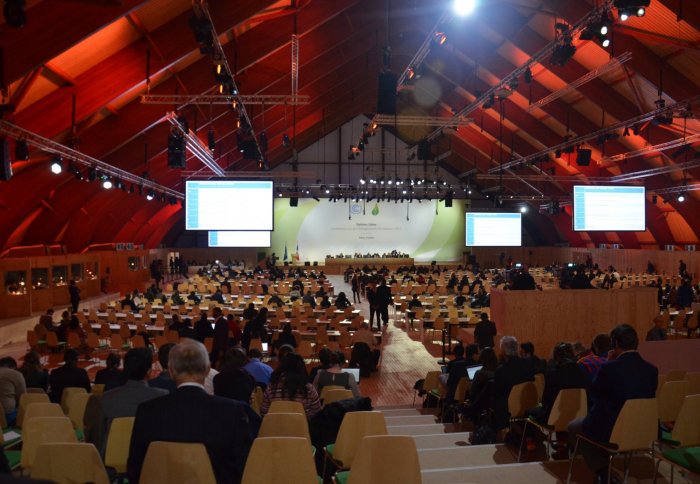
An alumnus of the Sustainable Energy Futures MSc was at COP21 and helped create a public record of the negotiations in a remarkable online document.
While all eyes were on Paris, Hamish Laing, an alumnus from the MSc in Sustainable Energy Futures, was in the thick of it working with the New Zealand delegation. He was therefore well-placed to create, along with his colleague Ryan Mearns, a public record of the negotiations in a remarkable Google Doc. We caught up with Hamish to chat to him about the document, COP21 and life after Imperial College London.
Q: It seemed like the whole world had descended on Paris over the last fortnight but how did you get so close to the action?
A: I was selected as a delegate with the Aotearoa Youth Leadership Institute (AYLI), an organisation which gives young New Zealanders the opportunity to attend international conferences all over the world. Through AYLI, I was able to obtain accreditation as an ‘Observer’ for both weeks of the conference. This was a massive privilege, and we wanted to ensure we made the most of our time here. One interesting thing about COP is that Observers often have a lot more access than the Press. So although many meetings were closed we still had a good feel for how things were progressing.
Q: The document has garnered a bit of attention. Was that the main reason you were there or did it seem like a good thing to do?
A: Creating the document was never our intention, and the attention it gained grew quite organically. Civil society had been pushing hard to gain access to a lot of the meetings, and there was a plea to make sure that when we did get access that we would take good notes of what was happening. The main reason I was there was for educational purposes: to engage and understand the process in order to evaluate how one can create influence.
Q: It is a fascinating piece of work. Does it seem like you were recording history in the making or did you just get on with it?
A: Not particularly. In the past there have always been a lot of people making notes on these sessions. I guess what we did differently was try and make them accessible and easy to read. The intended audience was youth inside and outside the conference centre who were following COP. It grew from there when some press picked it up and distributed it more widely as a way to easily understand what was happening.
Q: It can’t have been easy, long days, stretching into long nights without much sleep?
A: Fortunately (and unfortunately) we didn’t have too many late nights until right near the end of the conference. Mostly because as ‘Observers’ we couldn’t get into many meetings which went late into the night. This was incredibly frustrating and made it difficult to tell which parties were supporting various parts of the text and which were blocking it. It was true though that some of the meetings were very long and boring, thus the document provided a way for us to keep engaged and have some fun along the way. After writing more than 23,000 words between us in a week, our fingers were getting a little tired as well.
Q: What about your view on the negotiations? From the outside it all seems very good natured and useful. Do you think we will we see real global change and keep us under the 2â°C, or even 1.5â°C, temperature rise?
A: It’s really interesting actually to note the difference in what countries are prepared to sign up to and the action that they are taking. For example, on the long-term temperature goal, we seem to have moved past 2â°C and are now seriously talking about 1.5â°C while at the same time the INDCs which 158 countries have submitted currently put us on track for 2.7-3.5â°C of warming. I am definitely hopeful though and see the Paris Agreement as a massive step forward on the road to a safe climate future.
Q: You’ve just finished up the MSc in Sustainable Energy Futures from Energy Futures Lab, how has that framed how you approached the meeting in general and recording the discussions in particular?
A: I definitely approached the talks with great insight into what some of the solutions could be in these talks. Unfortunately, understanding some of the solutions made the situation more frustrating at times, especially when the science and technology takes a back seat to highly politicised issues. In terms of recording the discussions, we probably didn’t frame countries which were trying to undermine the talks in the best light and definitely had a better appreciation for the some of the most vulnerable countries and their asks.
Q: COP21 has clearly been a big part of your life but what else have you been up to since finishing in September?
A: Yes, definitely. As a delegate with the Aotearoa Youth Leadership Institute, we also had some training weekends in the lead up to the talks. Unfortunately for me, these were in New Zealand which has a time difference of 13hrs, resulting in some very late nights. Since September, I have taken some time to reflect but also kept on learning and completed an interesting online course in Climate Change Science and Negotiations run by Jeffery Sachs from the Earth Institute at Columbia University. Of course, the rugby world cup was also in London. So naturally, I was following the All Blacks success closely!
Q: And what does the future hold for Hamish Laing?
Both the MSc and attending the Climate talks have been very influential in my development, and I’m now thinking about where to go next. But first, I am starting an internship in January with Verdantix, a company in London which conducts research and consulting in Energy, Sustainability and Environment Health & Safety
Article text (excluding photos or graphics) © Imperial College London.
Photos and graphics subject to third party copyright used with permission or © Imperial College London.
Reporter
Neasan O'Neill
Faculty of Engineering
