.jpg)
Campus and community
/prod01/channel_4/imperial-news/media/news-images/3000X2000-main-article-images/2026-03-25_IRO_Latin-American-STEMB-Network-126.jpg)
Imperial has showcased the Latin America STEMB Network at an event bringing together colleagues, partners and guests from research, policy and diplomatic sectors to champion and recognise members of the Latin American community at Imperial.
The new science, technology, engineering, medicine and business network was launched at an event which brought together university leadership, academic, research, and teaching staff, partners, and representatives of the Latin American diplomatic community. Speakers included Imperial’s Provost and Deputy President, Professor Peter Haynes, HE Antonio de Aguiar Patriota, Ambassador of Brazil to the United Kingdom; and Dr Judith Alazraque Cherni, Honorary Senior Research Fellow, Centre for Environmental Policy; Lead, Imperial Latin America STEMB Network.
The Imperial Latin America STEMB Network represents several key themes that are central to Imperial’s mission – excellence in research, global collaboration, and real-world impact. Professor Peter Haynes Provost and Deputy President, Imperial College London
Professor Peter Haynes said, "The Imperial Latin America STEMB Network represents several key themes that are central to Imperial’s mission – excellence in research, global collaboration, and real-world impact. We are, and have long been, a deeply international university. Our strength comes not only from excellence within disciplines, but from the diversity of perspectives, experiences and ideas that our community brings together.”
Ambassador Antonio Patriota welcomed the progress made in the science and technology partnership between Latin America and the United Kingdom, underlining the importance of intergenerational responsibility in these fields. “Our generation is aware of finite resources and the unsustainable nature of several policies that are still pursued. Science and technology exist to improve the livelihood of humankind and its benefits should be equally shared,” he said.
The launch comprised of a panel discussion, enlightening research pitches and poster presentations to highlight the importance of work by Latin American academics and researchers at Imperial. Julia Kulik, Senior International Relations Manager (Americas), and Ana Carolina Souza, International Relations Officer (Americas), from the International Relations Office highlighted Imperial’s existing partnerships in the region, followed by a reception with remarks from the speakers.
Dr Judith Alazraque Cherni, Lead of the network, said, “the event has granted staff, students and others a forum to first, meet colleagues with Latin American backgrounds; second, learn about the outstanding work they carry out, in different faculties and departments and at different stages of their careers; and, third, open possibilities to explore potential collaborations.”
Dr Wayne Mitchell, Associate Provost (Equality, Diversity and Inclusion), chaired a panel discussing speakers’ research, collaborations in Latin America, and their experiences of being from Latin American heritage at Imperial. Panel member Dr Ana Cruz Ruiz, Project Manager at the Hamlyn Centre for Robotic Surgery, reflected, “recognising that our trajectories are often not linear was an important part of the event for me. The effort required to get the education we want – PhDs, Master's – demands more commitment, as we have to find and carve out a route that often doesn't exist, it is difficult to find, or is badly supported. It's not straightforward; it takes a lot of perseverance.”
Pitch presentations, chaired by Dr Diego Mesa Peña, Research Fellow in the Department of Earth Science and Engineering, introduced researchers from across the breadth of Imperial, covering subjects from tropical disease transmission to seismic engineering, business, environmental policy, and cancer detection and treatment.
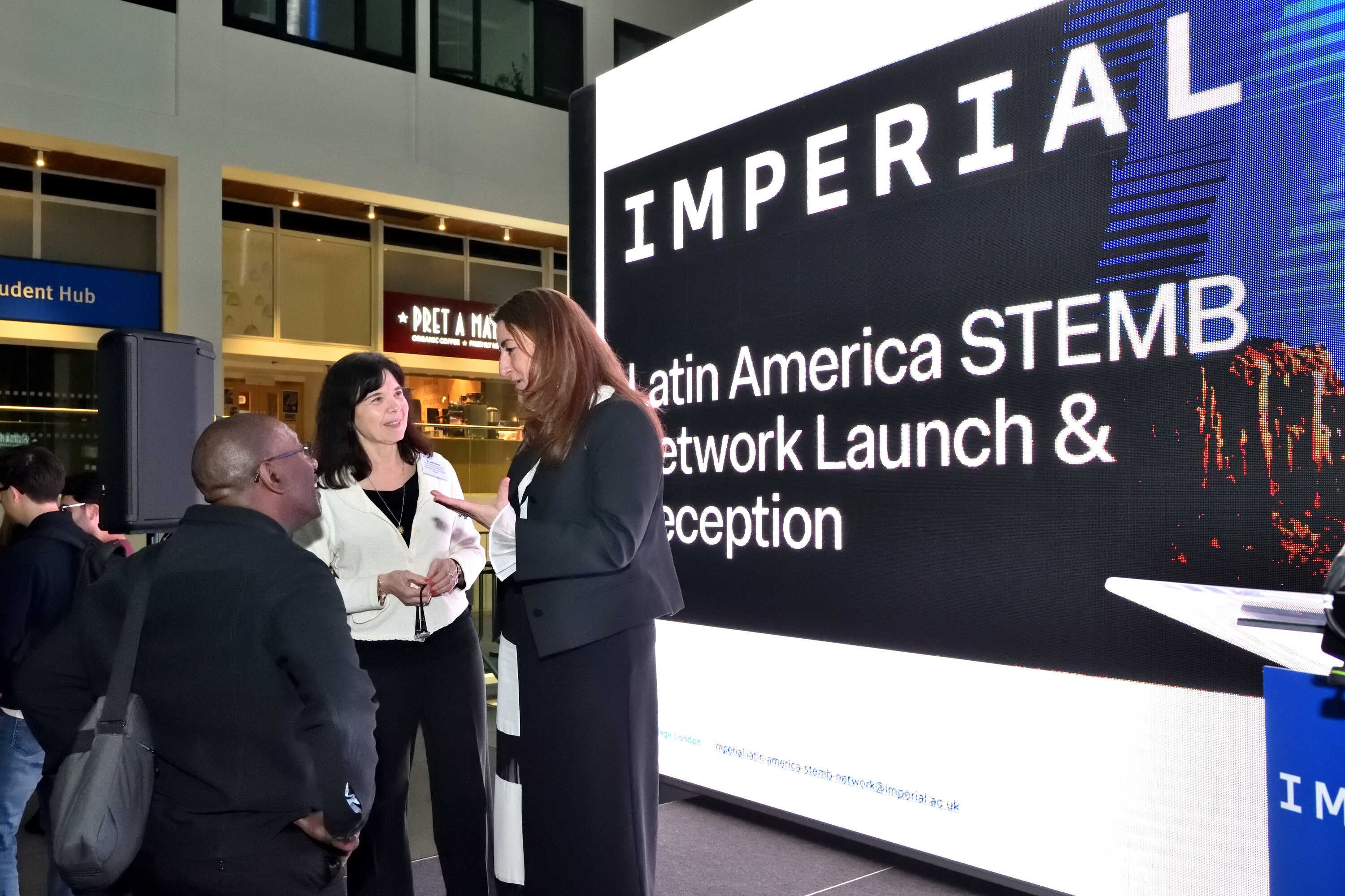 The Latin America STEMB Network brings together Latin American scholars at all stages of their career across Imperial to showcase their work, strengthen collaboration and deepen Imperial’s engagement with the region.
By creating a visible, supportive and interdisciplinary community, the network aims to elevate the profile and recognition of Latin American staff at Imperial, showcase its contribution to advance scientific excellence at Imperial, open new pathways for co-created research with partners in the region, contribute to more inclusive knowledge production and share tangible impact this work is having for communities, policy and practice across the region and the world.
My dream is to amplify visibility and recognition of Imperial staff of Latin American background through the lens of our scholarship, intellectual capacity and dedication to advancing scientific excellence here, in the region, and across the globe. Dr Judith Alazraque Cherni Lead, Latin America STEMB Network
The network’s origins lie in a project from 2021 entitled Latin America Visible@Imperial, led by Dr Cherni, the first project of its kind to address Latin American inclusivity in academia at Imperial. Since then, Dr Cherni has continued to build on that work and identify members of the Latin American staff community, with the encouraging support of Imperial as One, Imperial's staff network for Black, Asian and Minority Ethnic staff and those interested in race equality. Since 2023, the network has led meetings and presentations; it was awarded EDI seed funding in 2025–26 for the project Spaces for Latin American Identities.
Dr Cherni said, “Amid our significant contribution to research, Latin Americans still represent a minority. My dream is to amplify visibility and recognition of Imperial staff of Latin American background through the lens of our scholarship, intellectual capacity and dedication to advancing scientific excellence here, in the region, and across the globe.”
The network welcomes new members who are Imperial staff of Latin American backgrounds. To join and find out about upcoming events, please get in touch via email.
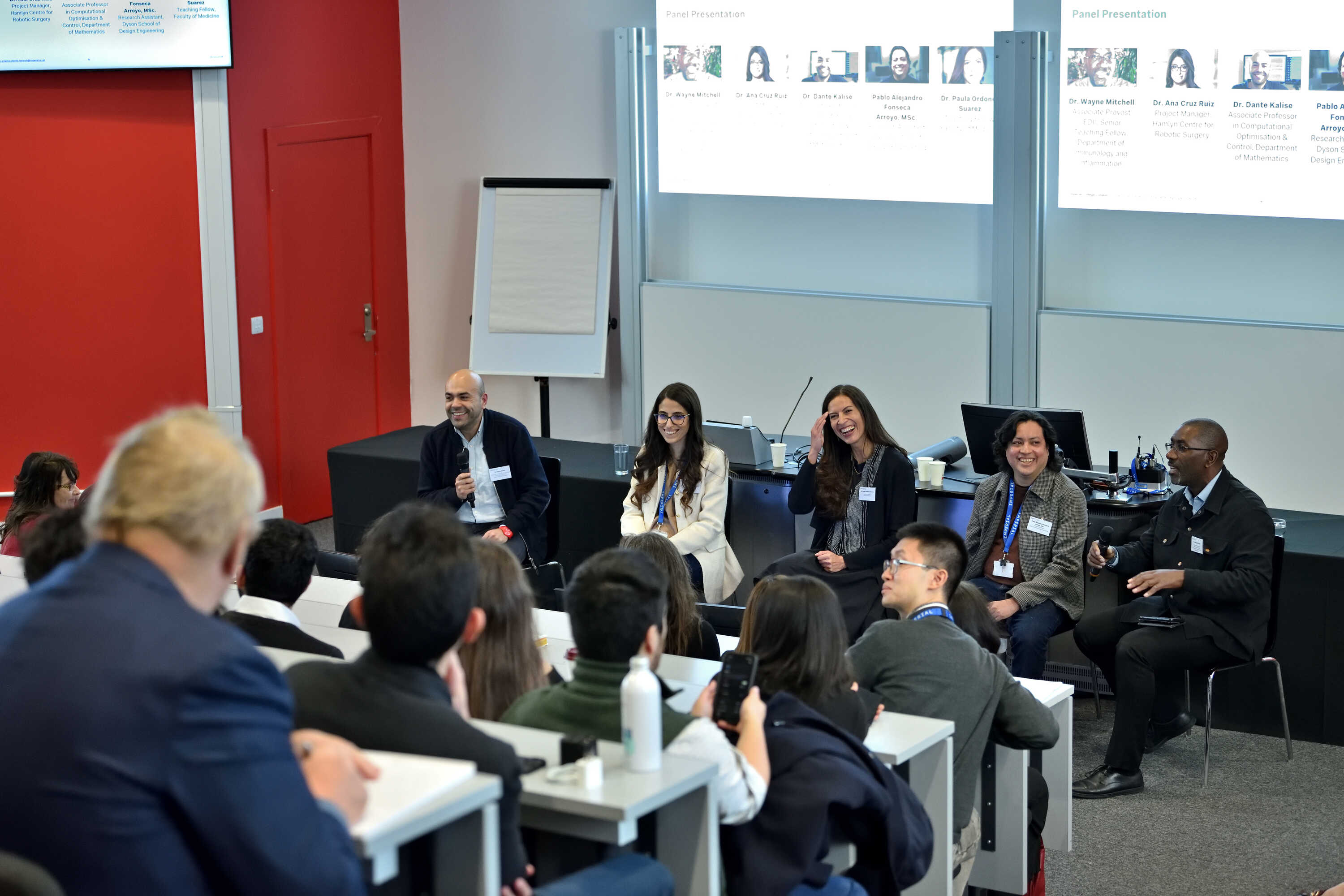
Imperial is one of the most internationally diverse and connected universities in the world. We have deep and longstanding connections across Latin America including a partnership with the University of São Paulo (USP), scholarship programmes with Chile, Colombia and Brazil, and strong academic-led partnerships with organisations across the region.
Connections with USP are extensive, including ongoing collaborative research projects in the energy transition, bioeconomy, and one health research areas. In May 2026, the Imperial–University of São Paulo Collaborative Research Workshop on One Health convened academics to develop proposals for seed funding leading to large-scale strategic grant proposal to key funders such as FAPESP in Brazil and the UKRI in the UK. Following the workshop, the University of São Paulo-Imperial Seed Fund is now open for applications and welcomes proposals for collaborative research projects.
USP is also a partner on Imperial’s Schmidt Sciences AI in Science Global Fellowship, which assists talented faculty members from global partner institutions to use AI to enhance their scientific research, while also building sustained local capacity at their home institutions. This year, Daniela Damasceno, Lucas Medeiros, Mariana Severo Ramundo and Rodrigo Malavazi Corder have joined from USP, harnessing the power of AI to make advances across the disciplines of nanotechnology, X-ray spectroscopy and viral and infectious diseases.
Find out more about the Latin America STEMB Network, and to join please contact us via email.
Article text (excluding photos or graphics) © Imperial College London.
Photos and graphics subject to third party copyright used with permission or © Imperial College London.
Administration/Non-faculty departments
.jpg)
Campus and community

Engineering

Engineering

Engineering
Imperial Global
Cross-faculty
Campus and community
Discover more Imperial News
Search all articlesDiscover more Imperial News
Search all articles