
Cross-faculty
/prod01/channel_4/imperial-news/media/images/landscape-3000X2000/Image-for-the-atmosfair-blog.jpg)
A year-long pilot initiative has demonstrated that a transparent, reduction-led offsetting scheme can be practical, affordable, and readily adopted across departments. In this blog post, Semra Bakkaloglu and Salvador Acha Izquierdo, members of the Department of Chemical Engineering Sustainability Committee, explore the initiative in detail and share what they have learned.
|
473 |
338.4 tCO2 |
327.5 tCO2 |
97% |
Academic travel is part of how research happens. Conferences, meetings, fostering collaboration, and fieldwork all rely on people meeting across borders. But air travel also carries a significant carbon impact, which means departments need practical ways to reduce emissions and deal responsibly with the journeys that remain pivotal in our field of work. Imperial College London has set a carbon emissions reduction target on air travel of 25% by 2026.
Championed by its Sustainability Committee, the Department of Chemical Engineering air travel offsetting pilot, in collaboration with Atmosfair, gives us a clear example of how such a scheme can work. Using flight-leg data from the departmental travel records, the pilot converted travel emissions into a set of offset purchases that funds sustainability projects which benefit low- and middle-income countries (LMICs). The pilot did not remove the need to reduce travel; instead it created an accountable backstop for necessary business air travel and a dataset that can inform better decisions in the future. Each researcher who needed to procure flights was given the option to i) offset their emissions via the scheme offered by the department, ii) offset their emissions on their own, iii) take no action.
High coverage at modest cost
Across the dataset, 473 flights were logged, representing 338.4 tonnes of CO2. The department centrally offset 327.5 tonnes covering 444 flights. A further 0.9 tonnes were reported to personally offset their flight emissions, leaving about 10 tonnes declined for offset. On an emissions basis, 96.8% were centrally offset and 97% was covered when personal offsets are included.
The associated costs of the pilot is important to analyse in detail. The central offset portfolio across a year had a total cost of €9,029 for the department, or €27.57 per tonne of CO2. Put another way, the scheme cost roughly €20 per recorded flight. Extending coverage to the remaining 10.8 tonnes at the same average portfolio price would have required around €300 more. This illustrates a practical advantage of a centralised, department-wide approach: once the administrative processes and approved portfolio are in place, the additional cost of improving coverage is relatively small.
The portfolio was not selected on price alone. Before implementation, the department assessed potential providers using the MIT AVID+ framework, which asks whether credits are Additional, Verifiable, Immediate and Durable, while also considering wider social and environmental benefits. Atmosfair was selected following this assessment and staff consultation. Crucially, the programme used Atmosfair’s Corresponding Adjustment option—rather than its lower-cost contribution-claim option—because a corresponding adjustment is designed to address the risk that the same emission reduction could be counted both by the host country towards its national climate target, and by the purchaser. This makes the relevant comparison not with the cheapest credits available, but with credits that meet comparable integrity and accounting requirements.
At €27.57 per tonne of CO₂, the pilot’s average cost falls within the €25–30 per tonne range considered for Atmosfair’s corresponding-adjustment option during the Department’s pre-selection assessment. The cost should therefore be understood as the price of a deliberately selected, higher-integrity portfolio for unavoidable travel emissions, which is not as a substitute for reducing those emissions at source.
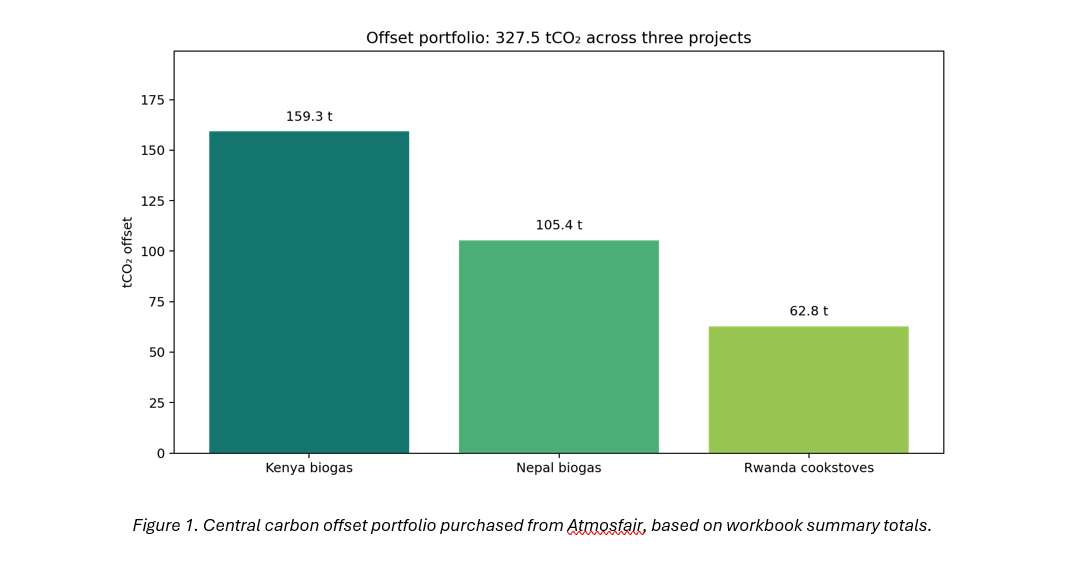
Figure 1: Central carbon offset portfolio purchased from Atmosfair, based on workbook summary totals.
 Where the offsets went
The Atmosfair offset portfolio has three household-energy and clean-cooking project categories, which the end-user could choose from: 1) biogas from cow dung in Kenya, 2) biogas plants for household energy in Nepal, and 3) efficient cookstoves in Rwanda. The Kenya biogas project accounted for 159.3 tonnes of CO2, or 48.6% of central offset emissions. Nepal biogas accounted for 105.4 tonnes, or 32.2%. Rwanda cookstoves accounted for 62.8 tonnes, or 19.2%.
We believe that giving end-users a range of offset projects has a communication advantage. Staff and students can understand what their offset purchase is supporting, while administrators can report coverage, spend, and portfolio balance in a few clear metrics. This simple and quantifiable approach makes the pilot easy to replicate if other Imperial departments wish to do so.
Offsetting is not a substitute for reducing travel
The strongest case for offsetting is also the most honest one: it should come after a conscious effort on travel reduction has taken place. Imperial's sustainable travel guidance is explicitly focused on reducing air travel impacts and taking the lowest-carbon practical option. The Oxford Offsetting Principles make a similar point: credible offsetting starts with reducing one's own emissions, using high-integrity offsets, and disclosing how offsets are used.
The Department of Chemical Engineering data can support that reduction-first approach. Economy travel represented 57.9% of recorded emissions, but premium economy, business and first-class travel together represented about 42% of emissions. That does not mean premium cabins are never justified; it does show why cabin choice, trip consolidation and rail substitution should be part of the same conversation as offsetting.
Figure 2: Emissions by cabin class, with spelling variants consolidated.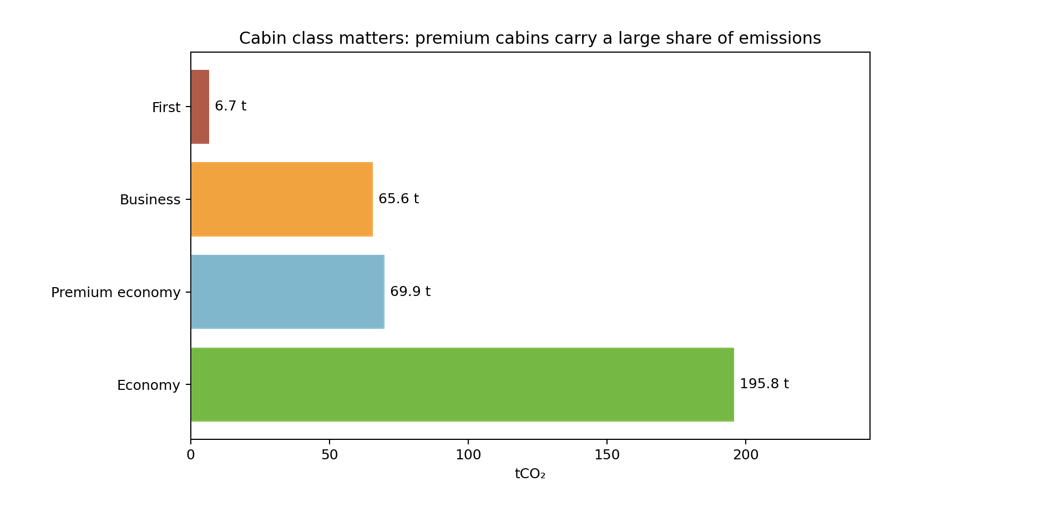 A model for other departments
The pilot points to a repeatable model. A department needs a travel emissions dataset (derived from its travel PO procurement data), a small portfolio of approved offset options, a visible field for staff who decline or offset personally, and a periodical reporting process. That is enough to make offsetting measurable and verifiable rather than ad hoc.
For the Department of Chemical Engineering, the next step is to close the small remaining gap and tighten data quality checks. The workbook contains some missing emissions values in declined and personal-offset rows, plus five dates outside the stated May 2025 to May 2026 window. These are normal pilot issues, and they are exactly why a transparent dataset is useful: it reveals what must be improved before the approach is scaled. We hope that over time we can communicate regularly our travel activities and how its environmental impact is addressed.
The main takeaway
The pilot shows that offsetting can be practical, affordable, and informative when it is designed as part of a wider sustainable travel hierarchy. Our initiative has provided the Department of Chemical Engineering with a clear emissions baseline, funded offsets for almost all recorded air-travel emissions, and produced insights that can guide smarter travel choices.
Most importantly, the pilot has created a template. If they wish to do so, other departments can adopt the same basic workflow: reduce travel where possible, choose lower-carbon routes and cabins where practical, offset unavoidable emissions transparently, and report the results.
That is how offsetting becomes more than a transaction. It becomes a quantifiable and verifiable shared sustainable practice across Imperial.
©️Image: Adobe stock
Article text (excluding photos or graphics) © Imperial College London.
Photos and graphics subject to third party copyright used with permission or © Imperial College London.
Faculty of Engineering

Faculty of Engineering

Cross-faculty

Imperial Global
.jpg)
Campus and community

Engineering
Engineering
Engineering
Imperial Global
Discover more Imperial News
Search all articlesDiscover more Imperial News
Search all articles