From Digital to AI: Kelsey Flott on the next era of patient safety
/prod01/channel_4/imperial-news/media/images/landscape-3000X2000/this-one.jpg)
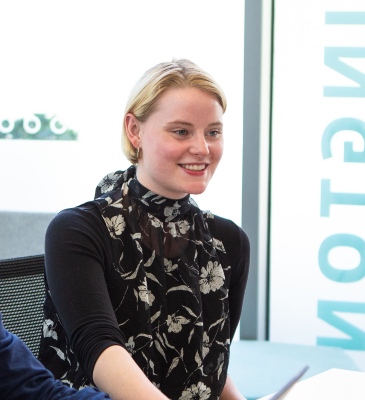
Kelsey Flott has spent her career at the intersection of health policy, patient safety and digital innovation. Her work has focused on turning evidence into safer, better care. With AI and digital tools increasingly reshaping how the NHS operates, few people are better placed to make sense of what that means for the future of care.
After completing her PhD at NIHR Patient Safety Research Collaboration: North West London (PSRC: NWL), Kelsey stepped into the role of Centre Manager, working closely with NHS England to translate patient safety evidence into meaningful improvements for patients and staff.
That same instinct for turning evidence into action now shapes her role as Associate Director of iCARE, a data and analytics initiative specialising in the translational research of digital health tools within the NHS. Much of that work runs through the Imperial Secure Data Environment (SDE), which iCARE operates, letting approved researchers analyse effectively anonymised health data without it ever leaving the NHS. It's a natural fit: a space built to turn data into safer, better care for patients and staff.
I collaborated with my colleagues at NIHR PSRC: NWL to understand what first drew Kelsey to this field, what she's learned about translating research into practice, and why she believes AI represents the next major shift in patient safety.
1. Your career has spanned research and policy in healthcare improvement. What first sparked your interest in patient safety and digital health interventions, and what continues to motivate you in this field today?
My interest started academically. I studied politics, then health policy, and soon found the NHS the most compelling social service in the world. What it is, who it serves and what it stands for is an everyday inspiration to me.
However, I also had to come to terms with the fact that it was far from perfect, and I wanted to play a part in its continuous improvement. That's when I became interested in quality, a field where I felt I could add value. After working in patient safety in both academic and policy roles, the writing was on the wall: the future of patient safety was going to be digital. Without a technology background, I jumped into digital safety policy at a point when it was still very embryonic, and later led the development of the NHS Digital Clinical Safety Strategy.
Today, it's no longer embryonic. Every national NHS health and life science strategy relies on technology to solve entrenched problems and yield a more efficient, patient-centric and sustainable health system. Digital might be the engine for transformation, but data is the fuel.
Our routinely collected health data is the information currency for change. That's what excites me: the chance to help drive the kind of radical improvement that keeps the NHS the global exemplar it is.
2. Digital technologies are playing an increasingly important role in healthcare. From your perspective, what are the biggest opportunities and challenges for using digital innovation to improve healthcare quality and safety?
The opportunities that excite me most are the technologies that eliminate, rather than cause, frustration for patients and staff. I love the idea that data can feed the development of AI that makes interacting with the NHS slicker, and day-to-day work more fluid.
There's also enormous scope for faster scientific discovery, in ways that could support treatment and reduce inequalities.
3. Much of your work focuses on translating evidence into real-world practice. What have you learned about turning research insights into meaningful improvements for patients and healthcare staff?
Mostly, I've learned the importance of listening and adopting the perspective of others. I'm not a clinician, a digital expert, or an ops manager. I learned early as a translational researcher that meaningful translation means continuously hearing and partnering with everyone across the health service.
There's a more theoretical answer too, drawing on Kingdon's theory of policy windows, which I learned during my Master's. Translation, or policy change, happens when three streams converge: a problem, a set of possible solutions, and a political environment open to adopting them. Capitalising on that moment requires a "policy entrepreneur," someone skilled at navigating all three streams and their stakeholders. A large part of what I've learned is recognising when these windows appear, staying patient when they don't, and stepping into that entrepreneur role when I can.
4. Patient voices are central to improving healthcare quality and safety. How can researchers and healthcare organisations better listen to and act on patient feedback?
Nearly ten years ago, I wrote my PhD on improving the use and usefulness of patient experience feedback. Back then, the answer was largely about improving how we collect feedback, using digital tools to turn it into actionable insight, and using more open-ended surveys. The world has moved on since. Now, without doing three years of dedicated research, I think the best thing anyone can do is spend time in the service they're researching. If you want to hear the patient voice, go hear it in real time.
5. Looking ahead, what gives you the most optimism about the future of patient safety, and what advice would you give to the next generation of researchers and improvement leaders entering the field?
Believe it or not, AI! I'm excited about how it can help us overcome long-standing challenges around integrating safety data with other routinely collected healthcare data, to better understand how to drive improvement. I think it will also free up a lot of the time currently spent on reporting and writing investigations, time that could go toward more meaningful safety work and clinical care. I say that with a balanced view: we're entering a new era for safety, and how AI plays out in clinical practice is still unfolding. If ten years ago the future of safety was digital, the future of safety now is AI, both in how we keep AI safe, and in how we use it to drive safety.
Academic research in healthcare is changing, and there's increasingly a role for everyone, not just the typical academic roles.
My advice: don't let what is normal stand in the way of what is achievable.
Kelsey's reflections point to a consistent thread: meaningful change in healthcare requires listening, to patients, to frontline staff, to the moment when conditions are finally right for something to shift.
That thread runs directly through her work at iCARE, where research only has value once it moves beyond the data and reaches the people delivering and receiving care. As she puts it, the next generation of researchers and improvement leaders shouldn't let "what is normal stand in the way of what is achievable," a challenge iCARE is built to help meet.
iCARE looks forward to continuing our collaboration with NIHR PSRC: NWL, who are at the forefront of turning innovation into real-world impact. Together, we have exciting plans to advance digital innovation in patient safety.
iCARE is a partnership between Imperial College London and Imperial College Healthcare NHS Trust (ICHT), supported by the NIHR Imperial Biomedical Research Centre (BRC).
Article text (excluding photos or graphics) © Imperial College London.
Photos and graphics subject to third party copyright used with permission or © Imperial College London.
Article people, mentions and related links
Laura Bassett
Faculty of Medicine