Reflections on the 2026 Health Data Science Black Internship at iCARE

The data science team at iCARE was delighted to welcome Albert Joseph and Siobhan Oghughu this summer. The pair joined through Health Data Research UK's Health Data Science Black Internship Programme, now in its fifth year, and are the fourth cohort iCARE has hosted.
Health data at iCARE
iCARE is a data and analytics initiative, and home to the Imperial Secure Data Environment, where researchers can analyse anonymised health and care data without it ever leaving the NHS.
Data is the bread and butter of a data scientist’s work, helping turn everyday hospital records into evidence that improves care. That is exactly what Albert and Siobhan focused on: using real-world patient data to understand who Imperial College Healthcare NHS Trust serves and where they come from.
Meet the interns
Siobhan has just finished a bachelor's in Medical Biosciences at Imperial, where her final-year project looked at how human immune cells and antibodies respond to a protein biotherapeutic. After a degree in the lab, she wanted something “purely computational” to build her coding and data handling skills.
Albert is a qualified pharmacist with an MSc in Health Economics and Policy. He taught himself SQL and Python through online courses, even building a portfolio of dashboard projects which can be found here.
The project: Not just genetics, but geography
Health isn't only about biology. Where you live shapes it too, through income, education, housing and, ultimately, which services you can reach. It's the so-called "postcode lottery", and you can't tackle it without knowing where patients actually come from.
That is what Albert and Siobhan set out to explore. They mapped ICHT's patients by borough, ICB and region, comparing emergency, inpatient and outpatient care. The aim, Siobhan explained, was to give “researchers and clinicians who require descriptive population insights” a clearer picture, particularly of patients travelling in from outside London.
Albert noted that the timing was particularly relevant. Changes to the local NHS commissioning landscape have shifted how patient populations are grouped, making it “especially important to understand where patients are coming from across the newly combined region.”
Getting hands-on with the data
The work started in SQL, retrieving anonymised patient data within Imperial Secure Data Environment, before moving into Python to analyse the data and create charts and maps.
For both, the project was a chance to grow technically in different ways. Albert built on his existing SQL and Python experience, including working with Snowflake and Microsoft Azure Machine Learning, while Siobhan developed the confidence to retrieve the data she needed and experiment with different approaches to visualisation.
Working with real health data also encouraged the interns to think beyond the technical side. For Siobhan, one of the biggest lessons was that “health data is much more than mere numbers and categorical variables, and it always tells a story.” Albert, meanwhile, highlighted how he understood the theory of inequalities, ‘but working directly with the data gave me a much more tangible sense of how they can appear in practice.
Becoming part of the team
Both highlighted the welcome they received from across iCARE, particularly the support of their mentor, Toheeb Sodiq, who joined iCARE through the same HDR UK internship programme a few years earlier and is now a Data Scientist.
“From the start, everyone was welcoming, approachable and generous with their time,” says Albert, “which made it easy to ask questions and learn.”
Towards the end of the internship, Albert and Siobhan presented their findings to the wider iCARE team.
Siobhan admits she was initially “daunted”, but as colleagues asked questions, shared insights and engaged with their findings, that changed. “I became more confident and assured that our outputs were worthwhile and practical. It was a very satisfying and rewarding moment!”
Connecting with the wider community
The internship also gave Albert and Siobhan opportunities to connect beyond iCARE. This year, iCARE collaborated with the EHR-group at University of Bristol, which hosted two interns of its own, Nagat Guled and Halimat Olatunji. The four interns came together over the summer to share their work and experiences, from Nagat's interactive dashboard visualising general practice characteristics and secondary care use to Halimat's work developing an algorithm for OpenSAFELY.
They also had the chance to connect with others across the HDR UK internship programme, culminating in the closing ceremony. Both Albert and Siobhan were shortlisted for poster presentations, while Albert was also part of a team that finished runner-up in the programme’s technical challenge.
Together, these experiences gave them a chance to meet others starting out in health data, exchange ideas and see the breadth of work happening across the field.
Looking ahead
The internship may have ended, but both Albert and Siobhan are keen to stay close to health data.
I'm taking away a much stronger understanding of secure data environments, data governance, and how patient information can be protected while still being used responsibly for research. Albert Joseph Intern at iCARE
Siobhan says she is "wants to continue working closely with health data," inspired by the impact and potential of projects across iCARE and similar organisations. This autumn she begins a Master's in Cancer Biology at Imperial College London, where she hopes to draw useful insights from biological data in a similar fashion to her time at iCARE.
Albert plans to keep developing his technical skills and explore opportunities that bring together his clinical background, health economics training and growing experience in data science.
He leaves iCARE with a deeper understanding of how health data can be used responsibly: “I'm taking away a much stronger understanding of secure data environments, data governance, and how patient information can be protected while still being used responsibly for research.” 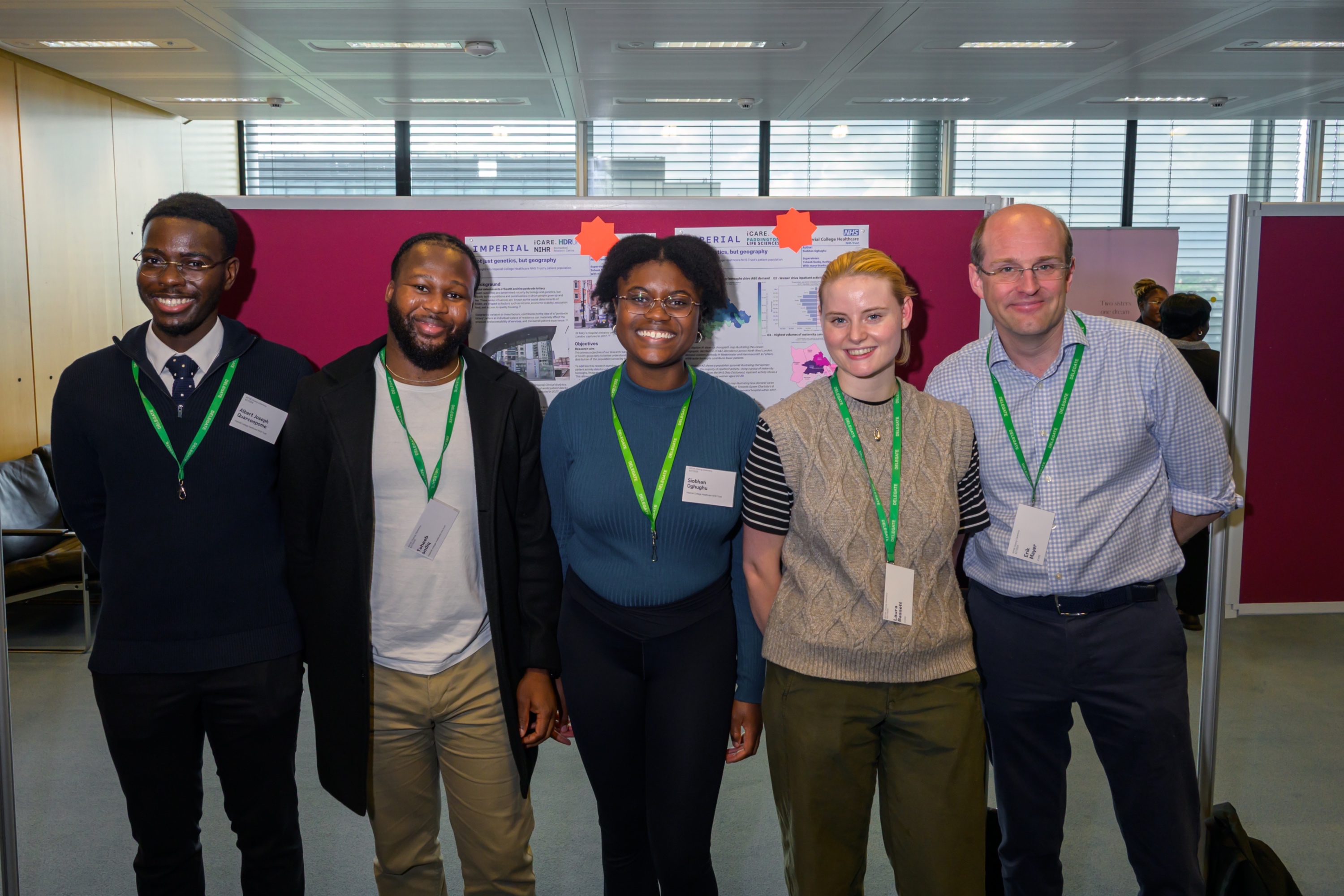
Article text (excluding photos or graphics) © Imperial College London.
Photos and graphics subject to third party copyright used with permission or © Imperial College London.
Article people, mentions and related links
Laura Bassett
Faculty of Medicine