Our approach
"Scientific thought and its creation is the common heritage of [humanity]."
Abdus Salam (Imperial College 1956-1994, Atoms for Peace Award 1968, Physics Nobel Prize 1979)
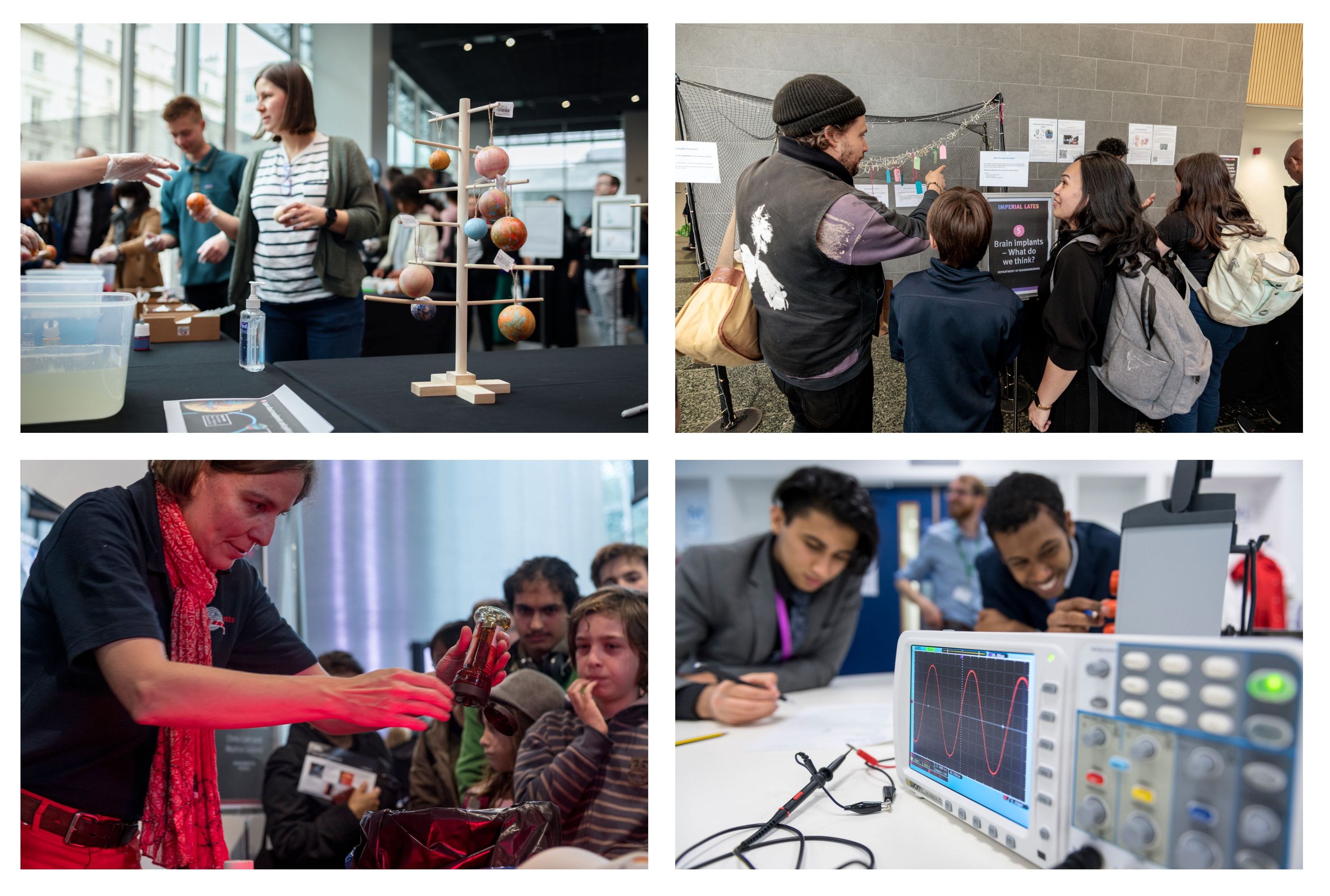
With this motto in mind, people at Imperial Physics are committed to sensitising the general public to scientific topics and issues by organising a wide range of outreach activities, such as Events for the Public, Schools and Work Experiences.
"Our students really appreciated the opportunity to tour the Physics department, they were particularly interested to learn about the wide-range of areas of Physics they could study and were excited by the buzz of students heading in and out of lectures."
Head of Physics, Sydenham High School
Our Outreach team also collaborates with the Outreach Office at Imperial. To find out more about upcoming events, check out their monthly newsletter. Signing up is required.
Our work

Engagements by topic
Our researchers appear across media to speak on a wide range of physics topics.

Get involved
Read about our public engagement activities and find out how to get involved.
Our outreach
Imperial Schools Year 1 Project Open Days
During their first year at Imperial, physics students work with a researcher to develop and undertake a research project of their own design. During this event, they will present their results at stands in the department to fellow students, staff and visiting schools. Over 60 projects will be on display, offering visitors an opportunity to learn about the Physics research being conducted in the department.
Additionally there are talks by researchers throughout the event, giving school students the chance to learn more about the physics department and the cutting-edge research being conducted in the field. These events are suitable for students studying science or physics at GCSE and A-level.
We will be announcing 2027 dates soon.
You can watch videos from our previous student participants below.
Videos
Best Project - Team V9SM
Building and Characterising DIY Particle Detectors
Student researchers: Eric Ji, Bogdan Pamfile, Jovitta Winceslaus, Jessica Yu
Supervisor: Prof. Yoshi Uchida
In this project, we built several DIY particle detectors, including a cloud chamber, scintillator and photodiode-based detector, with mostly commercially available products, to detect and characterise common particles such as cosmic muons and beta particles. We measured the count rates of muons using all the particle detectors, and compared the efficiencies of their detection. We also investigated the energy spectra of muons detected with the photodiode-based detector and scintillator, and verified the relationship between muon flux and zenith angle with the Geiger counters-based detector. The video is broken down into 3 key parts, theory, project work, and results and discussion, which developed on the ideas above.

Best Project - Team V9SM
Learn about Team V9SM, winners of the Best Project award.
Building and Characterising DIY Particle Detectors
Student researchers: Eric Ji, Bogdan Pamfile, Jovitta Winceslaus, Jessica Yu
Supervisor: Prof. Yoshi Uchida
In this project, we built several DIY particle detectors, including a cloud chamber, scintillator and photodiode-based detector, with mostly commercially available products, to detect and characterise common particles such as cosmic muons and beta particles. We measured the count rates of muons using all the particle detectors, and compared the efficiencies of their detection. We also investigated the energy spectra of muons detected with the photodiode-based detector and scintillator, and verified the relationship between muon flux and zenith angle with the Geiger counters-based detector. The video is broken down into 3 key parts, theory, project work, and results and discussion, which developed on the ideas above.
Best Computation Video Prize - Team Y3RF
Learn about Team Y3RF, winners of the Best Computation Video Prize.
Modelling Gravitational Lensing and Einstein Rings, Analysis of SLOAN Lens Survey Data set
Student researchers: Joseph Dyson, Prabhmeet Johal, Leiyi Sun, Cyrus Tang
Supervisor: Elias van den Dreissche
Using python our team developed a ray tracing model of gravitational lensing to measure the theoretical value of the radius of an Einstein ring around a lens and compared the theoretical prediction to those recorded in the Sloan lens ACS survey (SLACS). We analysed the data to investigate any discrepancies between theoretical and observational data and possible reasons that could explain these differences. We also created an image of a black hole, and analysed the data to show that dark matter exists.
Best Experimental Video Prize - Team P7BR
Learn about Team P7BR, winners of the Best Experimental Video Prize.
Selective Hearing: Combining Sound Source Localisation and Active Noise Cancellation
Student researchers: Abram Chui Hoi Yiu, Mei Kojima, Robert Lascar, Aanya Maheshwari
Supervisor: Dr Mark Richards
A small-scale active noise cancellation and direction estimation prototype was developed using a RaspberryPi, I2S microphones and a headphone model. Direction estimation was achieved using a GCC-PHAT beamforming algorithm, while ANC was tested using adaptive filtering. The system showed successful angle detection and achieved a maximum signal correlation of 93% at 170 Hz, although latency and hardware limitations prevented full simultaneous directional ANC.
Popular Vote Prize - Team N4QC
Learn about Team N4QC, winners of the Popular Vote Prize.
Can Physics Win the World Cup?: The Aerodynamics Behind Football's Most Chaotic Freekicks
Student researchers: Abu-Bakr Camatchee, Bihadu Jayaweera, Sharen Shivagumar, Reilly Webster
Supervisor: Prof. Jonathan Eastwood
An investigation into the physics behind knuckleball free-kicks in football using research papers has been completed in light of the upcoming World Cup, identifying two main aspects to a knuckleball. Using existing video footage one of the two main aspects were verified. A simulation was produced based on wind tunnel data to verify the other aspect. By combining all aspects of the investigation a game was produced based upon the physics to show the random chaotic nature of a knuckleball. Finally, it was determined that a knuckleball free-kick should not routinely be attempted at the 2026 World Cup.
Our work experience
Currently, the Department does not have any work experience opportunities. However, Imperial does run a number of opportunities with formal schemes. You can learn more about the Work Experience Programme on the Imperial Outreach webpage.