What if we are solving the wrong problems?
In many academic research settings, work begins with a hypothesis or a research question, often motivated by a broader benefit to society. Investigators frame a technical question, develop methods to explore it, and arrive at conclusions. This is a well established and valuable way of doing science.
As work moves closer to integrated systems and real world testing, particularly in areas like robotics, the nature of the challenge begins to shift. We are then dealing with open, physically grounded problems such as interaction, manipulation, and locomotion. These problems are inherently complex and not easily captured through simulation alone. We design and test new robots, and in doing so, we gradually build a deeper understanding of the problem itself.
However, if we move too quickly through this phase of understanding, we can end up with systems that are elegant from a kinematics or dynamics perspective, yet do not translate into real world use or solve the problems we originally set out to address.
In industry, the approach often starts with a clearly defined gap tied to value creation. From there, investigation is directed toward aligning the problem definition with the approach. When the whole team is clear about the underlying need, it helps keep efforts focused on what actually matters.
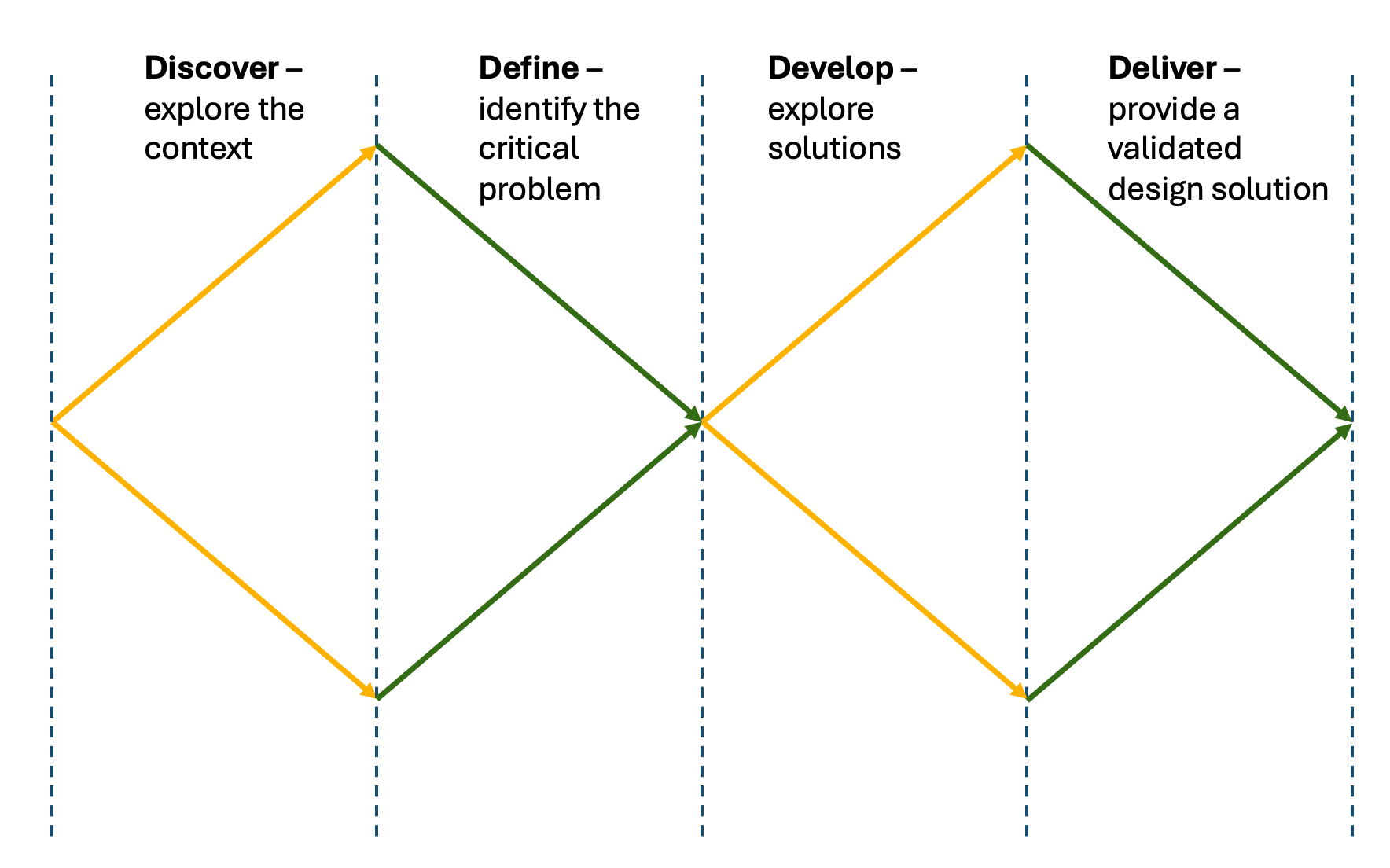
This is where design thinking becomes useful. Among several frameworks, the double diamond offers a structured way to navigate this space (see figure below). The first phase is divergent: discovering what the problem really is. This means opening up the problem space, understanding the context, and identifying the factors that define it.
Take agriculture as an example. As a roboticist, rather than developing a sophisticated technology only to later find that it does not work in the field or is too costly to scale, it is more useful to step back and first ask what the actual problem is. That requires engaging with the ecosystem, observing and speaking with stakeholders. And importantly, the farmer is not the only stakeholder. There are equipment manufacturers, service providers, fertilizer and chemical suppliers, irrigation specialists, agronomists, policymakers, and others. Agriculture operates as a networked system.
If we only speak to one group, for example farmers, we may miss the larger opportunity. A farmer might say they cannot afford new technology, which is a real constraint. But that perspective alone may not reveal opportunities where technology could reduce costs, improve yield, or enhance quality and consistency, ultimately increasing income. To see that, we need to understand how value flows across the entire ecosystem.
This is why engaging multiple stakeholders is critical. Structured conversations, guided by approaches such as those in The Mom Test, help uncover genuine pain points without biasing responses. Through this divergent phase, we build a richer picture of the system and identify where meaningful problems lie.
The next phase is convergent. Here, we narrow the broad set of observations into a smaller number of well-defined problems or opportunities. The aim is to identify interventions that create value across stakeholders, solutions that are economically viable, environmentally responsible, and practically adoptable. Ideally, farmers benefit, service providers benefit, governments see value, and there is a sustainable business model.
At this point, we move from understanding the problem space to defining a specific problem we are well positioned to solve. This is where our own strengths come in, our technical capabilities, our tools, and our scientific perspective.
After defining the problem, or a small set of problems, we move into a second divergent phase: exploring different ways of solving it. This is where scientific thinking naturally fits. We can frame hypotheses, run question driven investigations, and systematically explore alternative solutions.
Take a simple example like hydration in agriculture. Suppose we focus on a specific crop such as chili, grown in a particular region. Even in this seemingly simple case, the problem quickly expands. What counts as enough hydration in that region in different months of the year? How often should irrigation happen? And how should it be delivered, through surface flow, spraying, drip irrigation, or injection at specific points in the soil?
Once we ask these questions, a range of technical challenges emerges: controlling pressure, scheduling irrigation, placing delivery points, and adapting to soil conditions. If there is established knowledge, we can implement it directly. But often there is room for exploration. That is where controlled experiments become valuable, testing different hypotheses across groups of plants, comparing yield, consistency, and water usage.
Hydration is just one example. The same applies to weeding: manual, chemical, mechanical, laser based, or hybrid approaches. Each option opens up a design space with different trade offs. The key point is that this phase of exploring solutions should be done efficiently, often through pretotypes rather than fully developed systems.
This phase of divergent thinking, combining technical and economic perspectives, helps us filter out solutions that may be scientifically appealing but not viable in practice. For instance, I might be tempted to design a tree climbing robot to harvest coconuts, with sophisticated signal processing to detect ripeness of coconuts. However, when we factor in the cost of intervention, added logistical complexity, and the expected commercial return, it becomes much easier to identify which solutions are genuinely viable and worth investigating deeper.
Once we identify options that are technically viable, economically reasonable, and potentially scalable, we move into a convergent phase again: defining the actual solution. That solution is then implemented, and importantly, implementation itself becomes a source of learning. We begin to see how stakeholders respond, how the system behaves in practice, and where assumptions break down. This naturally feeds back into the earlier phase of problem understanding. In that sense, the double diamond is not a one-off process. It is iterative.
What is interesting, though, is that this process can be improved as shown in the figure below. There is value in not strictly separating problem exploration and solution exploration. In practice, early, even rough solution ideas, mock ups or quick pretotypes, can be introduced during the problem understanding phase itself. This allows stakeholders to react to something tangible much earlier allowing us to understand how the intervention changes stakeholder behaviour.
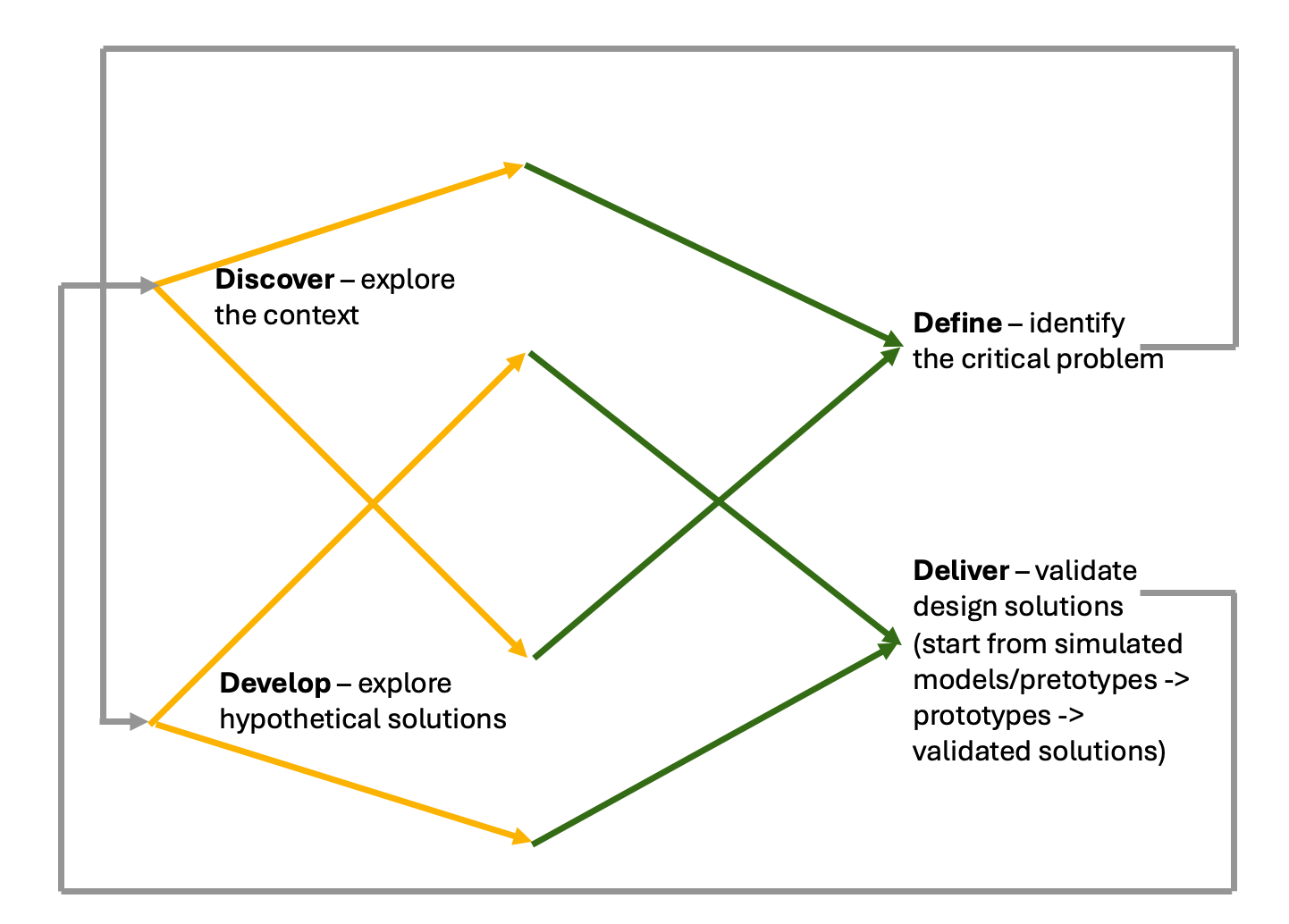
For example, in a conventional approach, we might identify weeding as a key problem in a crop like cinnamon, design a robotic solution, and only then present it to farmers. At that point, rejection can happen for reasons that were not visible during the initial analysis, such as cultural practices, workflow incompatibility, or economic concerns. By contrast, if tentative solution ideas are introduced early in conversations, we can surface these constraints much sooner.
In that sense, it becomes useful to embed solution-oriented thinking within the problem exploration phase. This creates an agile process, where understanding the problem and shaping the solution evolve together. However, without structure, this can become ad hoc and inefficient. To avoid that, the discipline of divergent and convergent thinking still matters. We need space to explore broadly before narrowing down. This process also helps unify the team around a shared understanding and enables early stakeholder buy in.
The stories of my startups, Permia Sensing and EvoTouch, did not begin this way. They started as curiosity driven explorations and only moved into a spinout pathway after broader stakeholder engagement. That late stage engagement helped ground the work, but it came later than it should have. If I were to start those projects again, I would spend more time early on engaging stakeholders with the team to understand the real pain points as soon as possible.
Contact the PI
Professor Thrishantha Nanayakkara
RCS1 M229, Dyson Building
25 Exhibition Road
South Kensington, SW7 2DB
Email: t.nanayakkara@imperial.ac.uk