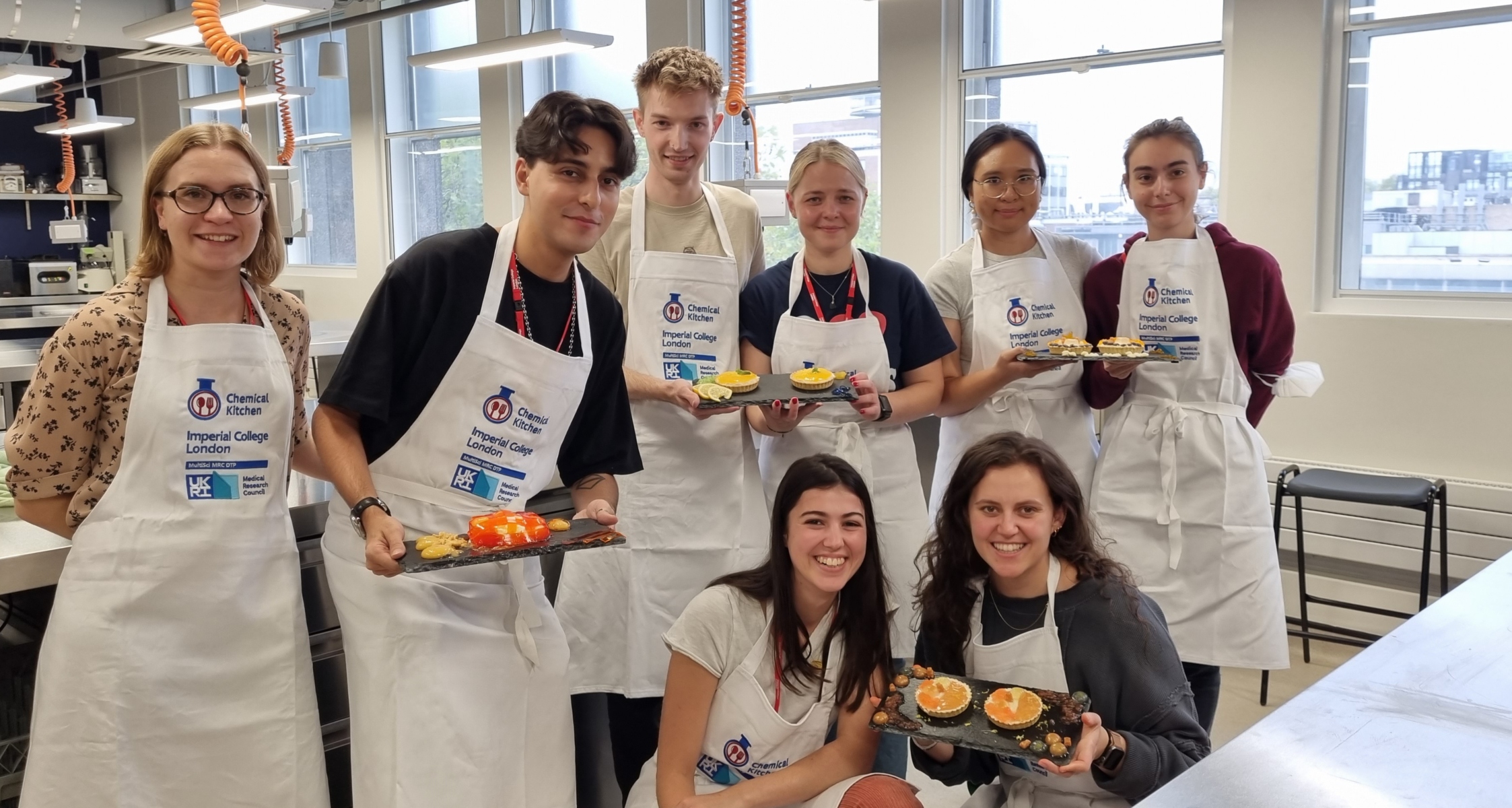
Imperial College London ranks top in the UK overall – with a greater proportion of 4* “world-leading” research than any other UK university. Students who have received MultiSci studentships are driving innovative research across a wide variety of topics throughout the university.
We asked our first and second cohorts of MultSci DTP students (cohort 1 is pictured above at the Chemical Kitchen training event) about what made them choose Imperial for their studies, about their research interests and tips for those wishing to apply. Expand on each of the sections to see what they have to say.
Below, also, are video profiles of some of our former MRC DTP students.
MultiSci Cohort 1 Profiles
- Sara Patti
- Lorenzo Alonso Requena
- Tom Studd
- Julia Laskowska
- Amelia Lias
- Shirine Merlo-Nikpay Aslie
- Laila Evangelista
- Valentina Giunchiglia
Name: Sara Patti
LinkedIn profile: https://www.linkedin.com/in/sara-patti/
What were you doing before joining MultiSci? I worked in early drug discovery for several years at a large pharmaceutical company in their Inflammation and Immunology research unit.
Why did you choose to apply to MultiSci? I wanted to do a PhD at a university with a strong immunology department. I was also interested in moving to London.
What will you be researching for your PhD? My project combines immunological and bioinformatic techniques in order to understand the molecular signals that operate during a range of chronic lung diseases to facilitate successful resolution and effective tissue repair and thus prevent harmful fibrosis, disease progression and organ failure.
How did the MRes year of MultiSci help you in developing your PhD project proposal? It allowed me to gain experience working in data science before starting my PhD.
What's your top tip for anyone considering applying to MultiSci? Determine if you are keen on doing an MRes prior to starting your PhD work.
What do you enjoy most about doing research? I enjoy learning new and interesting things about human disease. More importantly, I enjoy working on projects that have direct translational capabilities to address unmet clinical needs.
What would you like to do after your PhD? I would like to go back into early drug discovery in industry or potentially in venture capital for biotechs.
What do you enjoy most about living and studying in London? I love how many things there are to do in London- gigs, restaurants/markets, and museums. I also love how easy it is to travel around Europe from London.
Name: Lorenzo Alonso Requena
LinkedIn profile: https://www.linkedin.com/in/lorenzo-alonso-requena-810336177/
What were you doing before joining MultiSci? An MRes in Translational Cancer Medicine at KCL.
Why did you choose to apply to MultiSci? My dream has always been to do research and get a PhD, and the focus of the MultiSci on interdisciplinary science as well as its focus on biomedical research perfectly aligned with my interests. Additionally I wanted to do rotations before my PhD project and this program offered them.
What will you be researching for your PhD? I will be exploring and developing new statistical methods for multi-omic data integration in the context of hormone dependant breast cancer awakening. This type of cancer has a constant rate of recurrence which does not go down with time, and this issue is thought to be caused by cells entering dormancy, avoiding treatment; and then awakening, leading to a relapse. Exploring this phenomenon through multiple layers of gene regulation is key, and in order to extract as most information as possible from them, in the most rigorous way, solid statistical multi-omic integration methods are required. I will be focusing on the analysis of the data joining the expertise of mathematics groups with experience in integration with the data produced by a biology focused lab, developing the algorithms to explore this phenomenon.
How did the MRes year of MultiSci help you in developing your PhD project proposal? I enjoyed very much my two rotations, one in a biology group and the other one in a mathematics group. Me and the supervisors planned these rotations in advance in the hopes that if everything went well, a PhD project could happen as a collaboration between them. Fortunately everything did, and I was able to join the two fascinating focuses of the groups. Additionally, the rotations were a great opportunity to see if the supervisors, their groups and me were compatible, which is one of the most important things in choosing a PhD project!
What's your top tip for anyone considering applying to MultiSci? Make sure you have the passion and drive to pursue a PhD. The first year Master's is not easy and a PhD is hard work, so the thing that is going to keep you going is real passion for science and research. Once you have that, everything else will follow, both in you PhD applications and future PhD work.
What do you enjoy most about doing research? I actually really enjoy the day to day; writing code, learning about interesting topics, having meetings and talking with my colleagues.
What would you like to do after your PhD? I would like to either continue in research and pursue a post-doc, or combine my interests in science and politics and go into science policy.
What do you enjoy most about living and studying in London? London is a huge city full of things to do. After 6 years her, I keep discovering new places to go to and things to do almost on a daily basis. The diversity in the city also makes me feel at home, despite me not being British, it is a city for everyone.
Name: Tom Studd
LinkedIn profile: www.linkedin.com/in/toms1997
What were you doing before joining MultiSci? Working in a Covid-19 testing laboratory.
Why did you choose to apply to MultiSci? I had wanted to pursue a PhD for a number of years and I liked what MultiSci offered.
What will you be researching for your PhD? The JNK kinase phosphorylates the c-JUN proto-oncoprotein, activating c-JUN and switching on the transcription of genes that control cell proliferation, leading to tumourigenesis. c-JUN expression and activity is augmented in many tumour types and JNK kinase has been a desirable drug target but so far JNK inhibitors have not been translated into clinical use. Thus, there is an urgent need to generate knowledge that will enable the design of novel cancer treatments targeting this important pathway. Our Lab recently demonstrated that the temporal multisite phosphorylation of c-JUN by JNK controls c-JUN activity via cofactor recruitment. The aim of my project is to study the function of these novel phospho-c-JUN interacting proteins in order to address the mechanism by which c-JUN activity is switched on and off by phosphorylation, and how it gets jammed 'on' making cells cancerous, which up-to-now remains elusive.
How did the MRes year of MultiSci help you in developing your PhD project proposal? I was unsure of exactly which subject area I wanted to commit to for a PhD. The MRes year allowed me to hone my interests and find the best project for me.
What's your top tip for anyone considering applying to MultiSci? Make sure to demonstrate your enthusiasm and excitement for the science that you are passionate about.
What do you enjoy most about doing research? The flexibility and variety in the work.
What would you like to do after your PhD? I'm still deciding.
What do you enjoy most about living and studying in London? There is always something fun to do/somewhere interesting to go.
Name: Julia Laskowska
LinkedIn profile: https://www.linkedin.com/in/julia-laskowska/
What were you doing before joining MultiSci? I was in the process of completing my first Master's degree. I was also working full-time at the same time.
Why did you choose to apply to MultiSci? I realised that doing a PhD was the next 'logical' step in my career, however, I was not certain which areas of biomedical research interest me. I wanted to explore a bit before settling into a topic that I would work on for the next three or so years!
What will you be researching for your PhD? My PhD will be focusing on understanding the effects of microplastics as a part of air pollution on the human lung. The aim of this project is to understand and predict how the increasing concentrations of microplastics in the air will impact our lungs, given that currently there are no effective legislations curbing the production or effective disposal of plastics.
How did the MRes year of MultiSci help you in developing your PhD project proposal? I used the MRes year as an 'exploratory' year, whereby I pursued two topics that I knew nothing about - the intention was to learn as much as I could and get out of my comfort zone. I broadened my horizons, but most importantly, I grew more confident as a scientist, which ultimately helped me to develop my PhD proposal, as I was able to reach out to different PI's and ultimately, 'craft' a project that was perfect for me.
What's your top tip for anyone considering applying to MultiSci? I would say that it is okay for you to not know what you want to do your PhD in. This programme is perfect for people like that!
What do you enjoy most about doing research? Although scary at first, I enjoy diving into the unknown and finding answers to questions that no one has answers to. I particularly enjoy looking at some of my findings and make sense of them.
What would you like to do after your PhD? Currently, I am not entirely sure what I would like to do. However, I know that I would like for it to be a mixture of working in research but also I would really like for there to be a 'human aspect', where I get to interact with others (presentations are my forte - literally ask anyone).
What do you enjoy most about living and studying in London? London is incredibly green - there are parks everyone. That is what I enjoy the most about it. After spending long days in the lab or in the library, I love to disconnect from science by strolling in the park or walking in the forests surrounding London.
Name: Amelia Lias
LinkedIn profile: https://www.linkedin.com/in/amelia-lias-50351b109
What were you doing before joining MultiSci? I was working as a Research Assistant in a malaria vaccine development lab at the University of Oxford.
Why did you choose to apply to MultiSci? I applied because Imperial carries out world-leading research in my area of interest (infectious diseases and immunology) and because being able to rotate through two different labs in the first year, before committing to a PhD project, was really important to me.
What will you be researching for your PhD? I will be researching the mechanisms underlying the development of adaptive immunity to Streptococcus pyogenes. This is something that is currently not well understood, but is information that would greatly assist vaccine development efforts.
How did the MRes year of MultiSci help you in developing your PhD project proposal? Although I knew I wanted to pursue a PhD in infectious diseases and immunology, I wasn’t sure which specific area to focus on. Being able to carry out two research projects in my first year was key in helping me narrow down on my PhD topic.
What's your top tip for anyone considering applying to MultiSci? Read up on the research taking place at Imperial to make sure there’s something there that aligns with your interests (and then mention that research in your application!).
What do you enjoy most about doing research? The collaborative nature of the work and the fact that you’re always learning something new.
What do you enjoy most about living and studying in London? London is a great place to study and work because there’s always lots going on, both academically and socially.
Name: Shirine Merlo-Nikpay Aslie
LinkedIn profile: www.linkedin.com/in/shirine-merlo
What were you doing before joining MultiSci? I completed my BSc and MSc in Bioengineering/Regenerative Medicine at UCL.
Why did you choose to apply to MultiSci? I wanted to evolve in a highly interdisciplinary research environment for my PhD, where different perspectives could shape more innovative research. The rotation year was a bonus, as I wanted to try different projects (and labs) before choosing the right PhD!
What will you be researching for your PhD? I will be trying to enhance the regeneration of the spinal cord after injury using bioelectronics.
How did the MRes year of MultiSci help you in developing your PhD project proposal? The MRes year helped me determine which research lab I wanted to stay in. I ended up staying in my first rotation lab, and my PhD project is based on similar concepts to my MRes project. Thus, I have already determined some knowledge gaps (and which specific aspects I would like to work on!).
What's your top tip for anyone considering applying to MultiSci? Have a look at Imperial's research groups and evaluate whether your research interest aligns with at least one or two labs (which I am sure it will!). Also, do not hesitate to contact potential supervisors before the interview!
What do you enjoy most about doing research? Being able to understand new pieces of the puzzle.
What would you like to do after your PhD? A mix of academia and biotech, although I am not sure how this will look like yet.
What do you enjoy most about living and studying in London? Each neighbourhood has its own atmosphere, and you can almost feel in a different country by changing neighbourhood, which I love. There is also plenty of fun activities to do, and so many museums to explore!
Name: Laila Evangelista
LinkedIn profile: https://www.linkedin.com/in/laila-evangelista/
What were you doing before joining MultiSci? Before joining the MultiSci, I was working as a computational research assistant looking at metabolomic signatures of type 2 diabetes onset and progression in a lab based at TwinsUK, King's College London.
Why did you choose to apply to MultiSci? I applied to the MultiSci because I knew I wanted to stay in London for my PhD, Imperial has an excellent reputation, and the programme allows for the opportunity to try out different labs/projects before committing to one.
What will you be researching for your PhD? For my PhD, I will be studying the molecular effects and efficacy of metabolic therapies in ovarian high-grade serous carcinoma (HGSC) - the most prevalent and aggressive type of ovarian cancer - using a range of wet lab and computational techniques, such as mass spectrometry imaging.
How did the MRes year of MultiSci help you in developing your PhD project proposal? By being able to do two 5-month rotations in labs of my choosing, the MRes year of the programme helped me to decide the combination of the research field I wanted to pursue for my PhD, the techniques I wanted to learn and develop, as well as the research groups and supervisors I wanted to work with longer term.
What's your top tip for anyone considering applying to MultiSci? I would say be open to and proactive in trying new things and enjoy the different kinds of experiences on offer as it's a very diverse and multidisciplinary programme!
What do you enjoy most about doing research? I like the excitement of potentially being the first person to discover something for the first time and contributing something new to an area of research that I'm interested in. Research life can be tough... but also fun because you're constantly learning and trying new things!
What are your hobbies? Outside of the lab, I like to unwind by taking long park walks with my dog, reading (anything but science!), watching films/tv, playing piano and travelling when possible.
Name: Valentina Giunchiglia
LinkedIn profile: https://www.linkedin.com/in/valentina-giunchiglia-b59747150/
What were you doing before joining MultiSci? I was working as research technician in a computational neuroscience lab.
Why did you choose to apply to MultiSci? Multiple reasons. First, I was interested in completing a PhD at the intersection of neuroscience and artificial intelligence and this PhD program highly supports interdisciplinary PhD projects. Then, this program did not require to finalise a project at the start of the PhD, which allowed me to further investigate my research interests before making a decision. In addition, the program gives flexibility regarding what project can be completed during the PhD, with the possibility to also collaborate with industry partners. Finally, it was at Imperial, which is the university where I wanted to study.
What will you be researching for your PhD? I will develop multimodal foundational artificial intelligence models to learn how changes at the single cell level are then translated into different cognitive impairments in patients affected by neurodegenerative conditions.
How did the MRes year of MultiSci help you in developing your PhD project proposal? During the MRes I had the possibility to extend my knowledge in specific AI techniques and data modalities that I then included in my PhD project proposal
What's your top tip for anyone considering applying to MultiSci? If you are not sure about what you want to work on during your PhD at the time of application, it is fine, and this program is probably the right fit for you. Give yourself the opportunity to work on different fields and try different research areas before you make your final decision on what to do the PhD on.
What would you like to do after your PhD? A postdoc.
What are your hobbies? Creative writing, tennis, and reading.
What do you enjoy most about living and studying in London? In London there is always something new to do and there are many opportunities. You just need to look for them :)
MultiSci Cohort 2 profiles
Name: Abigail Goodship
LinkedIn profile: https://www.linkedin.com/in/abigail-goodship-7820981b5
What were you doing before joining MultiSci? I completed an MSc in Reproductive and Developmental Biology and then worked at a life sciences consultancy called Protagoras Group.
Why did you choose to apply to MultiSci? I really liked that you could have so much freedom and input in choosing who and what to work on for your PhD and I also appreciated the focus on multidisciplinary research. There were also several lab groups at Imperial whose research aligned well with my interests.
What will you be researching for your PhD? My PhD project will be researching how the immune response affects the menstrual cycle. I will use a combination of wet and dry lab techniques to investigate how vaccinations and autoimmune diseases affect the hormones involved in the menstrual cycle.
How did the MRes year of MultiSci help you in developing your PhD project proposal? For my second MRes project, supervised by Dr Viki Male, I investigated how the menstrual cycle affects the symptoms of Long COVID and ME/CFS. I enjoyed this so much that I decided to continue in the Male lab for my PhD and stay working on how the menstrual cycle and the immune system interact with one another.
What's your top tip for anyone considering applying to MultiSci? Tailor your application to the MultiSci programme, making it clear why you are applying to this PhD in particular, not just any PhD programme. Mention faculty whose work aligns with your interests and think carefully about where you spend your 2 MRes projects.
What would you like to do after your PhD? I’m passionate about addressing the gender health gap and I would like to continue working in women’s health - which could look like staying in academia, working for in industry for a pharmaceutical company or start up, or working in public policy.
What do you enjoy most about living and studying in London? I love living in such a vibrant, diverse city - there are always new places to visit and new things to do. There so many incredible restaurants, museums & galleries, and events - ballets, theatre performances, lectures and conferences. As a global business hub, it also makes it easier to find companies to collaborate with on the PhD and I’ve enjoyed attending multiple FemTech networking events.
Name: Ashleigh Green
LinkedIn profile: https://uk.linkedin.com/in/ashleigh-green-987a94147
What were you doing before joining MultiSci? I was a lab technician in the Critical Care Research Group at Imperial. This is how I became interested in the field my PhD will be in.
Why did you choose to apply to MultiSci? Although I had a clear idea of what sort of topic area I wanted my PhD to be in, I liked that I could try other things and gain skills from people outside of the group I’d previously worked in. I think this is as useful even if you don’t know what you want to do within your PhD just yet.
What will you be researching for your PhD? My PhD will focus on the integration of multi-omics data to better understand sepsis phenotyping. Sepsis is a highly heterogeneous syndrome with a high mortality rate, and we are looking to use this data to understand the trajectories of patients during their illness. I’m interested in the host response to infection, how this differs among individuals and how this could potentially shape the medical care they receive.
How did the MRes year of MultiSci help you in developing your PhD project proposal? I chose the Data Science (DS) stream of the BMR MRes. The DS MRes has set me up with the skillset required to handle large complex datasets throughout my PhD, and this helped me consolidate a project proposal too.
What's your top tip for anyone considering applying to MultiSci? Do it! My advice when applying would be to not just highlight what you’ve done until this point (of course this is important though) but to think about what you’d gain from MultiSci when applying. Ask yourself “what kind of researcher do I want to be as a result of the programme?”
What do you enjoy most about doing research? I enjoy how creative you can be in research when tackling some of the world’s most complicated problems, even in a small way. It’s particularly good when you’re fortunate enough to work in a collaborative manner with people whose expertise differs to yours. I really like that I’m always learning.
What would you like to do after your PhD? I’m still not sure what I’d like to do after my PhD! Regardless of where I work afterwards, I find the interface of biology and data science interesting and my career will likely revolve around something that slots into that.
What are your hobbies? I’m a keen runner and an avid reader. I like hiking and being outdoors generally.
What do you enjoy most about living and studying in London? When you’re a child it’s so much easier to try extracurricular activities with people similar to you than it can be as a grown up. Living and studying in London makes this a lot easier, it’s normal to try so many hobbies as a beginner with other people here. I also quite like that the calibre of food from other cultures is pretty high in London.
Name: Ellie Sweeney
LinkedIn profile: https://uk.linkedin.com/in/ellie-sweeney-8b43341b0?trk=people-guest_people_search-card
What were you doing before joining MultiSci? BSc- Biological Research before MSc- Genes, Drugs and Stem Cells Novel Therapies.
Why did you choose to apply to MultiSci? Knowing that I wanted to continue my studies and eventually do a PhD but unsure in what field/ research area, MultiSci gave the perfect opportunity to explore a wide range of research topics and lab placements in my first year and continue this with the multi-disciplinary aspect of MultiSci throughout my PhD. The unique supplement scheme provides an amazing opportunity to develop and explore other skills and experiences alongside my PhD
What will you be researching for your PhD? Developing CDK7 inhibitors for cancer. The host laboratory, in the Department of Surgery & Cancer, together with colleagues in the Department of Chemistry at Imperial College, has developed a selective CDK7 inhibitor, Samuraciclib, which has been progressed to early-stage clinical trials, showing patient responses in breast and other cancers. Focusing on breast cancer, I will use transcriptomic and proteogenomic approaches for identifying modulators of response to Samuraciclib. Follow-up mechanistic studies will be used to define the cellular signalling pathways driving cancer cell responses to Samuraciclib.
How did the MRes year of MultiSci help you in developing your PhD project proposal? The two 6-month lab placements gave the me the opportunity to explore two different areas of research and decide what sort of lab and supervisors I wanted to continue my PhD in. I am now continuing my PhD in the lab that I did my second lab rotation in.
What's your top tip for anyone considering applying to MultiSci? Make sure that you are passionate and driven to do your PhD and continue research, but do not worry if you do not know exactly what you want to do your PhD in - the MultiSci programme provides the perfect opportunity to explore your interests and decide this through your first MRes year.
What would you like to do after your PhD? Currently I’m not entirely sure what I would like to do - definitely stay in the scientific field whether this is a post doc or working for a company.
What do you enjoy most about living and studying in London? Living in London there is always something going on and endless opportunities to meet new people or try new things/hobbies etc.
Name: Laia Rigat Nogareda
LinkedIn profile: https://www.linkedin.com/in/laia-rigat-nogareda/
What were you doing before joining MultiSci? I was working as a Research Assistant in the Department of Infectious Disease at Imperial College London.
Why did you choose to apply to MultiSci? Having worked at Imperial before, I was confident that I wanted to do the PhD here, as the research environment and available opportunities were excellent. More importantly, MultiSci facilitates both personal and professional development while also ensuring a good support net is in place throughout the program. Besides, MultiSci's interdisciplinarity will enable me to do the PhD project between two departments to broaden the project's perspective.
What will you be researching for your PhD? For my PhD, I will work with modified nucleotides for RNA vaccines and therapeutics. I will assess their impact on RNA function and test novel ways to improve the RNA platform.
How did the MRes year of MultiSci help you in developing your PhD project proposal? The MRes year helped me set the groundwork for my PhD project and do a rotation in each of my future supervisors' labs. The knowledge gained during the MRes year has helped me take more ownership of the project direction of my PhD and be convinced I am doing the project I would like to be doing with the people who can best support me.
What's your top tip for anyone considering applying to MultiSci? Show you are passionate about your topic and enthusiastic about science, but don’t worry if you don’t exactly know what you want to do; that’s what the first year is for.
What do you enjoy most about doing research? The capacity to generate new knowledge and deepen the understanding of my topic to enable meaningful contributions and advancements in the field.
What are your hobbies? Anything sports-related! I have played basketball all my life, and it takes up most of my free time. And when I get the opportunity, I love to get into nature and go hiking or cycling.
What do you enjoy most about living and studying in London? It is a really diverse city with lots of opportunities and things to do, you just can’t get tired of it.
Name: Lauren Mason
LinkedIn profile: https://www.linkedin.com/in/lauren-mason-733496177/
What were you doing before joining MultiSci? As part of the MRes in Clinical Research (also at Imperial), I was working on a project investigating the effects of a dietary intervention on bone turnover in the elderly.
Why did you choose to apply to MultiSci? Through my research experiences during my undergraduate and first MRes, I was confident that I enjoyed research, but I wasn’t sure which area I wanted to focus on. MultiSci provides the opportunity to carry out rotations during the first year, which I felt would help me figure out exactly what I wanted to (and didn’t want to!) work on for the rest of my PhD.
What will you be researching for your PhD? I’ll be researching how the commensal microbiota in the gut protects against colonisation by drug-resistant Pseudomonas aeruginosa, and in turn how antibiotic treatment disrupts this ‘colonisation resistance’ conferred by the commensal microbial community. The aim of this research is to develop novel microbiome-based strategies for preventing and treating gastrointestinal infection with P. aeruginosa.
How did the MRes year of MultiSci help you in developing your PhD project proposal? My background is in Exercise Science and Nutrition, so the MRes year was essential for me to get to grips with lab-based research and to help me transition from studying humans to studying bacteria! I’ll be doing my PhD in one of my MRes labs, so my proposal is a natural progression from my MRes project.
What's your top tip for anyone considering applying to MultiSci? Don’t feel like you need to have extensive experience in the area you think you want to research before applying and interviewing. This program is great for giving you opportunities to explore different areas before committing to a PhD project.
Who or what has been the biggest inspiration in your scientific career to date? My 7th grade science teacher was the person who first introduced me to the idea that a career in science was possible! She was kind and encouraging, as well as being incredibly knowledgeable, and that combination sparked my enthusiasm for science.
What do you enjoy most about doing research? Getting to work with people who share my excitement and enthusiasm about my area of interest, and have interesting discussions on a daily basis is definitely one of my favourite aspects.
What are your hobbies? Rock climbing, yoga, camping and spending time in nature, gig-attending, meditation, reading, guitar, and hunting down the best vegan food in London.
What do you enjoy most about living and studying in London? I've lived here nearly my whole life and am still always finding new things to do and experience!
Name: Lingyi Wang
LinkedIn profile: https://uk.linkedin.com/in/lingyi-wang-6683821b9
What were you doing before joining MultiSci? Before joining MultiSci, I did my undergraduate at Imperial studying Biochemistry, during which I did a placement year at GSK. After this, I did the MRes Biomedical Research also at Imperial College London.
Why did you choose to apply to MultiSci? I think the MRes year is a highlight of MultiSci. Having two research projects and the diverse modules during this year would greatly help me to enrich skills inside and outside the laboratory. I also like the variable training opportunities, in which we could interact with our peers and meet new people. I think the feeling of within a cohort is unique, because in most other PhD courses, students usually only engage in their own research group. Further, the supplement scheme offers greatly flexibility, which allows me to acquire requisite skills to not only become a good researcher but also be capable of exploring other opportunities alongside research in the future.
What will you be researching for your PhD? My PhD project is about the metabolic regulation of T cells in type 1 diabetes. I am investigating how the impaired metabolic environment in type 1 diabetes may alter the functionality of T cells, and the involvement of different metabolic pathways on cytokine production by T cells. Furthermore, as miRNAs are emerging as important biomarkers of type 1 diabetes, I will also explore if miRNA contributes to T cell dysfunction during type 1 diabetes pathogenesis.
How did the MRes year of MultiSci help you in developing your PhD project proposal? I think the MRes year provides a really good opportunity to learn new techniques and explore different research areas. Most importantly, this allows us to test the research areas before fully committing for a PhD. I also really enjoyed the MultiSci activities provided during this year, which also provided a good opportunity to network with my course-mates. Before joining MultiSci, I did the same MRes Biomedical Research course for masters - having the same MRes twice allowed me to work for 4 different projects, and I find this greatly improved my research skills and let me network with more people!
What's your top tip for anyone considering applying to MultiSci? I would suggest understanding why you would like to pursue a PhD and how MultiSci suits your goal, and any potential areas you are interested in. Do research about the course details and prepare carefully for the interview. Finally, be confident, and show your enthusiasm about research during the application, and good luck!
Who or what has been the biggest inspiration in your scientific career to date? Jennifer Doudna who discovered the genome editing tool CRISPR-Cas9.
What do you enjoy most about doing research? I find it fascinating to try new things during research, sometimes we could find something and become the first person to witness this in the world.
What animal best represents you and why? I would say rabbit maybe. I describe myself as an extroverted introvert, it takes some time for me to open up myself during socials. I think this reflects the quiet but active feature of a rabbit :).
What would you like to do after your PhD? For now, I am thinking to stay in research after the PhD, and plan to find postdoc opportunities. I am also trying to explore other science-related work, and plan to utilise the MultiSci Supplement Scheme to undertake internships and see how I like it.
What are your hobbies? In my spare time, I usually practice figure skating, go swimming or cooking. I also love outdoor sports, including skiing and hiking.
What do you enjoy most about living and studying in London? In London, there are always a lot of new things going on. Most people in London are quite friendly and open-minded. I love how lively London as a city, and it is so convenient to travel from London to other cities to explore other places.
MultiSci Cohort 3 profiles
- Chloe Wilson
- Elena Perini
- Fatima Faizi
- Gabriel Ferrante
- Jan Wos
- Maja Witowoska
- Matthew Murphy
- Vanessa Drevenakova
- Wang Guo
Name: Chloe Wilson
What were you doing before joining MultiSci? I was completing my MSc in Regenerative Medicine.
Why did you choose to apply to MultiSci? MultiSci offers a great opportunity to explore many different research areas before committing to a specific PhD project. I was particularly excited about having the opportunity to develop a broad skill set through two different lab rotations, as well as the flexibility to choose a PhD lab independently of the rotation projects. There are also many training and professional development opportunities available to students. Before applying, I found a few labs of interest and had the opportunity to discuss possible project ideas with potential supervisors.
What will you be researching for your PhD? My PhD project will explore ways to improve the re-cellularisation of de-cellularised Precision-Cut Lung Slices (PCLS). I aim to combine the native cues from the lung’s extracellular matrix with engineered hydrogel supports. This will allow us to improve the delivery and integration of alveolar type II cells while preserving the extracellular matrix. I aim to recreate a functional lung microenvironment, which could help us gain a deeper understanding of the mechanisms involved in lung repair and regeneration.
How did the MRes year of MultiSci help you in developing your PhD project proposal? The MRes year was instrumental in the development of my PhD project. My PhD project builds on the research I did during my second lab rotation of the MRes. This was really beneficial, as when it came to writing my initial research plan, I already knew the potential of the project, a rough idea of which direction I wanted the project to go in and knowledge gaps that I could address. The MRes rotation also allowed me to experience the lab’s working environment, which is equally as important as the project itself!
What's your top tip for anyone considering applying to MultiSci? Find labs that match your research interests and try to contact supervisors, they’re often happy to discuss their research and potential projects!
What do you enjoy most about doing research? I enjoy the structure and planning of experiments, as well as the flexibility of research.
What do you enjoy most about living and studying in London? Never being bored, there's always something do and something for everyone!
Name: Elena Perini
LinkedIn profile: https://www.linkedin.com/in/elena-perini02
What were you doing before joining MultiSci? Before joining MultiSci, I completed an MEng in Molecular Bioengineering at Imperial. The course gave me a strong scientific foundation, which I continue to apply daily. Alongside my studies, I also had valuable experiences through a UROP research project and an internship at a life sciences consulting firm.
Why did you choose to apply to MultiSci? I chose to apply to MultiSci because I was interested in pursuing a PhD after my undergraduate studies, but wanted to first explore different research areas to identify the best fit. The program offered the opportunity to gain experience across multiple projects and labs before committing to the PhD project. I was also drawn to MultiSci as it fosters very interdisciplinary projects, where having more than one supervisor is mandatory.
What will you be researching for your PhD? My PhD project is about developing a point-of-care urine test for prostate cancer detection. The work involves setting up and validating assays to detect a panel of RNA targets associated with the cancer. This is performed using an electronic lab-on-chip technology previously established in the lab for other applications and commercialized through an Imperial spin-out.
How did the MRes year of MultiSci help you in developing your PhD project proposal? The MRes was a crucial part of the MultiSci program. One of the two projects I pursued during the program became my PhD project. The MRes ensured that, beyond having a strong interest in the actual project, the supervisors and the labs were also a good fit for me. The second project was still highly beneficial, as it allowed me to connect with more labs that I would not have engaged with otherwise and to further expand my skill set.
What's your top tip for anyone considering applying to MultiSci? If you are passionate about applying your skills in research with a multidisciplinary approach, but are not yet ready to commit to a single project and lab at Imperial, I would definitely recommend applying!
What do you enjoy most about doing research? What I love most about doing research is the satisfaction of figuring out why something did not work as expected and finding a way to fix it, as well as experiencing successful results in the lab after weeks of preparation. I also find it very rewarding to build something from the ground up with the resources available.
What do you enjoy most about living and studying in London? What I enjoy most about London is that there’s always something to do, no matter the day. Whatever hobby or interest you might have, you can always find a group of people who share it here. I also value being surrounded by so many students from all over the world, which makes the city full of energy.
Name: Fatima Faizi
LinkedIn profile: www.linkedin.com/in/fatima-faizi
What were you doing before joining MultiSci? I was working as a research scientist at a tech start-up company.
Why did you choose to apply to MultiSci? I have always found it really satisfying to learn about new scientific concepts in depth and develop my technical skills in the lab. I felt that pursuing a PhD would allow me to do the work that I enjoy, while enabling me to develop my skills as an independent scientist. I felt that I could be interested in many areas of biomedical research and wanted to explore different subjects before choosing my PhD, which is why the flexibility of the MultiSci programme appealed to me.
What will you be researching for your PhD? My research is going to focus on self-amplifying RNA (saRNA) vaccines– a new generation of RNA vaccines that have the ability to multiply within our cells. Currently, the traditional RNA vaccines tend to elicit a swiftly declining antibody response, with a limited duration of immune protection. My project aims to explore whether saRNA vaccine technology can address these limitations, and whether there are ways in which we could modify saRNA vaccines to boost the immune response.
How did the MRes year of MultiSci help you in developing your PhD project proposal? In the MRes year, I was able to pursue two projects that were completely different to each other. I gained unique and valuable skills from each project and ultimately selected one of them as my PhD. In collaboration with my supervisor, I was able to build on the rotation project to create a PhD project proposal that was exciting and incorporated my interests. I also had confidence in my choice of the subject, my supervisors and the lab environment that I would be going into.
What's your top tip for anyone considering applying to MultiSci? It’s important to show your excitement for science and research as it makes it more likely that you’ll actually enjoy your PhD!
What do you enjoy most about doing research? I enjoy the satisfaction that arises after you solve a really difficult problem or overcome a challenge.
What do you enjoy most about living and studying in London? The diversity and how there are always so many things you can do! Even if you have the most niche hobby, you can rest assured that you will find a group of people in London doing just that.
Name: Gabriel Ferrante
LinkedIn profile: www.linkedin.com/in/luca-gabriel-ferrante-a4b474215
What were you doing before joining MultiSci? Prior to the MultiSci DTP i was conducting an MPhil in Pathology at the University of Cambridge, investigating the ubiquitin system in malaria parasites (Plasmodium falciparum).
Why did you choose to apply to MultiSci? I was drawn to the multidisciplinary nature of the programme and the opportunity to develop new skills in the rotational first year, which would foster and build my final PhD project.
What will you be researching for your PhD? I will be investigating the manipulation of inhibitory immune receptors by pathogenic bacteria and their roles in disease processes.
How did the MRes year of MultiSci help you in developing your PhD project proposal? My MRes rotations allowed me to scout out different labs, investigate how different PIs and the cultures of their labs worked to understand whether my interests and personality would complement their group’s direction. Additionally, the projects were selected to develop skills that could streamline the start of my PhD project and address areas in which I was lacking.
What's your top tip for anyone considering applying to MultiSci? Consider the compatibility of your interests with the strong emphasis on multidisciplinary training. The MRes year is a useful foundation year for the programme to develop your skills and interests in a new direction.
What do you enjoy most about doing research? The build-up of each layer of a project, where, through gathering each piece of evidence, to finally bring your project together and find something new to build a narrative of something interesting happening right in front of you.
What are your hobbies? I like to sing in choirs, drink tea, read fiction books and go to the gym or for the occasional run.
What do you enjoy most about living and studying in London? It’s an overwhelmingly large city with a ridiculous amount of things to do or see. You can literally do almost anything. Sometimes it’s nice to retreat to a park or go listen to some good music and participate in different societies/events.
Name: Jan Wos
LinkedIn profile: www.linkedin.com/in/jan-wos-a761191b5
What were you doing before joining MultiSci? I completed an MSc in Drug Design at UCL, with a research project investigating novel therapies for dementia.
Why did you choose to apply to MultiSci? I felt a PhD was the next step for me, and I wanted to stay in London. MultiSci offered the freedom and flexibility of forming my own PhD project which I was looking for, as well as a focus on interdisciplinary science which I enjoy and think is important.
What will you be researching for your PhD? I will be investigating the synapse as a therapeutic target in Alzheimer's Disease. I will be using post-mortem brain tissue and iPSC cell culture to analyse synapses, as well as including an interdisciplinary angle by using cryo-EM to study the structure of synapses.
How did the MRes year of MultiSci help you in developing your PhD project proposal? Firstly, it helped me further develop my scientific thinking and skills in my area of research. As I knew I wanted to go into dementia research, both of my projects were in that area, and combined with my previous Master's at UCL meant I had completed 3 research projects in the field, and felt super prepared going into my PhD. Secondly, I met both of my supervisors on the MRes projects. I enjoyed both projects a lot, decided to continue working on my second rotation project as the main focus of my PhD, whilst having my project one supervisor as a secondary supervisor.
What's your top tip for anyone considering applying to MultiSci? 1. Be 100% sure you want to do a PhD. 2. Focus on why interdisciplinary science appeals to you and why MultiSci specifically. 3. Once you are on the program, think about every decision you make through the perspective of knowing you will have to pick and start a PhD in a year. Don't pick a rotation project if you know you will never do a PhD in it, even if it may appeal to you for other reasons. On your project, focus on forming a relationship with your potential supervisors, not only just focusing on the project work itself.
What do you enjoy most about doing research? The euphoria of cracking a problem or getting something to finally work after many painful attempts.
What would you like to do after your PhD? I would like to go into industry and work in the drug discovery field looking for new therapies, most likely for dementia but also open to going into new areas.
What do you enjoy most about living and studying in London? The endless pubs, bars, clubs, and other places to go out with friends. London is so big you will always find new places. And (in the summer) the many lovely parks.
Name: Maja Witowoska
LinkedIn profile: https://www.linkedin.com/in/maja-witowska/
What were you doing before joining MultiSci? Working as a Research Assistant in an immunology lab at Imperial College London.
Why did you choose to apply to MultiSci? Opportunities to branch out of strictly wet-lab research through both the PhD project and funding for external collaborations and internships.
What will you be researching for your PhD? I will be bioengineering a model combining pancreatic, vascular, and immune components to uncover and modulate the causes of autoimmunity in type 1 diabetes.
How did the MRes year of MultiSci help you in developing your PhD project proposal? I realised I could use the engineering expertise of other scientists at Imperial College to translate my immunological background into more high impact findings.
What's your top tip for anyone considering applying to MultiSci? Think hard on what your ideal research project would be and how you’d go about bringing it to life. Chances are, thanks to the MultiSci resources, it’s possible to do it at Imperial.
Who or what has been the biggest inspiration in your scientific career to date? The biggest inspiration in my scientific career is Dr Imogen Grant MBE. Imogen won an Olympic gold at Paris Olympics while training to become a medical doctor. Combined with her passion for sustainability campaigns, Imogen inspires me to branch out beyond the academia and have the confidence to aim higher in everything I set out to achieve.
What are your hobbies? I’m a keen cyclist, so you can often spot me in Richmond Park, trying to beat my last lap time. I also like to paint my own interpretations of the human anatomy. Recently, I’ve also taken up learning Italian, to open up possibilities for research positions in places warmer than the UK.
Name: Matthew Murphy
LinkedIn profile: www.linkedin.com/in/mattmurphy551
What were you doing before joining MultiSci? Master's of Science at UCL
Why did you choose to apply to MultiSci? Wanted to undertake research with a multidisciplinary focus and the flexibility to choose my research direction
What will you be researching for your PhD? In my PhD, I will be using human-derived organoid models of the gut, complete with a human gut microbiome and enteric nervous system, functionally connected to a brain spheroid. Using this multi-organ-on-a-chip system, I will be investigating, with high temporal specificity, the changes in neurotransmission in response to stimuli. This project aims to bring together bioengineering, analytical chemistry, bioinformatics, systems biology and organoid biology to ultimately develop a model that can be used across conditions to enhance our understanding.
How did the MRes year of MultiSci help you in developing your PhD project proposal? Through the MRes year, I met my current PhD supervisors and began to develop the skills I will be using in my PhD. It was also a great opportunity to explore different research avenues and what my passions were.
What's your top tip for anyone considering applying to MultiSci? Research is and will always be curious iteration. Show evidence that you can approach problems from different viewpoints and that you are able to adapt your research. Most importantly, demonstrate a time that you encountered an apparent failure and what you did to overcome and move through that.
Who or what has been the biggest inspiration in your scientific career to date? My first inspiration was probably Addy Pross who wrote a book about how life began from individual molecules, I still think about that work even now. Since then, my inspirations constantly change but I have been driven by the mentors and supervisors around me. Most recently, it has been a series of podcast episodes from Modern Wisdom that continue to foster my curiosity, not just in areas outside my speciality, but also across different facets of life.
What do you enjoy most about doing research? The opportunity research provides for collaboration and meeting new people, and the feeling of producing a brand new idea after having read several papers
What do you enjoy most about living and studying in London? There are so many music events in London all the time, and chic places where you can listen to jazz music or even bring your own records. It is a melting point of so many different cultures and interests so there is always something to do.
Name: Vanessa Drevenakova
LinkedIn profile: https://www.linkedin.com/in/vanessa-drevenakova-181481253/
What were you doing before joining MultiSci? I did a BSc in Medical Biosciences and an MRes in Bioengineering, where I became interested in immunology, neuroscience and translational research.
Why did you choose to apply to MultiSci? I was looking for a multidisciplinary PhD where I could really shape the direction of my own project. I’ve always been curious about different fields, so the MultiSci MRes year felt like the right space to explore my interests, make connections, and figure out what I truly want to focus on.
What will you be researching for your PhD? My project focuses on understanding how focused ultrasound can modulate the brain’s immune cells, with the goal of delaying or even reversing aspects of brain ageing. In particular, I am interested in how microglia contribute to senescence and neuroinflammation, and how we might restore their function using non-invasive brain stimulation.
How did the MRes year of MultiSci help you in developing your PhD project proposal? The MRes year gave me the chance to explore different research areas and learn new techniques that helped me shape the direction of my PhD proposal. Additionally, attending conferences and connecting with researchers from various fields also helped me refine my ideas and build collaborations that influenced how I will approach my project.
What's your top tip for anyone considering applying to MultiSci? My top tip would be to really show your curiosity and enthusiasm. MultiSci looks for people who are eager to explore different fields and aren’t afraid to try new things. Don’t worry about having everything figured out, focus on your passion for learning and how you want to grow.
What would you like to do after your PhD? I would definitely love to stay in research, and my current plan is to do a postdoc.
What do you enjoy most about living and studying in London? I really enjoy all the opportunities London has to offer. From exploring diverse food to discovering new sports and art, there’s always something new to experience. On top of that, there are so many conferences, meetings, and hackathons, which makes it a really inspiring place to study.
Name: Wang Guo
LinkedIn profile: https://www.linkedin.com/in/wang1guo/
What were you doing before joining MultiSci? I was doing a BSc Biological Sciences degree specialised on cancer biology and immunology at Imperial College London. I also embarked on several projects at Imperial, Oxford and Cambridge.
Why did you choose to apply to MultiSci? MultiSci was one of the few doctoral programmes that offered a training year in the form of a MRes. This allowed me to explore other areas and develop a wider range of skills. I also had the freedom to decide the lab and topic of my PhD project. Finally, the programme offers tailored guidance and support, assisting me with any issues I have.
What will you be researching for your PhD? Proteasome inhibitors are crucial drugs for the treatment of multiple myeloma, a blood cancer. They target the proteasome, which is in charge of recycling defective proteins. Cancer cells are dependent on the proteasome due to their large protein production. Unfortunately, resistance to proteasome inhibitors is common in multiple myeloma. How multiple myeloma acquires resistance to proteasome inhibitors is poorly understood. My PhD focuses on unveiling the mechanisms of proteasome inhibitor resistance in multiple myeloma. In particular, I am interested in epigenetic and transcriptional adaptations with opportunities for interdisciplinary research. The end goal would be developing novel strategies to overcome proteasome inhibitor resistance.
How did the MRes year of MultiSci help you in developing your PhD project proposal? The MRes provided me with the opportunity to explore various research topics and techniques. I learnt what type of research I enjoyed doing. I also developed a clearer vision of the major challenges of cancer treatment that led me to my current PhD project.
What's your top tip for anyone considering applying to MultiSci? Ask for help, especially from other PhDs and postdocs. Most people are happy to provide feedback and tips because they were also in your same situation.
Who or what has been the biggest inspiration in your scientific career to date? I always had great interest in biology since I have a memory! The reason could be that I grew up in the countryside and spent most of my childhood exploring the woods. Another big influence was COVID-19. It made me reflect on the current biggest health problems. This motivated me to choose a career in biomedical research.
What do you enjoy most about doing research? I enjoy every single area of research! However, if I have to choose, I enjoy the thinking component: data interpretation, hypothesis formulation and experimental design.
What animal best represents you and why? Probably the honey badger - because they are relentless and adapt to any circumstances. Despite their small size, they dare to face lions. They do not give up against a big challenge.
What would you like to do after your PhD? Anything can happen in the future, but for now I would be happy to do a postdoc.
What are your hobbies? Reading non-fiction books, football, boxing and sometimes just wandering around.
What do you enjoy most about living and studying in London? As a foodie myself, London is a city that provides many gastronomical options. I keep a list of restaurants to visit in my free time.
MRC DTP Video Profiles
Meet some our other MRC DTP students.
Student video profiles

Student profile - Bethan Cracknell Daniels
Bethan talks to us about their MRC Studentship, and what made them choose Imperial for their studies
Student profile - Georgia Simmons
Georgia talks to us about their MRC Studentship, & what made them choose Imperial for their studies
Student profile - Rayyan Zafar
Rayyan talks to us about their MRC Studentship, and what made them choose Imperial for their studies
Discover MultiSci
Find out if MultiSci is the right programme for you by watching a recording of the October 2025 webinar and Q&A.
Funding
Successful MultiSci students will be supported by a tax-free stipend (currently £22,780 per annum) , paid tuition fees, an annual research training and support grant, a conference fund and access to the MRC Supplement Scheme to help fund a wide range of research and training activities. See our FAQs page.
General enquiries
For enquiries about the the MultiSci DTP at Imperial College London, please contact:
FEO Postgrad Team
feopostgradtm@imperial.ac.uk