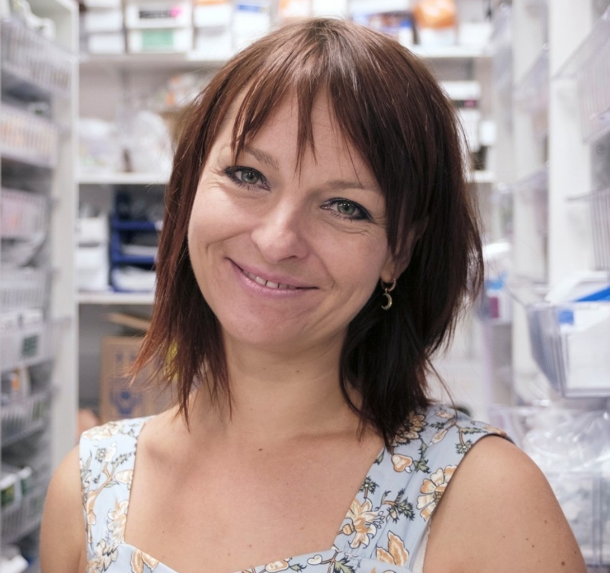
 A blog post by Jurga McLean
What is Pre-Doctoral Fellowship?
A research pre-doctoral fellowship award is a personal award, designed to help the individual grow personally and professionally. We all know about the three P’s right? (Person, Place, Project). I’ve heard many candidates concentrate too much on the project, but all three parts are equally important. Two years ago, I was awarded the Royal Marsden Charity Pre-Doctoral Research Fellowship and that’s when the tables started to turn, albeit very slowly.
Some people may think it is easy to get into such fellowships when working in the world-renowned Cancer Centre in London. And yes, I am feeling extremely fortunate with all the support that I have received so far, but the ride hasn’t been smooth, and I am still very much ’at work’ in building my confidence and trying to trudge my path into the research world. There were many obstacles in my way: a lack of recognition of pharmacists as researchers, a lack of support from some of the senior colleagues and personal barriers such as English being my second language. When I hear other PhD students talking about their projects, I often think to myself ‘one day I will sound just like them, able to articulate my ideas without a hint of hesitation!’ In addition, having an operational role within my department, did not provide me with much flexibility or time to carry out research related activities.
Despite some pros and some cons, tremendous changes took place recently and I wanted to share my story in the hope of inspiring others to believe in themselves and follow their heart. .At least that’s what I am doing, and it seems to be working!
I wanted to share my story in the hope of inspiring others to believe in themselves and follow their heart
Clinical academic qualities
Everyone would probably agree that to choose a career path as a clinical academic you must be slightly on a geeky side of the population spectrum, like to read and write, and do the stuff that many find boring. Well, I must be one and I think it’s about time I make use of my favourite activity.
Every Sunday morning, I would wake up, grab my diary and start pouring my heart out about this and that, sometimes writing six pages in one sitting until I’m ‘done’. I must say that for certain personal reasons I was engaging in this activity quite excessively over the last year, but I think I am ‘done’ now writing my diary, and I want to write about other things that I feel passionate about. Such as writing a blog like this and encourage someone to take their first steps into research.
Where to start when you want to turn the tables?
I have been working as a clinical pharmacist for almost ten years, failing in many attempts to get a promotion to a higher band. In a way, I am quite an extraordinary example of a pharmacist who’s done pretty much all the rotations that are on offer in the Trust. In hindsight, I recognise that I was not doing the job that I love, I did not have a clear vision of my future goals either. The direction started to alter about three years ago when I asked myself what kind of job would give me more purpose in life? Since I already spent about ten years studying pharmacy, I wasn’t too keen throwing it all away and coming up with an alternative profession, such as becoming a yoga teacher or a monk altogether.
A revelation came to me one day that life is only meaningful if we have a vision that is greater than ourselves and we continue growing and inspiring others to do the same. The answer seems to be obvious: without research there is no growth. If all the research in the world would stop today, there would be no new treatments for patients, no discoveries and we would be stuck in exactly the same place for the rest of our lives. Growth is important because it can improve our confidence, happiness, resilience, and success.
Growth is important because it can improve our confidence, happiness, resilience, and success.
So, I gathered my strength and applied for a Pan-London research fellowship and that’s where I met my mentor, who I believe is an angel in disguise, who landed on this planet Earth to save me. And the greatest thing is that the network of people that can advise and support only multiply along the way!
The first interview round I passed and felt really good about myself, only to disastrously fail in the second round with fifteen professors asking me difficult questions about my project that I could not answer and in addition I was competing with other PhD students. I was not surprised when I received a rejection. Everyone says that in the research world it is very common, and you have to be resilient. Well, I must say I have certainly developed that skill over the years!
The approach to failures I have these days is simple: dust off, head up and continue living a happy life because we only get one go at it (in this life at least).
Changing my research question. Twice!
From one failure to another, patiently, without losing my enthusiasm, I finally got there. In 2022 the research internship was in my pocket! It was a great opportunity for me to get my head around what research is, adapt to a new pace of work and to either fall in love with it or not. Only now, when I am in the second year of my Pre-Doc Research Fellowship, I can say that I did. A few personal obstacles were holding me back from accelerating at full capacity from the start.
I must admit, being 100% sure of my research topic (that I will be stuck with for another four to seven years of my life) was not an easy task! I kept changing my mind between two research interests: inequities in cancer or building research capacity and capability for pharmacy professionals. I was and am passionate about both topics, however I decided to attempt to reduce inequalities in healthcare, which coincidingly is one of the WHO’s current global priorities as well.
Don’t underestimate the power of connection
My vision is to bring two of my passions together: integrating research into the pharmacy profession as well as making equality, diversity and inclusion (EDI) strategy into a reality. One of my favourite activities as an early career clinical-academic is connecting with others, building collaborations with people that I would have never met otherwise.
The British Oncology Pharmacy Association (BOPA) is a professional organisation for oncology pharmacists and technicians, and I would encourage more people in joining this amazing organisation, as it really helped me to build my confidence over the years, despite me being shy for a long time and only sitting and nodding in meetings! Being part of BOPA helped me to publish my work, present findings of my research at national conferences and connect to enthusiastic people in this thriving community! Surely other professionals have their own organisations where they can make a difference.
As I have started to trust myself and other people more as well as trust the process, I noticed just how much help is out there!
As I have started to trust myself and other people more as well as trust the process, I noticed just how much help is out there! ‘It’s not about the destination or the journey, it’s about the company’ I’ve heard someone famous said and could not agree more. Linking with people who have similar research interests, sharing experiences and opinions not only helped me to grow in unexpected ways, but also my project has started to take shape, that path that I mentioned I was trudging into research is slowly unfolding right in front of me somehow. Just few days ago I have received another Pre-Doctoral support award to extend my research time and get the Doctoral Clinical and Practitioner Academic Fellowship (DCAF) application ready for the autumn round.
Creating a culture of belonging
Changing direction in life isn’t an easy task. Sometimes it does seem that falling into a victim mode is an obvious solution, but it never is. I found the Royal Pharmaceutical Society’s strategy on embedding inclusivity and diversity into the pharmacy profession thought provoking, as they were asking an interesting question: when will we know that we are truly inclusive? The authors suggesting that it will come when we all feel like we belong, when we are fulfilling our true potential and being our authentic selves. Of course, there is no way to measure this, but I do think that it is crucial that leaders in organisations recognise everyone’s strengths, because we all are different with different sets of skills and capabilities, and it is so important to allow people to sparkle and shine by creating that culture of belonging - that is one thing we all need as human beings as well as doing the job that we love and are good at.
If you've been inspired by Jurga's story, you can find out more about fellowship opportunities within the AHSC by visiting our webpage.
Useful links
Contact us
The CATO Team and Radiographers Incubator work on a Hybrid model, combining days in the office with days working from home – the best way to reach us is by email.
cato@imperial.ac.uk
radresearch@imperial.ac.uk
+44 (0)20 3313 7397
