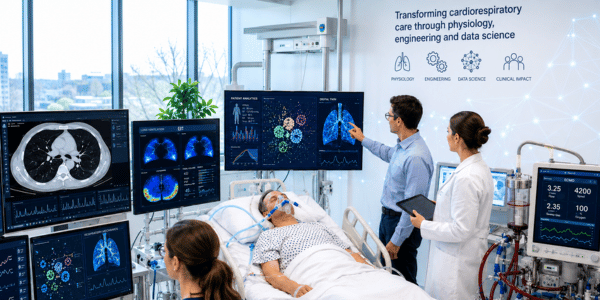
Transforming cardiorespiratory care through physiology, engineering and data science
Group lead
Professor Luigi Camporota
l.camporota@imperial.ac.uk
What we do
Our aim is to improve outcomes for patients with severe cardiac and respiratory failure. Recognising that these are heterogeneous syndromes rather than single diseases is central to our approach.
We therefore individualise support to a patient's own physiology through four connected lines of work:
- Physiological phenotyping of the injured lung: defining subgroups that respond differently to treatment.
- Cardiorespiratory interactions: understanding how spontaneous and mechanical breathing act on the lung, so that ventilatory strategy can be matched to the patients likely to benefit.
- Extracorporeal support (ECMO and extracorporeal CO₂ removal): resting the injured lung to promote healing and to reduce reliance on invasive ventilation and deep sedation, keeping patients awake, breathing spontaneously and able to mobilise.
- Physiology-guided clinical trials: combining detailed bedside measurement with multicentre studies, moving the care of cardiorespiratory failure towards a personalised approach.
Research areas
- Mechanisms of respiratory failure in critical illness and perioperative medicine.
- Respiratory muscle function, breathing mechanics, and the neurophysiology of respiratory drive and breathlessness.
- Personalised mechanical ventilation and respiratory monitoring in critical care.
- Advanced modes of mechanical ventilation.
- Extracorporeal support for cardiorespiratory failure, including extracorporeal carbon dioxide removal.
- Physiological phenotyping of ARDS, with computational and digital-twin modelling.
- Non-invasive and wearable technologies for monitoring cardiorespiratory function.
Accordions
Severe respiratory failure is one of the leading reasons for admission to intensive care and remains one of the highest-mortality conditions in critically ill patients. However, a substantial part of the associated morbidity and mortality arises not from the disease itself, but from the life-sustaining supportive treatments required to manage it.
Mechanical ventilation maintains oxygen and carbon dioxide at levels compatible with recovery, but it also transmits stress and strain to a lung that is already injured, producing further harm. This mechanism has been described using terms such as ventilator-induced and patient self-inflicted lung injury. Tolerance of the endotracheal tube in turn requires deep sedation and immobility, which precipitate delirium, diaphragmatic and skeletal muscle wasting, nosocomial infection and a convalescence that may extend over months to years. Critically, identical ventilator settings may be protective in one patient and injurious in another, because current practice is calibrated to population averages rather than to individual respiratory mechanics. Reducing this avoidable harm and improving both survival and functional recovery, requires a physiologically individualised approach.
An injured lung, like any injured organ, recovers most favourably when it is allowed to rest. Extracorporeal support can provide that rest directly and in the crucial early stages, achieving oxygenation and carbon dioxide clearance across an external membrane. Applied with this intent, it can take on the work of gas exchange, allow ventilatory settings to be reduced, and enable patients to remain awake, breathing spontaneously and be mobile without deep sedation. We hypothesise that this reduces complications, shortens recovery and improves survival.
This remains a hypothesis under active investigation. Determining which patients derive net benefit and building the physiological tools to deliver such support safely, is the central objective of our work.
By individualising treatment to a patient's physiology, we aim to reduce avoidable injury to the lung and to other organs.
Translated into validated bedside tools, this offers three gains: less iatrogenic injury; less sedation and immobility; and the prospect of remaining awake and physically active throughout critical illness, with corresponding improvements in survival and in the completeness of recovery.
Saving Life Awake redefines extracorporeal support not as a last resort for the sickest patients, but to replace invasive mechanical ventilation. Its aim is to rest the injured lung while the patient remains awake and breathing spontaneously, sparing patients from the deep sedation and immobility responsible for much of the lasting harm of critical illness. Across physiological studies, device development and clinical trials, the programme tests the hypothesis that resting the lung while preserving wakefulness reduces injury, shortens recovery and improves survival.
For patients
Our research is organised around five connected strands:
- Physiological phenotyping. Measuring lung mechanics, gas exchange and respiratory drive at the bedside to define subgroups that respond differently to treatment.
- Imaging and bedside monitoring. Electrical impedance tomography and continuous intravascular sensing to make regional lung physiology visible in real time.
- Computational modelling. Patient-specific simulation and digital twins that predict how an individual lung will respond to a change in support.
- Extracorporeal support. Developing and refining ECMO and extracorporeal CO₂ removal to rest the lung with the least possible sedation and invasiveness.
- Multicentre clinical trials. Testing these ideas in patients through national and international networks and adaptive designs.
Current trials include RELEASE and ROMEO , both funded by the National Institute for Health and Care Research, together with UK coordination of the international PANTHER and JULIET trials, delivered through national research networks and adaptive designs.
Tabs
- Funders & industry partners
- Grants, awards & leadership
- Related centres & research areas
- Collaborators
- Clinical trials
- Publications
Funders
- Joan Reece Chair in Critical Care - Professor Luigi Camporota, endowed through a philanthropic gift in memory of Joan Reece
- National Institute for Health and Care Research (NIHR; EME, HTA and i4i programmes)
- Engineering and Physical Sciences Research Council (EPSRC)
- British Heart Foundation
- King's Health Partners
- Royal Brompton and Harefield Hospitals Charity
- European Society of Intensive Care Medicine (ESICM)
Industry partners
- Dräger
- EuroSets
- Getinge
- Hamilton Medical
Selected research grants
- ROMEO: rest or moderate ventilation during ECMO. NIHR EME, Co-Chief Investigator (2024).
- RELEASE: APRV versus conventional ventilation in acute hypoxaemic respiratory failure. NIHR HTA, Chief Investigator (2023).
- Personalised simulation technologies for ICU treatment optimisation. EPSRC (2017).
- Robust, repeatable respiratory monitoring with electrical impedance tomography. EPSRC (2014).
- First-in-man evaluation of a continuous arterial oxygen sensor in critical illness. NIHR i4i (2020).
Scientific and editorial leadership
Current: Associate Editor, Critical Care; member, Scientific Committee, European Society of Intensive Care Medicine (ESICM); member, Legal and Ethical Advisory Group, Intensive Care Society (UK); NHS England clinical panel.
Previous: Associate Editor, Intensive Care Medicine, and Editorial Board, American Journal of Respiratory and Critical Care Medicine; Chair, ESICM Acute Respiratory Failure Section; co-chair, 2023 ESICM guidelines on ARDS; co-chair, ESICM and ERS Task Force on dyspnoea during mechanical ventilation; member, NICE COVID-19 expert advisory subpanel.
Awards and honours
- Lifetime Fellowship of the European Respiratory Society (FERS), 2022.
- National Research Award, UK Intensive Care Society, 2022.
Related centres
- Division of Anaesthetics, Pain Medicine and Intensive Care (APMIC)
- School of Convergence Science Human and Artificial Intelligence
- Data Science Imperial
Related research areas
AI, digital-twin and computational modelling
NIHR Imperial Biomedical Research Centre (BRC)
Diagnostics evidence and adoption
Internal
- Professor Anthony Gordon, Critical Care Trials
- Dr Nandor Marczin, Perioperative Inflammation
- Dr Kieran O'Dea, Translational Critical Care
- Dr Brijesh Patel, Cardiothoracic and Advanced Life Support
- Dr Sanooj Soni, Microvesicles in Acute Respiratory Distress Syndrome
- Professor Suveer Singh, Respiratory Critical Care
- Professor Masao Takata, Molecular Physiology in Critical Care
- Dr Michael Wilson, Respiratory Physiology
- Imperial Clinical Trials Unit
External
- Professor Danny McAuley, Queen's University Belfast
- Warwick Clinical Trials Unit
- Professor Louise Rose, King's College London
- Professor Manu Shankar-Hari, King's College London
- Professor Declan Bates, University of Warwick
- Professor Richard Bayford, Middlesex University
- Professor Andrew Farmery, University of Oxford
- Professor Marlies Ostermann, Guy's and St Thomas' NHS Foundation Trust, King’s College London
- Dr Nicholas Barrett, Guy's and St Thomas' NHS Foundation Trust, King’s College London
- Professor John Fraser, Critical Care Research Group, University of Queensland
- Professor Carol Hodgson, Monash University
- Professor Daniel Brodie, Johns Hopkins University
- Professor Eddy Fan, University of Toronto
- Dr Oriol Roca, Hospital Universitari de Bellvitge, Barcelona
- Professor Ewan Goligher, University of Toronto
- RELEASE. APRV versus conventional ventilation in moderate-to-severe acute hypoxaemic respiratory failure (NIHR HTA). Chief Investigator.
- ROMEO. Rest or moderate ventilation during ECMO (NIHR EME). Co-Chief Investigator.
- NAVA. Neurally adjusted ventilatory assist. Collaborator.
- CoReCCT. (The Confederation of Respiratory Critical Care Trials).
- Reddy K, Sinha P, Antcliffe DB, Camporota L, McAuley DF; PHIND investigators. Bedside identification of subphenotypes in acute respiratory failure (PHIND): a multicentre, observational cohort study. Lancet Respir Med. 2026;14(7):589–600. DOI
- Connolly B, Dickson N, Campbell C, Camporota L, McAuley DF; MARCH investigators. Carbocisteine or hypertonic saline for acute respiratory failure. N Engl J Med. 2026 (in press). DOI
- Zochios V, Brewer JM, Antonini MV, Camporota L, Yusuff H. Extracorporeal life support in adult critically ill patients: mechanisms of benefit in respiratory and cardiac failure. Am J Respir Crit Care Med. 2026 (in press). DOI
- Giosa L, Lubian M, Collins PD, Quintel M, Camporota L. Ventilatory efficiency during weaning from venovenous extracorporeal membrane oxygenation. Am J Respir Crit Care Med. 2026 (in press). DOI
- Grieco DL, Coudroy R, Jonkman AH, Camporota L, Maggiore SM. PEEP and alveolar recruitment after 60 years of acute respiratory distress syndrome. Intensive Care Med. 2026 (in press). DOI
- Saffaran S, Yu H, Shamohammadi H, Camporota L, Bates DG. Computational tools for personalizing treatment of acute respiratory failure, from machine learning to digital twins: a narrative review. Crit Care. 2026;30(1). DOI
- Yu H, Saffaran S, Ali A, Camporota L, Bates DG. In-hospital testing of NIVPredict, an AI tool for early prediction of non-invasive ventilation outcome in acute respiratory failure. Crit Care. 2026;30(1). DOI
- Masi P, Abrams D, Ait Hssain A, Camporota L, Luyt CE; SAVECMO investigators. A consensus of international experts on peripheral ECMO cannula-site infection obtained by the Delphi method: the SAVECMO study. Intensive Care Med. 2026;52(2):263–277. DOI
- Rubulotta F, Camporota L, Mascia L, Biasucci DG. Sex-specific considerations for mechanical ventilation in acute respiratory distress syndrome: a narrative review. Br J Anaesth. 2026;136(4):1387–1392. DOI
- Ball L, Camporota L, Constantin JM. Imaging in ARDS: physiology-guided decisions in the AI era. Intensive Care Med. 2026 (editorial). DOI
- Nieman GF, Bates JHT, Andrews PL, Rose L, Camporota L, Habashi NM. Expert recommendations for setting and adjusting airway pressure release ventilation. Front Med (Lausanne). 2026;13:1741129. DOI
- Gattarello S, Gazzè G, Rollo E, Camporota L, Gattinoni L, Busana M. Albumin kinetics, intravascular fluid volume and respiratory function in pigs ventilated at different levels of mechanical power. Intensive Care Med Exp. 2026;14(1):12. DOI
Selected from more than 300 peer-reviewed publications; citations verified via PubMed. Full list: PubMed.
Our researchers

PI: Professor Luigi Camporota MD PhD FRCP FFICM FERS, Joan Reece Chair in Critical Care
- Clinician-scientist and academic leader in respiratory failure, advanced mechanical ventilation and extracorporeal life support.
- Past Chair of the Acute Respiratory Failure Section of the European Society of Intensive Care Medicine and co-chair of the 2023 ESICM guidelines on ARDS. Associate Editor of Critical Care.
- ORCID ID