At the EYEC, sand is an important part for all our age groups’ development and is provided as part of our core experiences to enhance and enrich the enabling environment both indoors and out.

Exploring textures and shapes through sand play

Little builders experimenting with textures and tools

Curiosity and creativity at work in the sandbox
Learning Through Sand Play
Sand is a simple, natural material with endless opportunities for learning. At the EYEC, sand play is a core experience for all age groups and is available both indoors and outdoors. Children explore sand in wet and dry forms, supported by a wide range of tools and resources that encourage both individual and group play.
Friedrich Froebel, the founder of the kindergarten movement, recognised the value of sand as a natural learning material and introduced sandboxes as part of his “children’s gardens.” He believed children learn best through self-activity, play and direct experience with natural materials. Today, sand continues to hold a central place in early childhood education due to its close connection to nature and its unlimited potential for learning.
Why Sand Matters
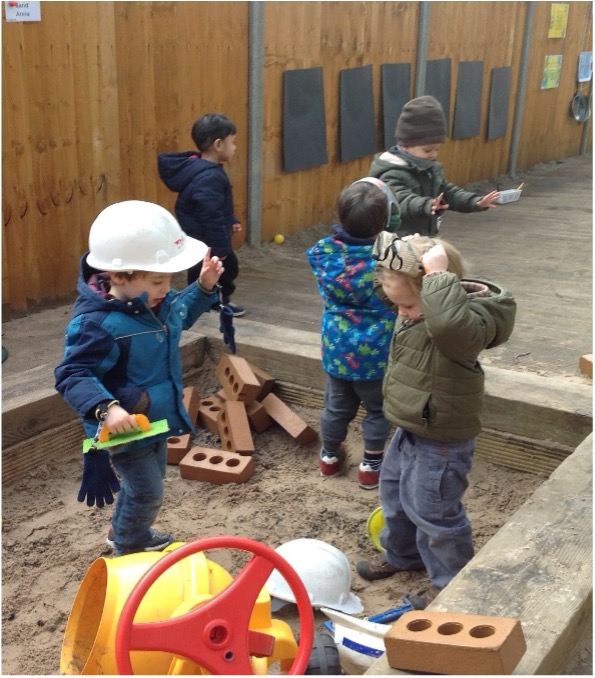 Sand is an open-ended material with no “right way” to use it. This freedom nurtures curiosity, creativity and exploration, allowing children to experiment, problem-solve and develop an understanding of the world around them. While some children may experience sand at the beach or at home, we believe every child deserves equal access to this valuable learning experience. For this reason, each room at the EYEC has its own sand area.
From babies to pre-schoolers, sand offers rich sensory experiences. Babies explore through touch and movement, while older children scoop, pour, build and transport sand, developing coordination, concentration and an understanding of cause and effect. As children grow, sand play supports early mathematical thinking, language development and scientific enquiry through hands-on exploration.
Imagination, Play and Learning
Sand play often develops into imaginative and role play, as children create structures, small worlds or pretend scenarios such as cooking or building homes. These experiences support social skills, communication and confidence. Educational theorist Lev Vygotsky highlighted the importance of imaginative play in children’s cognitive development, recognising that language, thinking and understanding are strengthened as children talk, collaborate and role-play with others.
Our Approach
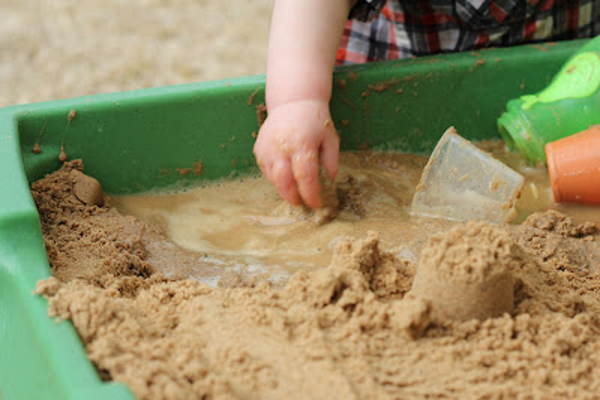 At the EYEC, adults support sand play by providing age-appropriate resources, observing children’s interests and encouraging exploration. Sand play can be both engaging and calming, offering children opportunities to focus, experiment and express themselves. Through these open-ended experiences, children build strong foundations for curiosity, creativity and lifelong learning.