Modified from https://olink.com/products/olink-reveal
Olink Reveal allows high-plex protein analysis with deep profiling of inflammation processes through NGS without the need of additional specialised equipment. The library preparation uses existing lab methods and standard pipetting techniques and requires just 2.5 hours of hands-on time. Reveal offers a broad proteome coverage of over 1000 proteins, refer to Olink Reveal Proteins.xlsx for the full list. Additionally, Olink provide free access to their data analysis tools, more details can be found below.
Please contact Katerina Rekopoulou and Nik Matthews to discuss your project.
Sample Requirements
- Sample type:
Plasma, serum or CSF. Other sample types are also applicable, please contact us to discuss what is feasible. - Number of samples:
1×86 samples or multiples thereof. - Volume of sample needed:
≥30 µL (max 60µl) - Plate design:
Each plate is designed to include 86 samples and 10 controls. The orientation of the plate is by column. The last ten wells (G11-H11 and A12-H12) are reserved for the controls and must be left empty.
Please make sure to use a temperature-resistant, protein-non-binding 96-well plate and seal that are suitable for storage at -80°C. The plate must be a V-shaped well plate.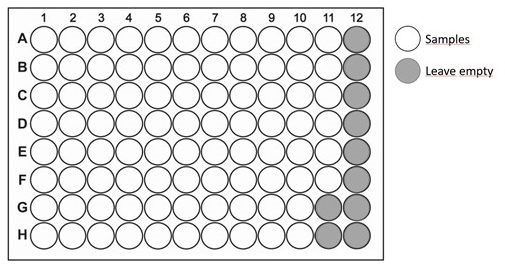
- Randomisation:
Samples must be randomized within and between the plates included in the project. This is done in order to minimize the risk of removing true biological differences during QC and to be able to check for row and column effects. - Standardisation:
The sample preparation procedure is crucial; it is best practice that all samples in the project are of the same type. - Collection of Samples
Collection of Serum Samples:
Collect whole blood into serum collection tubes. Allow the blood to clot at room temperature, which typically takes 15-30 minutes. In samples left for over 60 minutes, the clotting cells may begin to dissolve.
Centrifuge at 1000-2000 x g for 10 minutes in a refrigerated centrifuge (2-8°C) to remove the blood clot.
Immediately transfer the serum to a clean tube/plate; Store at -80°C.
Collection of Plasma Samples:
Collect whole blood into commercially available anticoagulant-treated collection tubes (treated with EDTA, citrate, or heparin).
Centrifuge at 1000-2000 x g for 10 minutes in a refrigerated centrifuge (2-8°C) to remove cells from the plasma.
Immediately transfer the plasma to a clean tube/plate; Store at -80°C.
Although we can run many other types of samples:
plasma
serum
CSF
DBS
EV
Cell supernatant
Cell/tissue lysate
For general guidelines for lysing tissue samples, please refer to Olink Sample Preparation – Tissue Samples.PDF and Olink Lysis and Elution Buffers Recommendations.PDF.
Please note – it is your responsibility to deactivate (please speak to Olink for the best procedure for your sample type, so the proteins are not damaged) any samples you feel could be contagious, even if you do deactivate, we will still require you to create a risk assessment document on the college website. We only run a Cat2 environment, and we are not immunised to Cat3 levels.
Data Analysis
Modified from https://olink.com/software/olink-analyze
Olink provides comprehensive data analysis and data visualisation tools to help researchers uncover biological insights from data.
You can access the Olink Analyze R package on CRAN or GitHub. We personally recommend Github so you receive notifications of updated releases. Or you can download directly into R using the install.package(“OlinkAnalyze”) command.