Contact
Professor Amanda Cross
amanda.cross@imperial.ac.uk
What we do
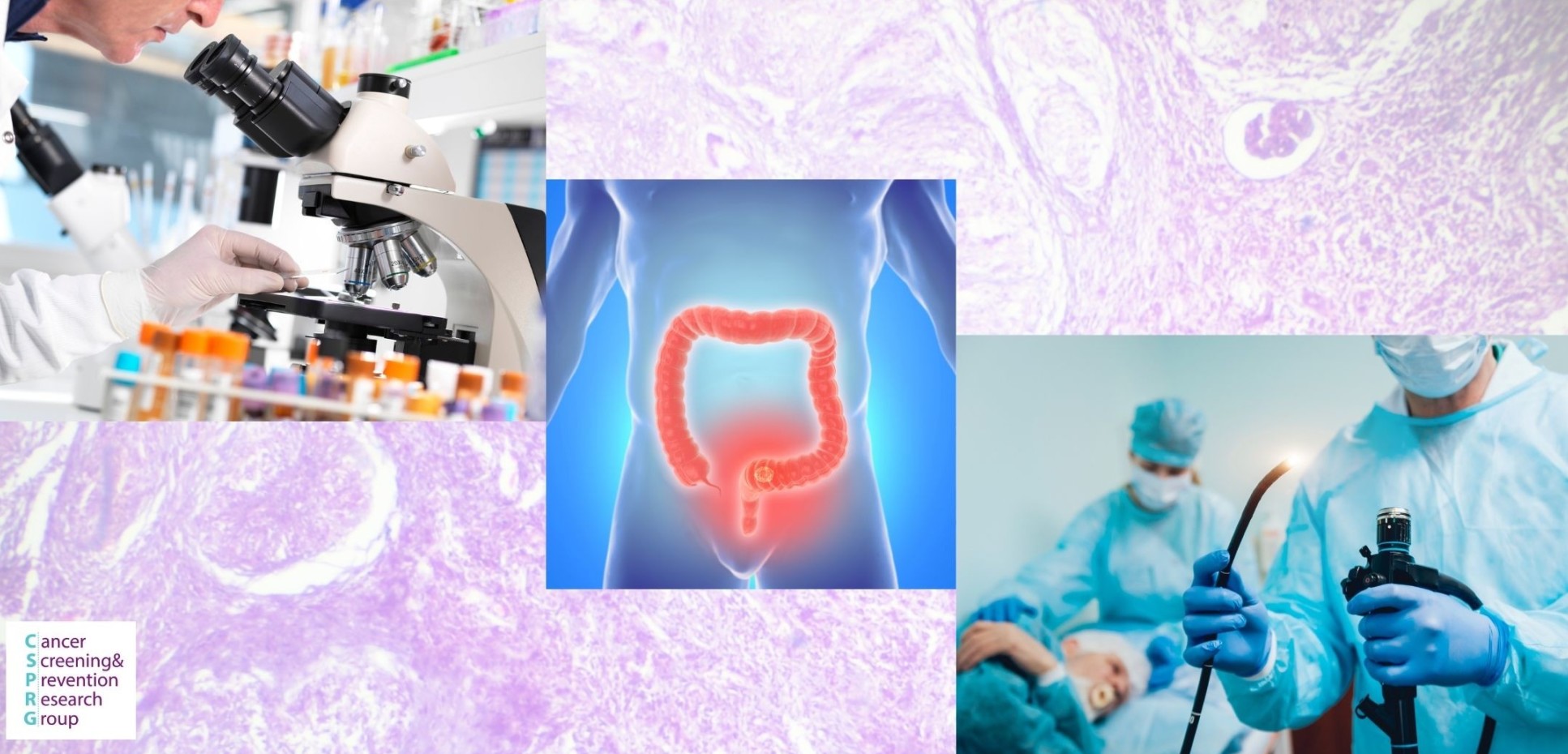
The research focus of the Cancer Screening and Prevention Research Group (CSPRG) is gastrointestinal cancers, such as bowel cancer (also known as colorectal cancer), oesophageal cancer and stomach cancer. We conduct large scale observational studies and clinical trials to reduce the incidence of and mortality from gastrointestinal cancer.
Why it is important
In the UK, over 41,000 people are diagnosed with bowel cancer every year and 16,000 people die from the disease. If diagnosed early, the five-year survival of bowel cancer is very high (~90% for stage I), while a large proportion of cases can be prevented altogether. Stomach cancer is the fifth most common cancer and fourth leading cause of cancer death, worldwide. Only 21% of people are diagnosed at stage I or II, and just one in five patients survive their disease for five years or more. Current screening tests for stomach cancer are invasive, expensive to conduct and early cancers can be missed. A simpler test is needed to improve early diagnosis and prevention. Over 9,000 new cases of cancer of the food pipe (oesophagus), are diagnosed yearly in the UK. Most people will not survive this disease beyond 5 years. This cancer is usually found when it has already spread, limiting what doctors can do to treat it. Understanding how the environment might cause oesophageal cancer can help us to design strategies in the UK and globally to help prevent it.
How it can benefit patients
Through our research we hope to reduce the numbers of people receiving a diagnosis of gastrointestinal cancer and dying from this disease. Much of our work focuses on what we can do to prevent gastrointestinal cancers and how to detect them earlier. In particular, we focus on how we can help make bowel cancer screening and surveillance programmes more effective and acceptable for patients, and more efficient for the NHS, and other health services internationally.
Summary of current research
Establishing air quality field studies in a high incidence region of oesophageal squamous cell cancer – Oesophageal squamous cell carcinoma (OSCC) represents 85% of global oesophageal cancer cases though its aetiology is less well understood relative to the other form of oesophageal cancer, adenocarcinoma (14% of global cases). We are working with researchers in east Africa where OSCC is very common to establish the feasibility of conducting new field studies of environmental exposures which may be driving the high rates of OSCC in the region.
Serologic biomarkers of stomach cancer precursor lesions (GEM study) – GEM aims to examine promising biomarkers for the early detection and diagnosis of stomach cancer. Using patient blood samples, the study will determine whether certain biomarkers may be clinically meaningful precursors to the emergence of stomach cancer.
The Lynch Syndrome (LS) Registry – The LS Pilot Registry aims to create a model for the management of all patients with a high genetic risk of bowel cancer. Through the creation of a national registry of LS patients we hope to: understand how people with LS are being monitored and managed; use the registry to improve timeliness of surveillance appointments and exams for LS patients; raise awareness of LS and promote future research in these patients.
UK Flexible Sigmoidoscopy Screening Trial (UKFSST) – The UKFSST started in 1994 and is still on-going. The main aim was to examine the effect of a once-only flexible sigmoidoscopy screening exam on the future risk of developing and dying from bowel cancer. The results published in 2010 confirmed that the test was both extremely effective and long-lasting in preventing bowel cancer, and led directly to the introduction of flexible sigmoidoscopy screening into the NHS English Bowel Cancer Screening Programme. The study is in long-term follow-up of participants to determine how long the cancer preventive benefit of the test lasts.
The Intermediate Adenoma (IA) study and the All Adenomas (AA) study – The IA and AA studies aim to determine how best people with adenomas, or bowel polyps, should be monitored to protect them from bowel cancer in the future, while minimising the burden of their ‘surveillance’ exams on the NHS. The results from the IA and AA studies played a key role in the update of the 2002 UK post-polypectomy surveillance guidelines to the new 2020 guidelines, and will be vital in informing future iterations.
FIT for Follow-Up – The FIT for Follow-Up study aimed to find out whether annual Faecal Immunochemical Tests (FIT) are accurate enough to replace three-yearly colonoscopy in people undergoing surveillance as a result of having a large polyp, or a few small polyps, removed at baseline colonoscopy. We are continuing to analyse the study data to answer further research questions.
Additional information
- Cancer Research UK – for information about all cancers and cancer research
- Bowel Cancer UK – for information about bowel cancer and support
- Macmillan Cancer Support – for information and support for people living with cancer
Internal
External
- Professor Sir John Burn
- Professor Matthew Rutter
- Professor Colin Rees
- Professor Stephen Duffy
- Professor Stephen Halloran
- Professor Stephen Morris
- Dr Sheraz Markar
- Dr Sally Benton
- Dr Suzanne Wright
- Dr Manuel De Oliveira Gomes
- Dr Gillian Borthwick
- Dr Fiona Lalloo
- Dr Lucy Side
- Dr Christian von Wagner
- Dr Andrew Veitch
- Professor Alastair Gray
- Professor David Weller
- Dr Theodore Levin
- Dr Carol Conell
- Claire Nickerson
- Professor Mark Hull
- Professor Steve Halligan
- Professor William Hamilton
- Margaret Vance
- Carolyn Piggott
- Nicholas Swart
- Professor Eva Morris
- Dr Jan Bornschein
- Dr Matthew Banks
- Professor Sisse Helle Njor
- Sharon Power
- Emma Robbins
- Gemma Mortell
- Nefeli Taravira
Our researchers
Professor Amanda Cross
/prod01/channel_3/media/migration/faculty-of-medicine/amandacross_1613058125293_x4.jpg)
Professor Amanda Cross
Professor of Cancer Epidemiology
Dr Gwen Murphy
/prod01/channel_3/media/images/people-list/Gwen.jpg)
Dr Gwen Murphy
Senior Research Fellow
Rhea Harewood
/prod01/channel_3/media/migration/faculty-of-medicine/rharewood-1_1613149596247_x4.jpg)
Rhea Harewood
Postdoctoral Research Fellow
Emma Robbins
/prod01/channel_3/media/imperial-college/medicine/surgery-cancer/csprg/Emma-400.png)
Emma Robbins
Postdoctoral Research Associate
Mariano Kälfors
/prod01/channel_3/media/imperial-college/medicine/surgery-cancer/csprg/mariano-400.png)
Mariano Kälfors
Project Manager
Kate Wooldrage
/prod01/channel_3/media/imperial-college/medicine/surgery-cancer/csprg/kate-W-400.png)
Kate Wooldrage
Medical Statistician
Paul Greliak
/prod01/channel_3/media/imperial-college/medicine/surgery-cancer/csprg/Paul.png)
Paul Greliak
Clinical Trial Manager
Amy Gowenlock
/prod01/channel_3/media/images/people-list/holding-png-tojpeg-1564655919889-x2_1613058763622_x4.jpg)
Amy Gowenlock
Clinical Trial Coordinator
Salman Shahrezaei
/prod01/channel_3/media/imperial-college/medicine/surgery-cancer/csprg/SHAHREZAEI,-Salman-07.09.2023-3---Copy.jpg)
Salman Shahrezaei
Data Analyst and Software Developer
Kevin Pack
/prod01/channel_3/media/migration/faculty-of-medicine/kpack_1613124836481_x4.jpg)
Kevin Pack
Senior Data Clerk
Will Kay
/prod01/channel_3/media/migration/faculty-of-medicine/will-picture_1620313257067_x4.jpg)
Will Kay
Research Support Officer
/prod01/channel_3/media/images/people-list/COOKE-Heather-24.07.2024-4-(1).jpg)
PhD students
Fangqing Li
/prod01/channel_3/media/imperial-college/medicine/surgery-cancer/csprg/fangqing-400px.png)
Fangqing Li
Kate Wooldrage
Kate Wooldrage
Naveed Hossain
/prod01/channel_3/media/imperial-college/medicine/surgery-cancer/csprg/naveed-400.png)
Naveed Hossain
Nefeli Taravira
/prod01/channel_3/media/imperial-college/medicine/surgery-cancer/csprg/nefeli-400.png)
Nefeli Taravira
Gemma Mortell
/prod01/channel_3/media/images/people-list/gemma-picture_1620313318798_x4.jpg)
Gemma Mortell