UG NoticeBoard
Invitation - Physics Colloquium with Dr Sowjanya Gollapinni, Tues 21 April
Dear all
I am pleased to invite you to attend the next Physics Colloquium:
Event details
Deciphering the Neutrino Sector with the DUNE Experiment
Speaker: Dr Sowjanya Gollapinni, Senior Scientist, Physics Division, Los Alamos National Laboratory
When: Tuesday 21 April, 16:00-18:00
Where: Lecture Theatre 3, Blackett Laboratory, Imperial College London, Exhibition Road, South Kensington Campus, London SW7 2AZ
Abstract
Neutrinos provide a promising window to probe a wide range of fundamental physics phenomena. Neutrino related discoveries in the last two decades indicate that the answer to the most sought-after question of why we live in a matter-dominated universe may be within reach. Although more than a trillion of neutrinos pass unnoticed through our bodies every second, they still remain largely mysterious. These ghostly little particles are notoriously difficult to detect given how reluctant they are to interact with matter and require building immense and exquisitely sensitive detectors. The Deep Underground Neutrino Experiment (DUNE) is a next generation neutrino experiment at Fermilab and South Dakota in United States with primary goals of resolving the neutrino mass ordering and measuring the charge-parity violating phase, the indicator of a possible explanation for our matter dominated universe. DUNE will use the promising liquid argon time projection chamber (LArTPC) technology as it presents neutrino interactions with unprecedented detail. After briefly reviewing the current state of neutrino physics and open questions, this talk will describe the DUNE experiment along with the rich physics that it offers and its current status.
The lecture will run from 16:00-17:00, followed by refreshments from 17:00-18:00 in the Level 2 Foyer of the Blackett Building.
For more information, please visit the event page.
For all event queries, please contactphysicsconnect@imperial.ac.uk
We look forward to seeing you there.
Best wishes
Ellie
StudentShapers project opportunity (with student bursary)
Are you interested in shaping the future of feedback and Generative AI in learning?
Join the FLAIR StudentShapers project to co-create resources on effective feedback and responsible GenAI use with researchers at Imperial. The recruitment advert can be found here.
Submit your interest here (Project name in the form: Enhancing Feedback practise and responsible GenAI use - FLAIR)
📅The deadline for applications is 5pm, Friday 3 April 2026.
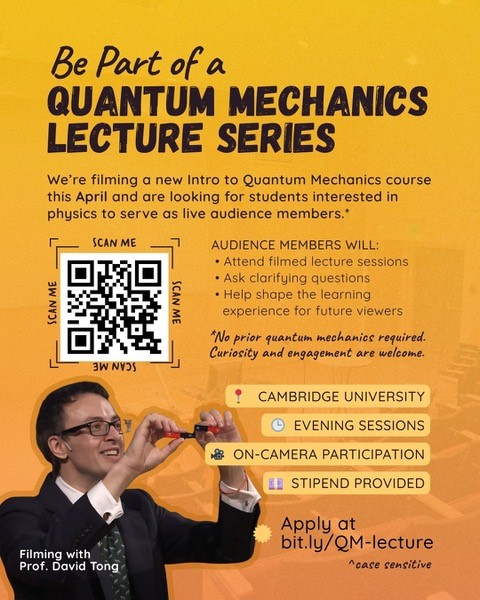
Opportunity to be part of audience for filmed QM lectures in Cambridge with David Tong (paid!)
Hall Senior Recruitment at Woodward Halls

REC Student Survey
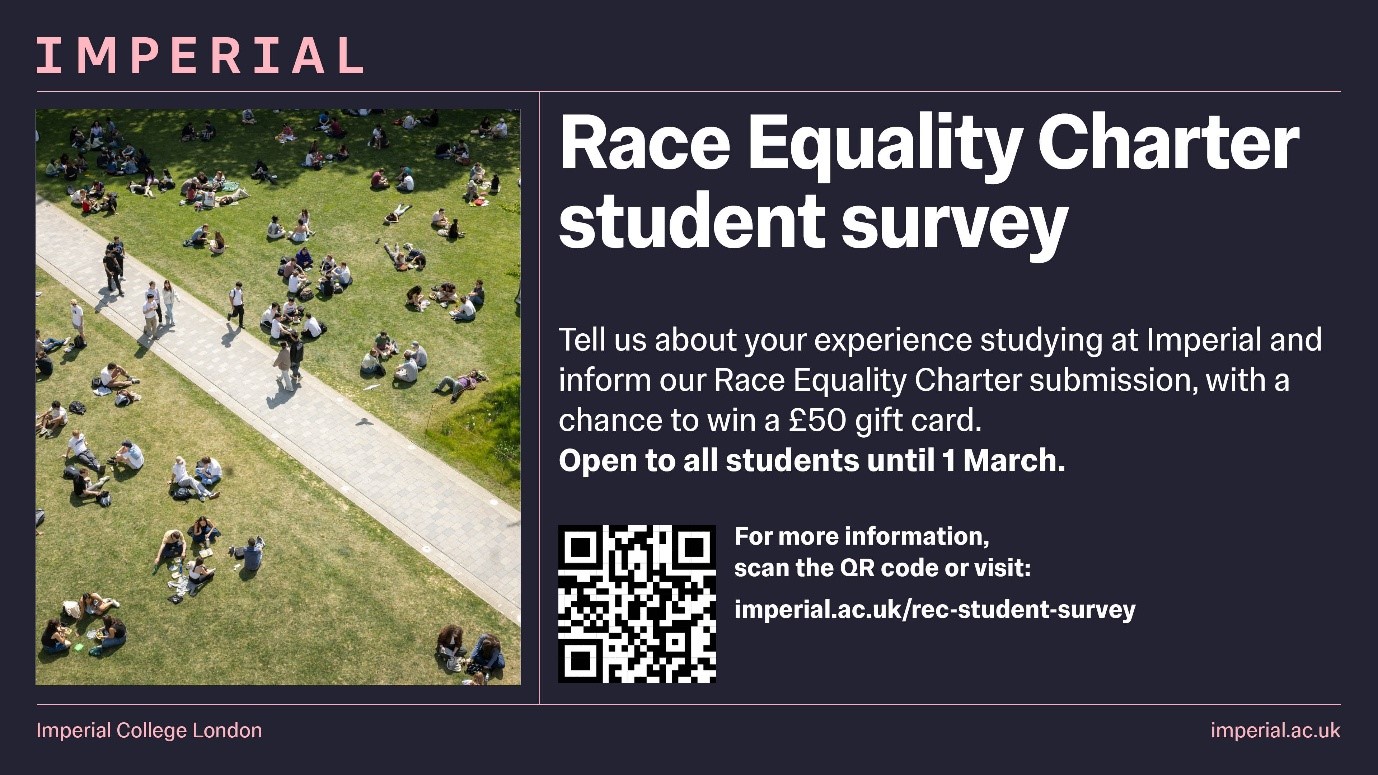
The survey should take less than 10 minutes and you have the chance to be entered in a prize draw for one of five £50 Love2Shop e-Gift cards which can be used in over 45 online high street shops.
The survey contains 20 multiple choice questions and is open to every student at Imperial, from all ethnicities. The more responses we receive, the better we can form a picture of how Imperial is supporting our students from Minority Ethnic backgrounds, where we can do better and what further initiatives we can explore in future.
The last REC Student Survey took place in 2019 and directly informed the launch of the Presidential scholarships for students of Black heritage, The Imperial as One Media Academy which delivers expert communications training for minority ethnic staff and students, the Shifting the Lens photo series inn partnership with the Royal College of Art. More information on many other projects Imperial has committed to as part of its race equality work, along with additional information is available on the REC Student Survey webpage.
Thank you in advance, your survey answers are very much appreciated and will help us shape a more equitable and inclusive university.
Anique Varleigh, REC SAT Co-Chair
Wayne Mitchell, REC SAT Co-Chair
Alex Dawes, REC SAT Coordinator
ADHD Speaks For Itself: An authentic learning resource on ADHD
The interviews can be done in-person or online, and the form in which it will be presented (Video, audio only, or text only) is up to your preference. You can even choose to remain anonymous. If you're interested or just want to find out more, please fill in the form attached!

100 seat study space at the Abdus Salam Library
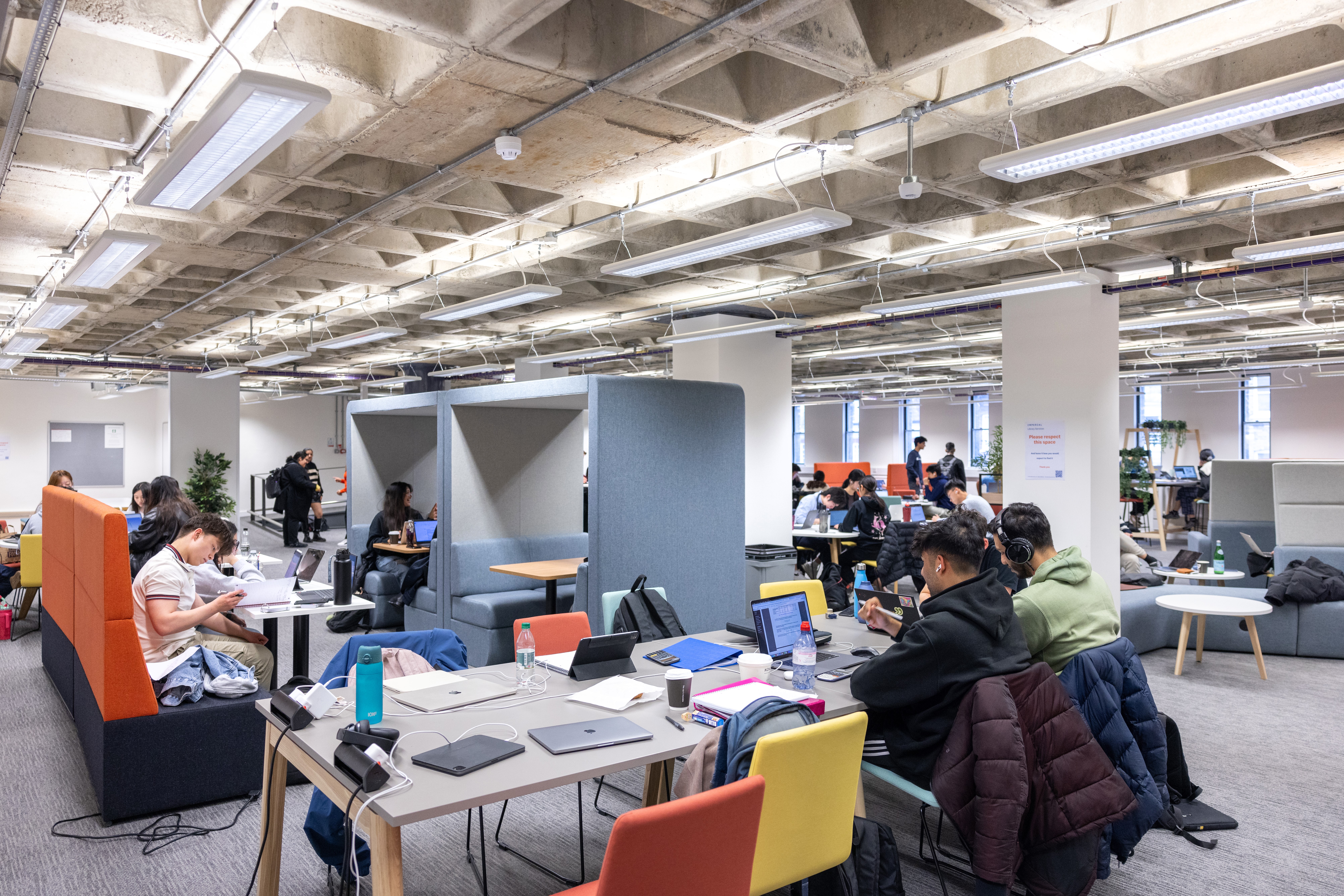
Library Services are pleased to announce the opening of a new Group Study Space on level 4 of the Abdus Salam Library. The area features over 100 study spaces in an array of different types of furniture such as 2, 4 and 6-seater meeting pods, standing desks and moveable furniture.
Whilst the main study furniture is bespoke and brand-new, we were very happy to be able to re-use a number of reclaimed whiteboards, a printer and a table and benches in the ‘tea-point’.
The ‘tea-point’ also includes a hot water boiler and cold vending machines.
Later in the year we will be adding to this space by opening two bookable group study rooms on the same floor.
We look forward to welcoming you to the space soon and please send your feedback to library@imperial.ac.uk.
Entrepreneur Masterclass: Customer Engagement and Protecting IP, Tues 24 March
I am pleased to invite you to the first of a new series of quarterly Entrepreneur Masterclass events, showcasing the commercial journeys of successful physics-based innovators.
Speaker: Graham Woodgate
When: Tuesday 24 March, 17:30-19:30
Where: Level 8 Common Room, Blackett Laboratory, Imperial College London, Exhibition Road, South Kensington Campus, London SW7 2AZ
Speaker
Graham Woodgate, is a serial technology entrepreneur, prolific inventor and physicist. He was a co-founder of Ocuity (3D) and Optovate (microLED) both pioneering companies in optical displays which were successfully sold to large corporates. The optical innovations he has co-created, protected, developed and commercialised over the last 30+ years have shipped in tens of millions of display products, including most recently privacy screens for HP laptops.
Graham will relate his experiences on both customer engagement and the importance of protectable IP. There will be an opportunity before and after Graham's talk to network with other common-minded colleagues and to talk with the speaker.
This event will include pizza’s, beer and wine.
For more information, and to register to attend, please visit the event page.
Please note: due to limited capacity, registration is essential through the link in the event page.
For all event queries, please contact p.may@imperial.ac.uk
Bridges - Leadership Development Programme
We’re recruiting 4 Faculty of Natural Sciences undergraduate students to work on an 8-week paid summer project (£3,256 bursary) to co-create a new Bridges Leadership & Skills Development Programme.
During the project, you’ll work with staff and students to explore how the Bridges Programme can support students from underrepresented identities beyond first year, helping design opportunities that build leadership skills, confidence and a stronger sense of belonging at Imperial.
It’s a great opportunity to develop skills in programme design, collaboration and student engagement while making a real impact on the student experience.
Deadline: 5pm, Wednesday 8 April 2026
Apply: via the StudentShapers “Student Expression of Interest” form on their website.
The dynamics of Earth’s magnetopause and their space weather impacts
Application deadline: 30 June 2026
Start date: 26 September 2026
Funded PhD Project (UK Students Only)
About the Project
This PhD project will probe the coupling and interplay between the solar wind and magnetosphere at its interface, the magnetopause, in new ways to understand not only the fundamental space plasma interactions but also elucidate how these impact upon our global space environment leading to space weather effects that can affect our everyday lives and society.
The ESA-CAS SMILE mission, due to launch imminently, will image the dayside magnetosphere for the first time in soft X-rays from solar wind charge exchange. Since X-ray emissions are expected to peak at the magnetopause, SMILE offers the possibility of remote sensing magnetopause dynamics for the first time. Through leveraging other spacecraft and ground-based instruments, these can then be linked to the effects felt within geospace and on the ground. This exciting new capability offers many possible opportunities in determining the large-scale response of the first link in the geospace processing chain that ultimately leads to space weather.
You will work in the context of international collaborations and the wider multi-national mission and instrument teams. Depending on your interests and skills, there will be opportunities to be involved with:
- Processing and analysing cutting-edge SMILE remote sensing soft X-ray data to track the magnetopause’s motion for the first time
- Undertaking global simulations of the solar wind – magnetosphere interaction using the Gorgon magnetohydrodynamic code developed at Imperial for interpreting SMILE observations
- Leveraging constellations of in situ spacecraft observing conditions within the solar wind and magnetosphere, linking these to one another and SMILE observations
- Analysing globally distributed ground-based measurements of auroral, ionospheric, and geomagnetic processes to determine how space weather effects arise from the dynamics in space
- Developing magnetohydrodynamic theory and numerical models underpinning these observations
This project is highly centred on data analysis, computer programming, and data visualisation. Experience with these will be vital. It will also leverage advanced interdisciplinary signal processing and machine learning methods, which it would be an advantage for you to have some familiarity with. Knowledge of basic plasma or space physics would also help, but is not necessarily required upon application.
For more information, please contact Dr Martin Archer (m.archer10@imperial.ac.uk).
Please refer to the following website for details on how to apply: https://www.imperial.ac.uk/space-and-atmospheric-physics/postgraduate-studies/phd-opportunities/
Funding Notes
This project is fully funded by the Department of Physics at Imperial College London for students with ‘home’ fee status. The studentship is available via a competitive process. The successful candidate will receive full funding for tuition and stipend. Due to the nature of the funding available, ‘overseas’ and self-funded students are not eligible.
Grantham Institute Funded PhD Position
Grantham Institute – Climate Change and the Environment
Department of Physics
PhD Post in Geophysics (Imperial College, South Kensington campus)
Funding: Home fees only and stipend (3.3 years)
Project title: Melting Greenland’s Ice Sheet from Above and Below: Earth’s Mantle as a Ground Source
Heat Pump
Supervisor: Dr Fiona Simpson
Co-Supervisors: Dr Fred Richards, Dr Jonathan Kingslake
Description
Greenland’s ice sheet is melting at an alarming rate. This has impacts on greenhouse gas emissions
through the exposure of wetlands and sea level rise, both of which drive climate change feedback
mechanisms. Atmospheric warming of the surface of the ice sheet due to climate change is the main
factor. However, heating from Earth’s mantle by a hypothesised mantle plume ascending from the coremantle
boundary adds to the regional heat budget to which the base of the ice sheet is also exposed
and may also lead to melting at the base of the ice sheet, promoting slip.
In this PhD, we will combine complementary ground-based geophysical and satellite-based earth
observation datasets and use modelling techniques to investigate the sensitivity of the Greenland ice
sheet to the mantle heat pump by constraining the thermal state of the mantle below Greenland and
assessing the effect of basal sliding, subglacial streams and basal topography on the evolution of the
Greenland ice sheet using ice flow models.
The student will receive training in geophysical and earth observation techniques, geophysical
fieldwork, data management and science communication, areas within which the Natural
Environmental Research Council (NERC) has idenfied skills gaps. They will be expected to present their
research at national and/or international conferences. They will also engage in the associated PhD
training and activities of the Grantham Institute for Climate Change and Environment and the
Department of Physics or Department of Earth Science and Engineering.
Requirements:
- First-class or very strong 2:1 degree (or international equivalent) in geophysics, physics or
applied mathematics.
- A strong grounding in numerical modelling.
- Good English writing and verbal communication skills.
- Experience with scientific programming and data analysis.
- Excellent organisational and time management skills.
- High degree of self-motivation and interest in geophysics and glaciology.
- Curiosity driven with ability to think independently and critically.
- Willingness to contribute to geophysical fieldwork.
- Clean driving licence.
Funding: The studentship will provide funding for tuition fees at the level of Home (UK) students and
a tax-free stipend at the standard UKRI London rate (£22,780 pa for 2025/26). The funding can also be
used to partially support an international student, combined with private resources or scholarships.
How to apply:
Enquiries and applications should be made to Dr Fiona Simpson at f.simpson@imperial.ac.uk with the
following materials in a single PDF file (under 20 MB):
- Cover Letter explaining your motivation and suitability, including details of any prior research
activities
- CV
- Undergraduate and masters grades and class rankings (if any)
- If relevant, English testing results, i.e. IELTS or TOFEL
- Details of two academic referees (including name, affiliation, and email address).
Review of applications will begin immediately and continue until the position is filled
PhD project at Imperial College London:
Molecular Simulation of Nanoparticle Synthesis for Battery Materials with Artificial
Intelligence Surrogate Models
Nanoparticle synthesis is a process for manufacturing nanoparticles that can be used as
advanced materials such as battery electrodes. To be suitable for their targeted use, the
nanoparticles need to be produced with controlled particle size and morphology. In the
process we are looking at, aerosol spray pyrolysis, the precursors are injected within
droplets and the nanoparticles are formed via crystallisation as the solvent evaporates.
It has been found that, under different conditions, the particles produced have different
morphologies, which have profound impact on the particle properties. However, we do
not know the physical mechanisms that determine these morphologies. In this project,
we aim to use molecular dynamics (MD) in order to study the fundamental
physicochemical processes that take place within the droplet while the solvent
evaporates and find a mechanistic explanation for the experimental observations based
on what happens at the molecular level.
MD simulations capable of resolving crystallisation and morphology evolution require
system sizes and timescales that become computationally prohibitive with conventional
force fields or direct quantum mechanical calculations. To overcome this, the project
will develop and deploy machine-learned interatomic potentials, which are artificial
intelligence (AI) surrogate models trained on quantum mechanical data that retain near
ab initio accuracy while enabling simulations orders of magnitude faster. The objective
is to establish a predictive framework linking molecular-level dynamics to
experimentally observed nanoparticle morphologies.
The project offers full funding for a home student and is supported by the Centre for
Doctoral Training (CDT) in Aerosol Science. The CDT offers also a comprehensive
programme of training courses in various aspects of aerosol science, an industry
placement, a 3-month sabbatical at another research group and several workshops and
other activities for interaction with academic and industrial partners. You can find out
more here:
https://www.aerosol-cdt.ac.uk The student will enrol at Imperial College London for the PhD degree.
Please contact the principal supervisor, Dr Stelios Rigopoulos (s.rigopoulos@imperial.ac.uk), for more information, while applications are handled via the CDT link above. The project is co-supervised by Prof. Greg Offer (Imperial College
Electrochemical Science and Engineering Group) and Prof. Simone Hochgreb (University
of Cambridge). Other collaborators include Prof. Kai Luo (University College London) and
CPERI (Chemical Process & Energy Resources Institute, Thessaloniki, Greece).
FindAPhD Advert - Quantum Sensing Theory for Cosmology
Dr Sebastian Ellis at King's College is advertising a PhD position to work on quantum sensing protocols for the detection of dark matter and gravitational waves from October 2026. The link to the job is here: https://www.findaphd.com/phds/project/quantum-sensing-theory-for-cosmology/?p193715.
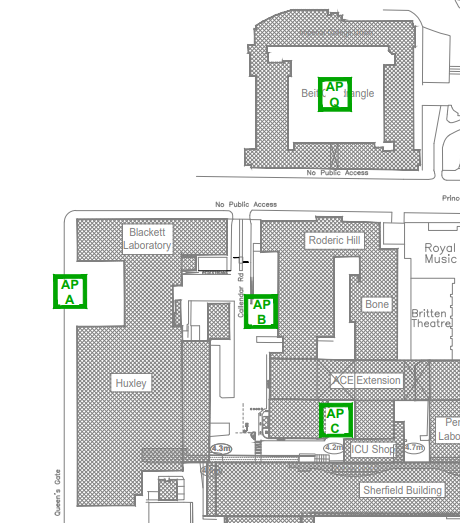
Fire evacuation assembly points for Blackett & Huxley
Dear all,
Thank you for the feedback provided following the triggering of the fire alarm in the Blackett Building last Tuesday. Please see below for the assembly points that should be used when evacuating from Blackett (points A or B) and Huxley (points A or C). You must use the nearest escape route which may not be the same route you normally use. For example, in Blackett there are the east and west stairwells which connect floors 0-7, in addition to the main stairwell which connects all floors. Always use the break glass to release exit doors and keep roads clear in case emergency vehicles need access.
Further information on fire safety can be found here: https://www.imperial.ac.uk/estates-facilities/health-and-safety/fire-safety/