
Powering the future from the ground up
To meet the global green energy targets, the number of offshore renewables projects has to increase dramatically over the next two to three decades. Offshore wind is one offshore renewable option, with wave and tidal expected to grow in importance as technology matures.
This course will provide you with offshore data experience and exposure to industry. It will take you through a curriculum that will enable a deepening of knowledge and skills associated with cutting-edge data science, AI, machine learning and associated computational and observational techniques, and their application to characterisation of the subsurface for renewable energy applications. The programme is currently supported by a number of companies in the Renewables sector who have contributed to curriculum development and will form an industry advisory board to ensure skills being taught match those required for the energy transition.
Find the most recent course information and specifications on the Imperial MSc READY course page.
/filters:format(webp)/prod01/channel_3/media/imperial-college/faculty-of-engineering/earth-science-and-engineering/earth-science-general/2000-x-2000-(2).png)
As renewable energy projects expand, there is a growing demand for specialists who can integrate geoscience expertise with machine learning and data science to characterise sites accurately, reduce uncertainty, and optimise resource development. This programme prepares graduates to apply AI-driven approaches to complex subsurface and environmental datasets, supporting smarter, faster, and more sustainable energy solutions. Dr Rebecca Bell MSc READY Course Director
Course Information
The Renewable Energy with AI and Data Science: Geology and Geophysics (READY) MSc programme is one of four computational programmes in ESE. The study programme consists of taught modules, mini projects, and one individual research project.
You can see the teaching schedule represented visually below. If you would like an accessible version of this information, please contact ESE webmaster.
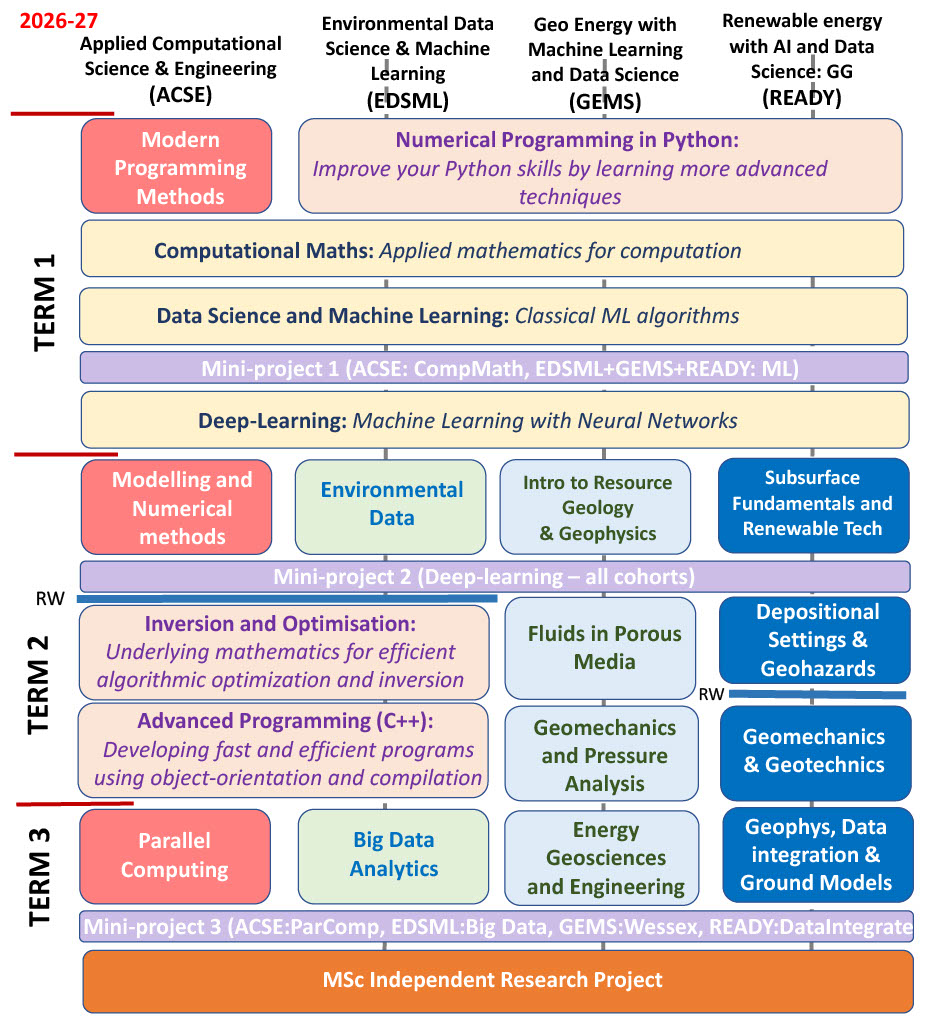
Based on previous cohorts of students from our existing suite of MSc progammes, approximately one-third go on to further study either another MSc programme or a PhD.
The other two-thirds work mainly in industry. The principal employers of graduates from this programme will be the growing renewables industry, including the companies who have already joined the consortium for curriculum development. After graduation, you could also find employment in large data and computer companies, consultancies offering services to the energy industry and working on natural geo-hazards, and the wider energy industry.