
Join our international community of talented students and world-leading researchers on a mission to help us live better, healthier, smarter and more sustainably.
Inside EEE - take a tour with with Bhavya
On the Sofa with the Department of Electrical and Electronic Engineering
Studying EEE at Imperial - meet our staff and students.
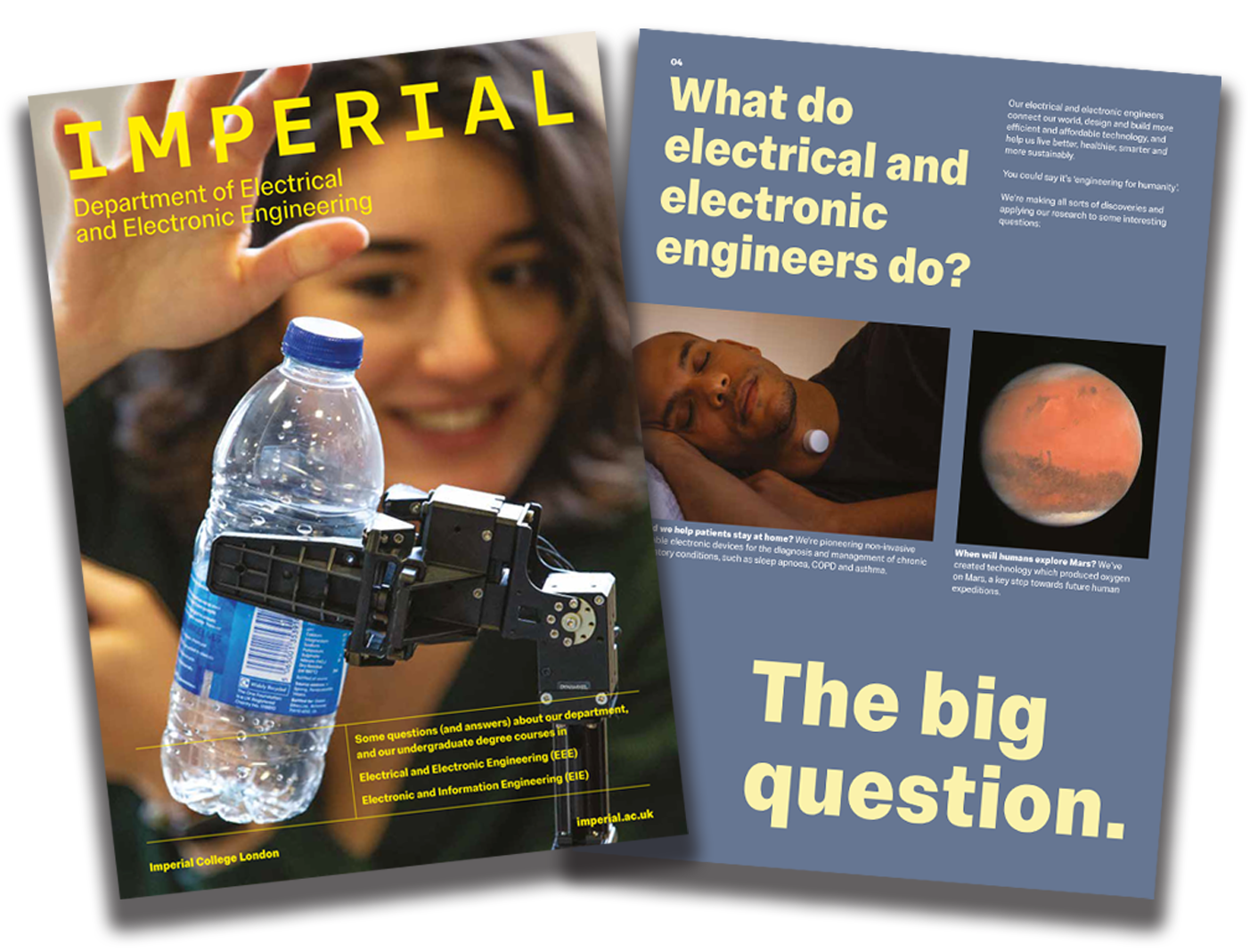 We are a world-leading centre for electrical and electronic engineering, shaping the future of energy, healthcare, smart technology, security and communications.
We can take you to some surprising places — under da Vinci's paintbrush, inside human DNA, or the atmosphere of Mars.
We’re creating the technology that powers modern life, and advancing the science to drive innovations we haven’t imagined yet.
Your choice of degree courses and pathways
Our teaching is led by our research strengths and focuses on inspiring and supporting tomorrow’s industry-ready engineers.
We offer MEng and BEng degrees across two main subject areas:
- Electrical and Electronic Engineering (EEE)
- Electronic and Information Engineering (EIE)
Your first year of undergraduate study is designed to give you room to explore the breadth of electrical, electronic and information engineering topics, so you can take your time to choose a route that fits your developing skills and interests and make a really informed decision between the main subject degree paths.
Find out more


Welcome to our department


Electrical and electronic engineering right now is characterised by its fast-evolving and inter-disciplinary nature, driving innovation across unlimited applications, and making it such an exciting and rewarding place for creative and talented problem-solvers.
What’s the difference between EEE and EIE subjects?
EEE: Everything that involves electrons and electromagnetism – from transistors, sensors, actuators, and wireless communication systems to electrical power systems and more.
EIE: Anything with computers – from microprocessors to mobile phones, laptops to servers and networks of servers.
EEE and EIE: Whichever pathway you choose, you’ll learn the software design and coding skills essential for creating all today’s technology.
EEE and EIE

Electrical and Electronic Engineering (EEE)
EEE degrees cover the entire spectrum of subjects from nano-devices in integrated circuits for signal processing, to high power renewable energy systems in a smart power transmission grid.

Electronic and Information Engineering (EIE)
EIE degrees combine modules from electronic engineering with computer science and information engineering.


