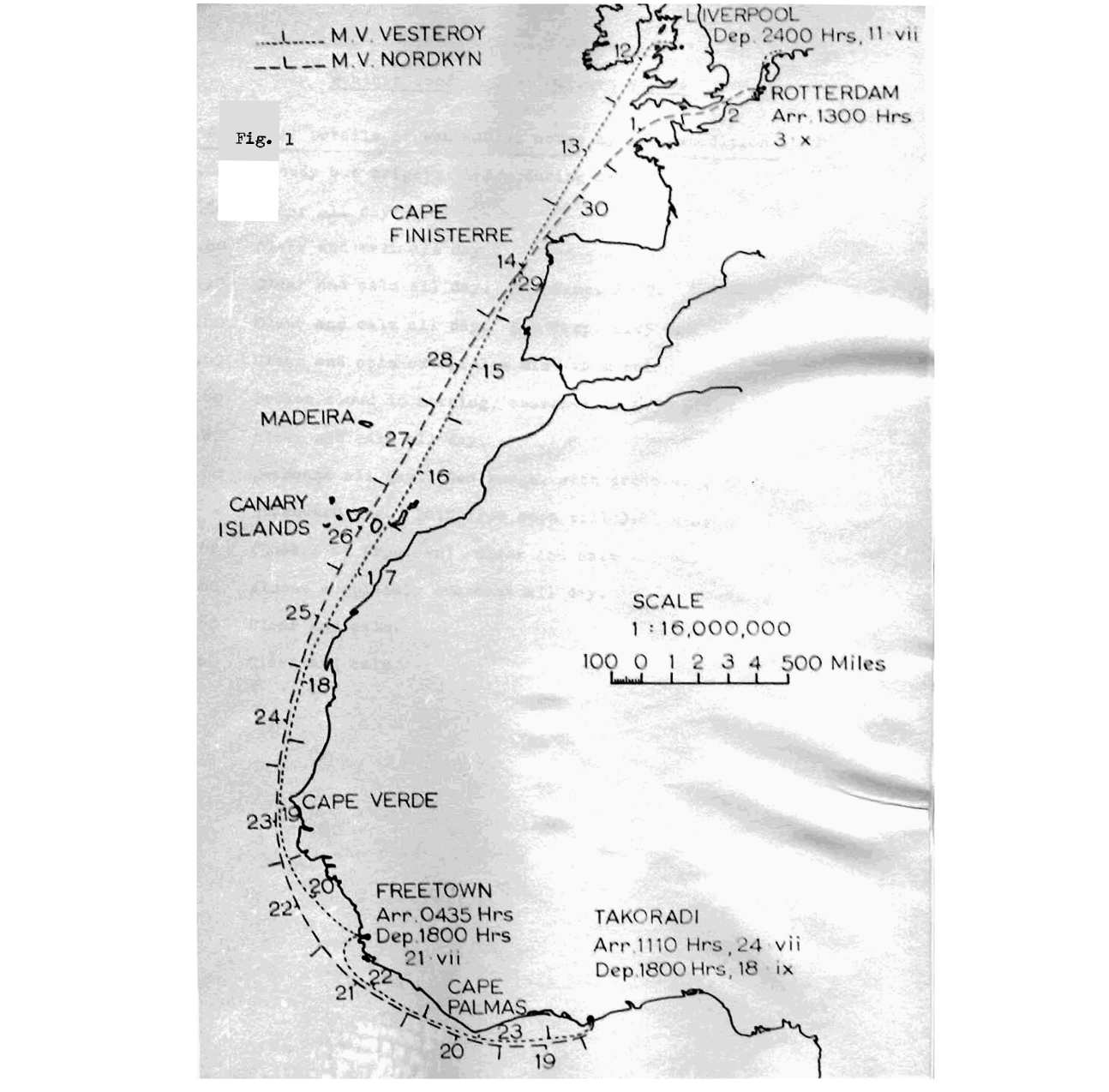
This expedition investigated the physical conditions inside ships’ holds during the transport of cocoa and other West African produce, and examined how these conditions influence insect infestation. This work followed earlier expeditions in 1957 and 1958 that highlighted how temperature, humidity, cargo arrangements, and ventilation affect pest survival and growth during voyages between West Africa and Europe.
The 1960 expedition aimed to measure temperature and humidity in multiple ship holds, assess residual insect populations, compare infestation levels at loading and unloading, and evaluate the impact of fumigation or chemical treatments. However, logistical constraints—such as last‑minute ship assignment, port labour strikes, limited access to holds, and the ship’s unexpected diversion to continental ports—prevented most work except the physical measurements.
Detailed temperature and humidity readings were taken on both outward and homeward voyages. Results confirmed earlier findings that temperatures rise toward the centre of the ship and near engine‑room bulkheads, reaching up to 37°C in cocoa and over 40°C in copra. Diurnal solar heating affected the shelter deck strongly but had limited impact deeper in the holds. Unlike previous expeditions, vertical temperature gradients were inconsistent, likely due to partially filled holds and strong cooling effects from the sea. Humidity remained generally high (70–90%), conditions favourable for stored‑product insects.
Moisture‑content measurements showed variation across stacked cocoa bags, with higher moisture near hatch covers and deeper in stacks—patterns influenced by compression, ventilation, and condensation. Observations at Takoradi docks indicated improved warehouse design and fumigation procedures under the Ghana Cocoa Marketing Board, though risks of cross‑infestation persisted when fumigated and unfumigated consignments were stored nearby.