The 1963 Malta Expedition, jointly organised by the R.N. Engineering College (Manadon), R.A.F. St. Mawgan, and Imperial College London, aimed to investigate submerged sea caves around Malta, Gozo, and Comino. Motivated by reports from local divers and the absence of formal documentation on Maltese underwater caves, the expedition sought to locate, describe, and survey these formations, with particular interest in their geological origins and potential archaeological significance.
The programme focused on confirming existing cave reports, discovering new examples, and classifying them in relation to Pleistocene sea‑level data. A combination of aerial reconnaissance and systematic underwater searches was employed. A helicopter survey of the southwest coast identified concentrations of surface caves, while daily diving operations from an anchored vessel enabled methodical exploration of submerged cliff sections. Divers recorded cave dimensions, sketched their forms, and undertook detailed examinations of promising sites.
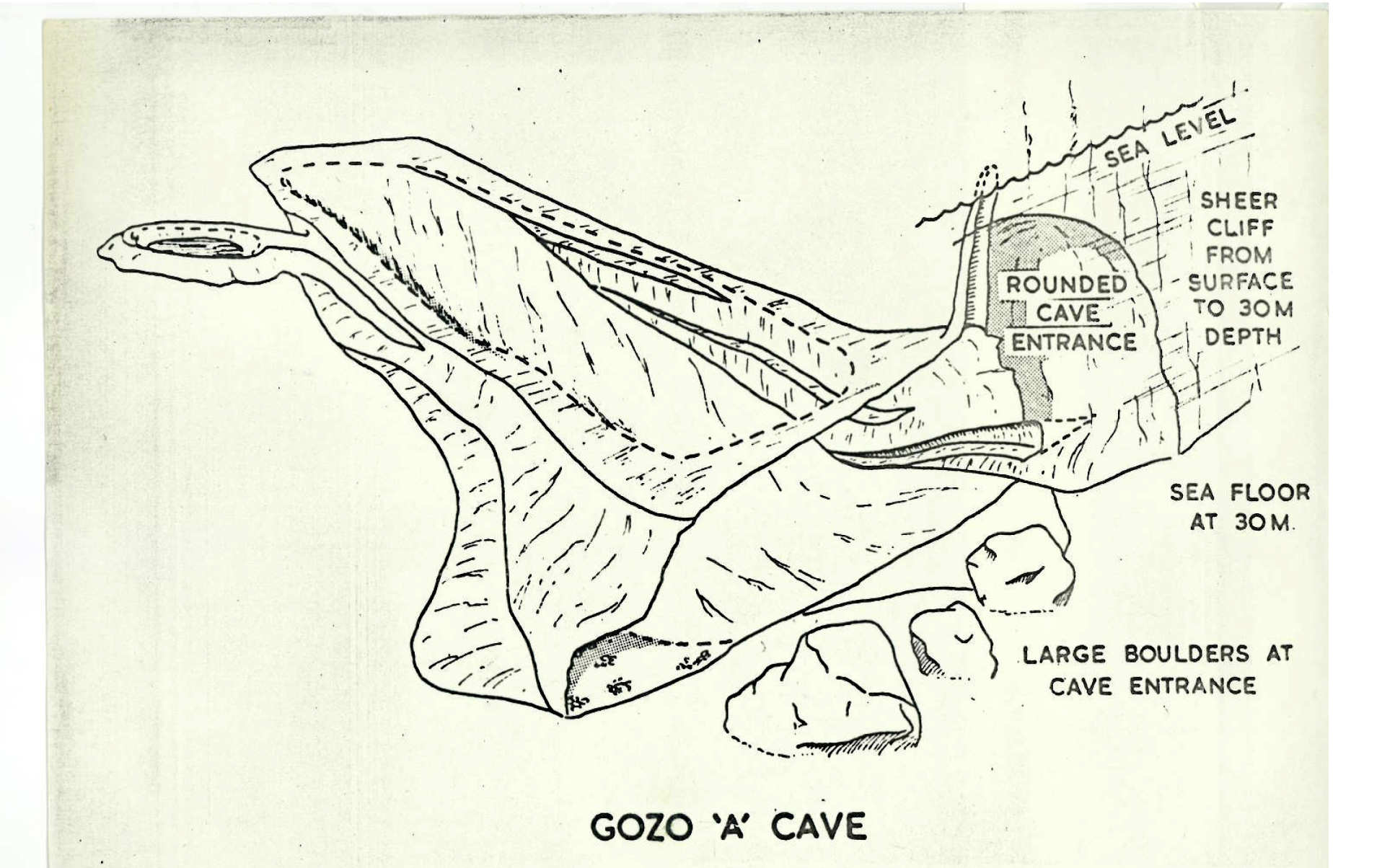
The most significant discovery was the large underwater cave designated Gozo “A”, which received five days of intensive study. A fixed axis line allowed divers to collect precise depth and range measurements, producing vertical and horizontal sections used to model the cave’s structure. Gozo “A” exhibits a broad, rectangular profile, deep sediment deposits, extensive marine growth, and well‑preserved internal wave‑cut notches, marking it as one of the largest submerged caves yet reported.
Overall results revealed numerous caves of varying sizes, shapes, and developmental stages. Many formed along faults or bedding weaknesses, while larger examples showed substantial horizontal expansion before submergence halted further growth. The expedition concluded that Malta’s submerged caves represent a uniquely dense and accessible resource for studying coastal geomorphology, marine ecology, and potential prehistoric environments.