The 1966 East Greenland Expedition set out to explore and climb previously unattempted peaks in the Schweizerland region, particularly around the Paris Glacier near Mount Forel. The eight‑member team combined experienced mountaineers with students and aimed to conduct both mountaineering and glaciological research. Planning began in 1965, but delays in permissions and logistics, including arranging an airdrop of equipment, shifted the expedition to summer 1966.
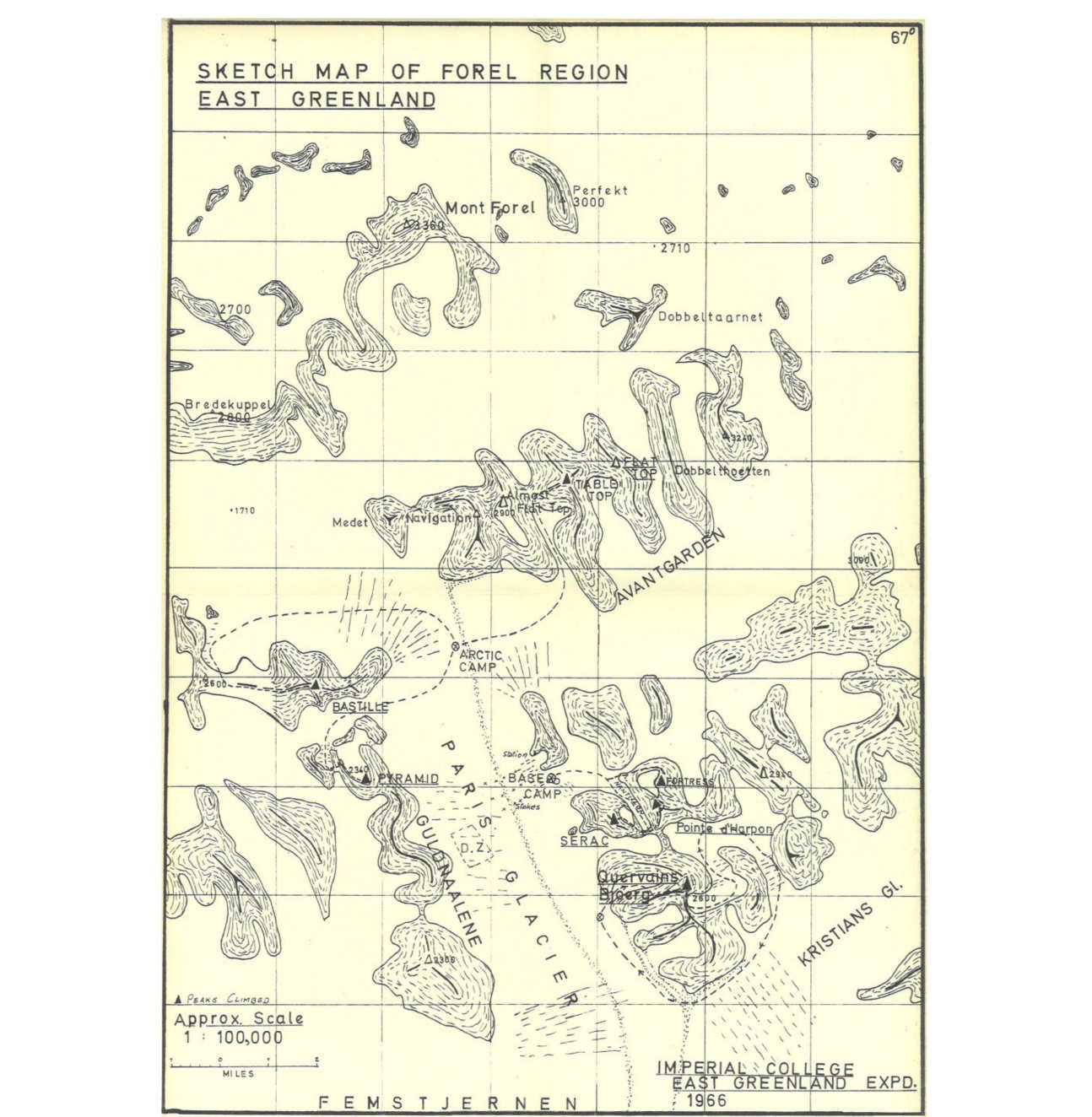
Because the area is about 70 miles inland, access posed a major challenge, and previous expeditions had failed to reach the Paris Glacier using sledges alone. The team therefore used a military‑style airdrop of food, fuel, and equipment from an Icelandair DC‑3, with an advance party marching in early to receive the supplies. Bad weather delayed their arrival, and many parachuted loads were blown into crevasses, requiring extensive recovery efforts. Base Camp, “Fortress Camp,” was established on a rocky outcrop above the glacier.
Despite injuries and severe weather during the return, the mountaineering programme was highly successful. Seventeen peaks were climbed, including Pointe d’Harpon, de Quervain’s Bjerg, Bastille, Pyramid Peak, Fortress Peak, and Serac Peak. Many routes involved long, complex glacier approaches, difficult ridges, bivouacs, and mixed rock‑ice climbing comparable to Alpine “difficile” (AD) grades.
Glaciological work included resistivity measurements to estimate glacier depth, involving electrode arrays and high‑voltage equipment, and a detailed surface‑flow survey using theodolites and stakes across the glacier. Results suggested a glacier depth of about 400 m and provided data on deformation and ablation. The return journey was complicated by storms, deep snow, sledge damage, and difficult crevasse terrain, but the expedition ultimately reached the coast and returned via Eskimo boat and Icelandair. The expedition achieved its scientific and mountaineering goals despite considerable adversity.