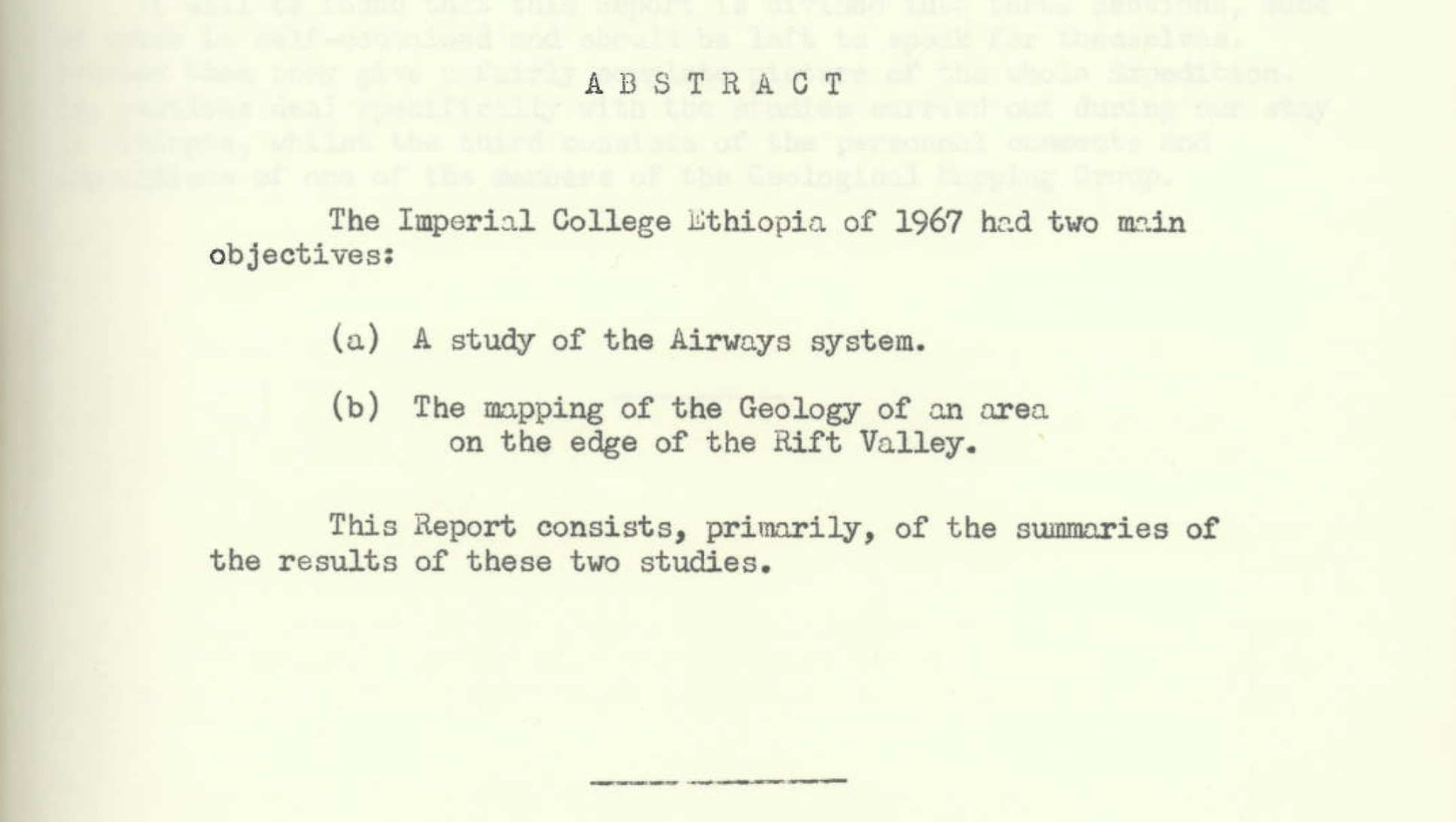
This expedition to Ethiopia pursued two main scientific objectives: a study of Ethiopia’s airways system and geological mapping south of Dire Dawa, on the edge of the Rift Valley. These goals were selected to address gaps in existing knowledge—particularly the limited mapping of the region’s Jurassic geology and the lack of systematic assessment of domestic air transport infrastructure.
The expedition divided into two specialist groups. The aviation team, assisted by Ethiopian contacts, compiled extensive data on airfields, passenger patterns, freight movements, road competition, and projected growth across Ethiopia’s Southern, Red Sea, Northern, and Western regions. Their findings highlight how geography, seasonal rains, military activity, poor road networks, and tourism shaped regional air traffic. The report provides detailed route‑by‑route statistics, growth forecasts, and assessments of infrastructure limitations such as runway gradients, obstacles, and operational constraints at dozens of airfields.
The geological team conducted five weeks of field mapping near Dire Dawa, supported by aerial photographs. They documented Precambrian basement gneisses, Jurassic limestones and sandstones, multiple intrusive phases—including basic sills, dyke systems, and distinctive fine‑grained white intrusions—and localised contact metamorphism. Structural analysis revealed major east‑west normal faults forming the southern boundary of the Afar Depression and additional north–south faults influencing landscape geometry. The team also recorded caliche/tufa deposits and noted limited economic potential, aside from small limestone and building‑stone quarries.