Summary
Kalmaegi was the most powerful typhoon landfalling in Vietnam in 2025. For this rapid study the IRIS model estimates that climate change increased the maximum wind speed by 3%, eyewall rain by 8.6% and the economic damage in Vietnam by 9%. Kalmaegi was about 33% more likely or frequent because of climate change.
| Maximum wind speed | Eyewall rainfall rate | Economic damage | |
|---|---|---|---|
| +1.3°C (2025) | +3% | +8.6% | +9% |
| +2.0°C | +7% | +19% |
+26% |
Table 1. Changes of maximum wind speed at landfall, eyewall rainfall rate at landfall and the Vietnam economic damage relative to the pre-industrial baseline for typhoon Kalmaegi.
Background
Typhoon Kalmaegi was Category 4 with a reported life-time maximum wind speed of 210 km/h in the South China Sea. Kalmaegi’s rainfall caused extensive damage in the Philippines and Vietnam. Kalmaegi was a Category 3 typhoon at landfall in Vietnam on the 6th of November 2025.
The IRIS model (Sparks and Toumi, 2024) is used to infer the additional strengthening of a “Kalmaegi” type storm that can be attributed to recent warming or more specifically to changes in potential intensity (PI). For the warming scenarios the observed changes in potential intensity are scaled by the global mean surface temperature as described by Sparks and Toumi (2025).
Maximum wind speed at landfall
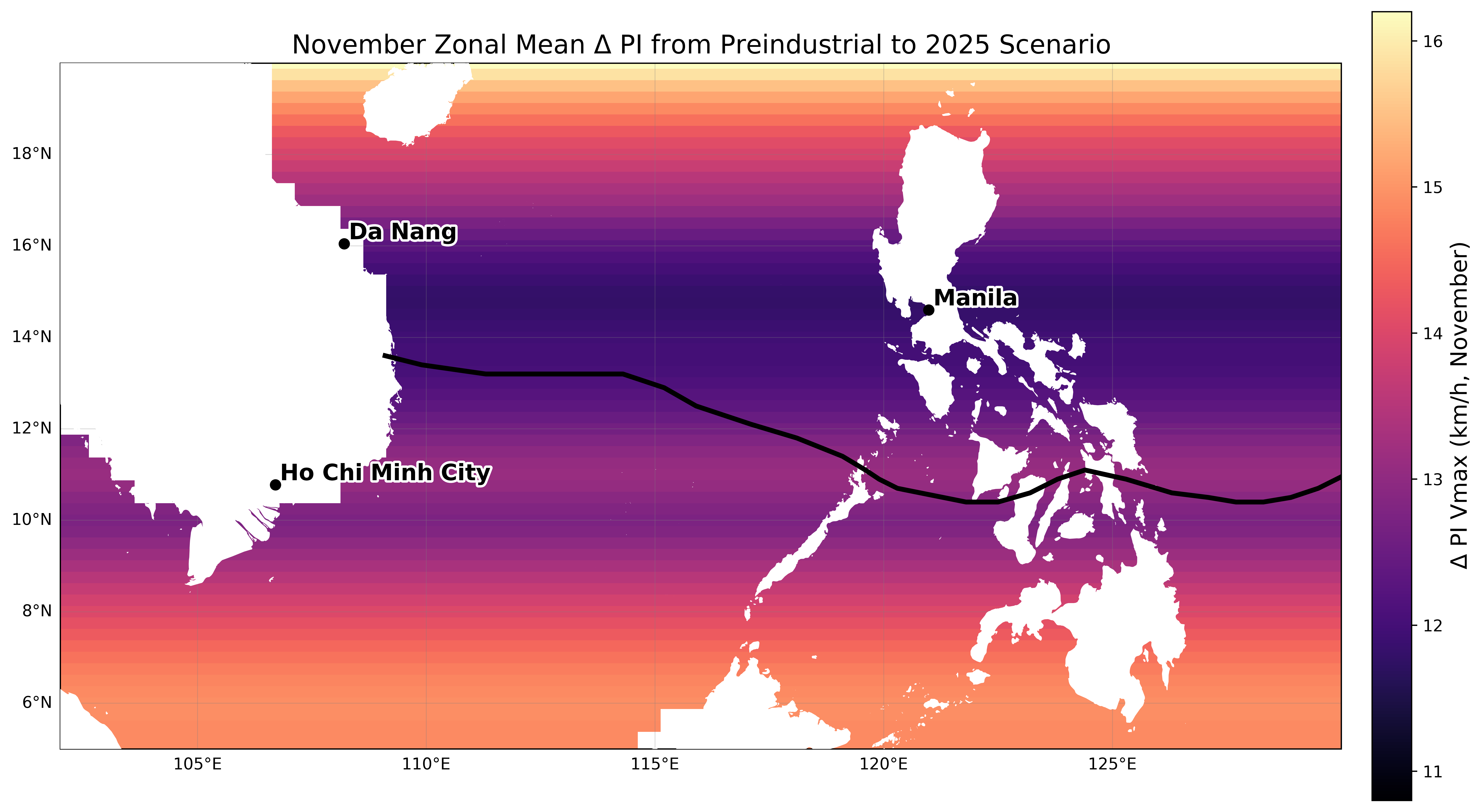
Figure 1 shows the zonal mean difference in November PI between 2025 and the pre-industrial estimate. The PI difference between 2025 and pre-industrial is about +13 km/h in the South China Sea. The frequency of landfall is the next consideration. The IRIS model calculates the intensity along the observed storm tracks for a 100,000 year simulation.
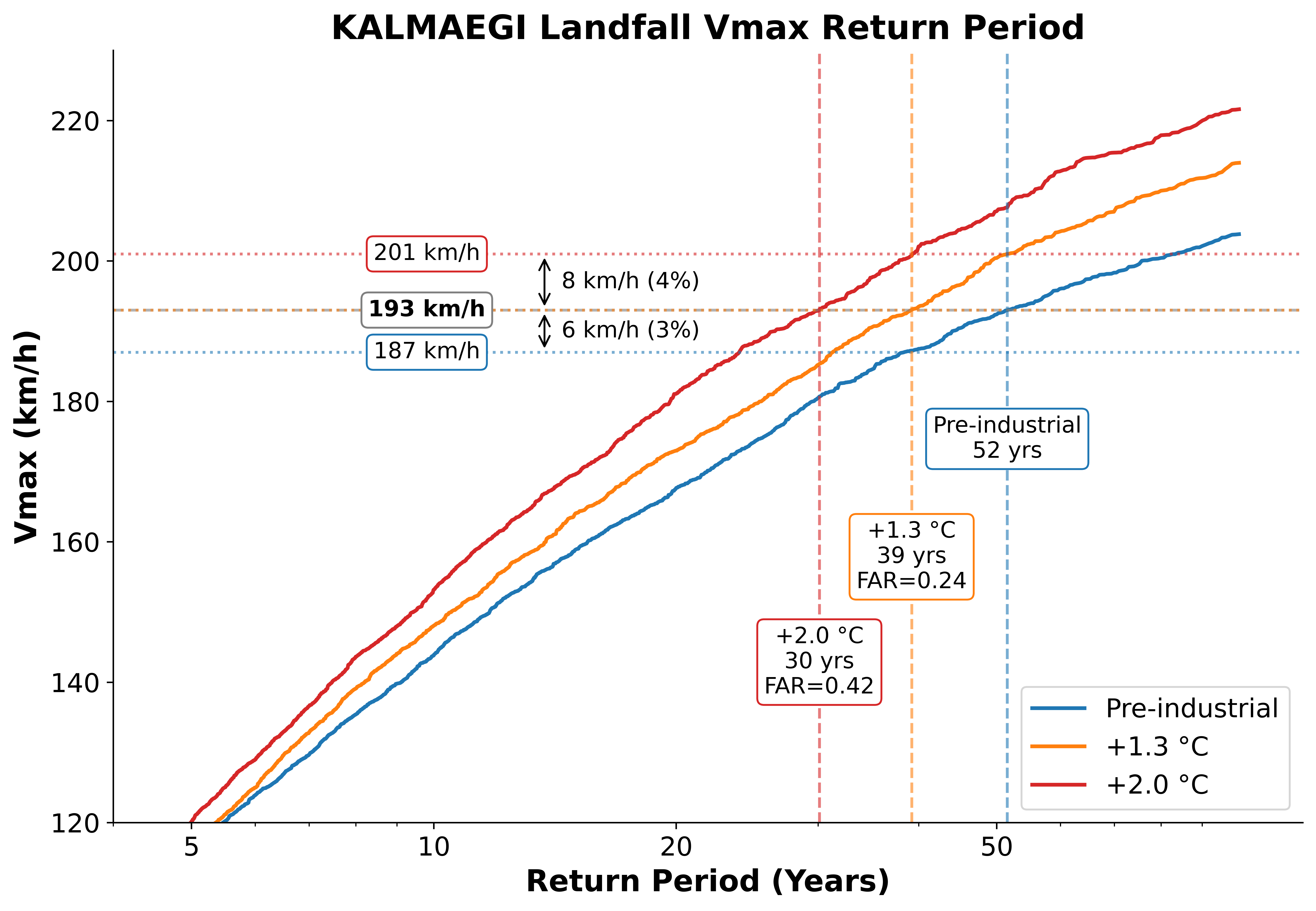
Figure 2 shows the model return period plot for typhoon landfall wind speeds in Vietnam. In the case of Kalmaegi, a Category 3 at landfall, we estimate that this type of event was 33% more likely or frequent compared to pre-industrial times. For the same return period, the current wind speed compared to pre-industrial events has increased by 6 km/h or +3%. In a +2°C degree warmer world, the landfall wind speed increases by a further 8 km/h or +7% compared to pre-industrial.
In the climate change attribution literature the fractional attributable risk, FAR, is frequently used. FAR is here defined as:
|
FAR = (Pnow - PPre-Ind) / Pnow |
(1) |
|---|
where Pnow and PPre-Ind are the probabilities of an event of the minimum intensity for the current (now) and pre-industrial (Pre-Ind) climate respectively. The FAR for “Kalmaegi ” type is 0.24. This means that at least 24% of the likelihood of this type of event can be attributed to climate change.
Eyewall rain rate at landfall
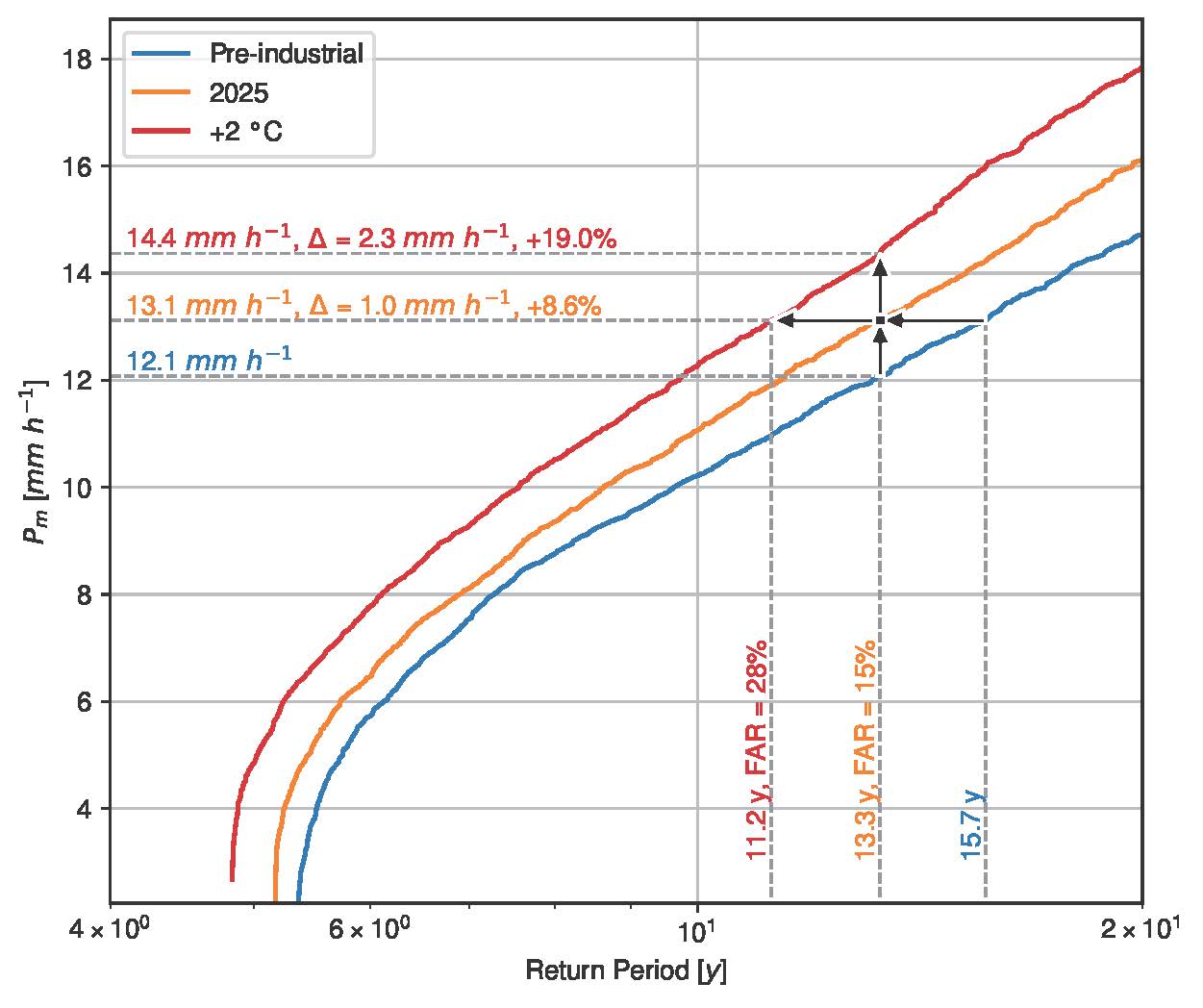
We also calculate the change of the typhoon eyewall rain rate as described by (Lau et al., 2025). The observed value of 13.1 mm/h is calculated as the maximum azimuthal mean rain rate at landfall from IMERG. Figure 3 shows the model return period of typhoon eyewall rain rate (maximum azimuthal mean) for central Vietnam. We estimate that this type of event was about 18.0% more likely compared to pre-industrial times. The return period has decreased from 15.7 yrs to 13.3 yrs. For the same return period the current rain rate compared to pre-industrial events has increased by 1.0 mm/h or 8.6%. In a +2°C degree warmer world, the landfall eyewall rain rate increases by a further 1.3 mm/h, which amounts to a 19.0% increase compared to pre-industrial events. The FAR for “Kalmaegi ” type rain rate is 0.15. This means that at least 15% of the likelihood of this type of event can be attributed to climate change.
Attributing economic damage
We make an estimate of economic damage on physical assets. Wind is used as a proxy for tropical cyclone hazard and the damage function indirectly accounts for the other perils such as storm surge and flood. We combine reported wind fields with damage functions (Eberenz et al. 2021) and 10 km gridded exposure adjusted for population growth and inflation (Eberenz et al. 2020). To estimate the damage uncertainty we simulate thousands of damages following the track by varying the damage function with a half-damage wind speed (range of 35-85 m/s), wind speed (+/-18 km/h), exposure (+/- 25%).
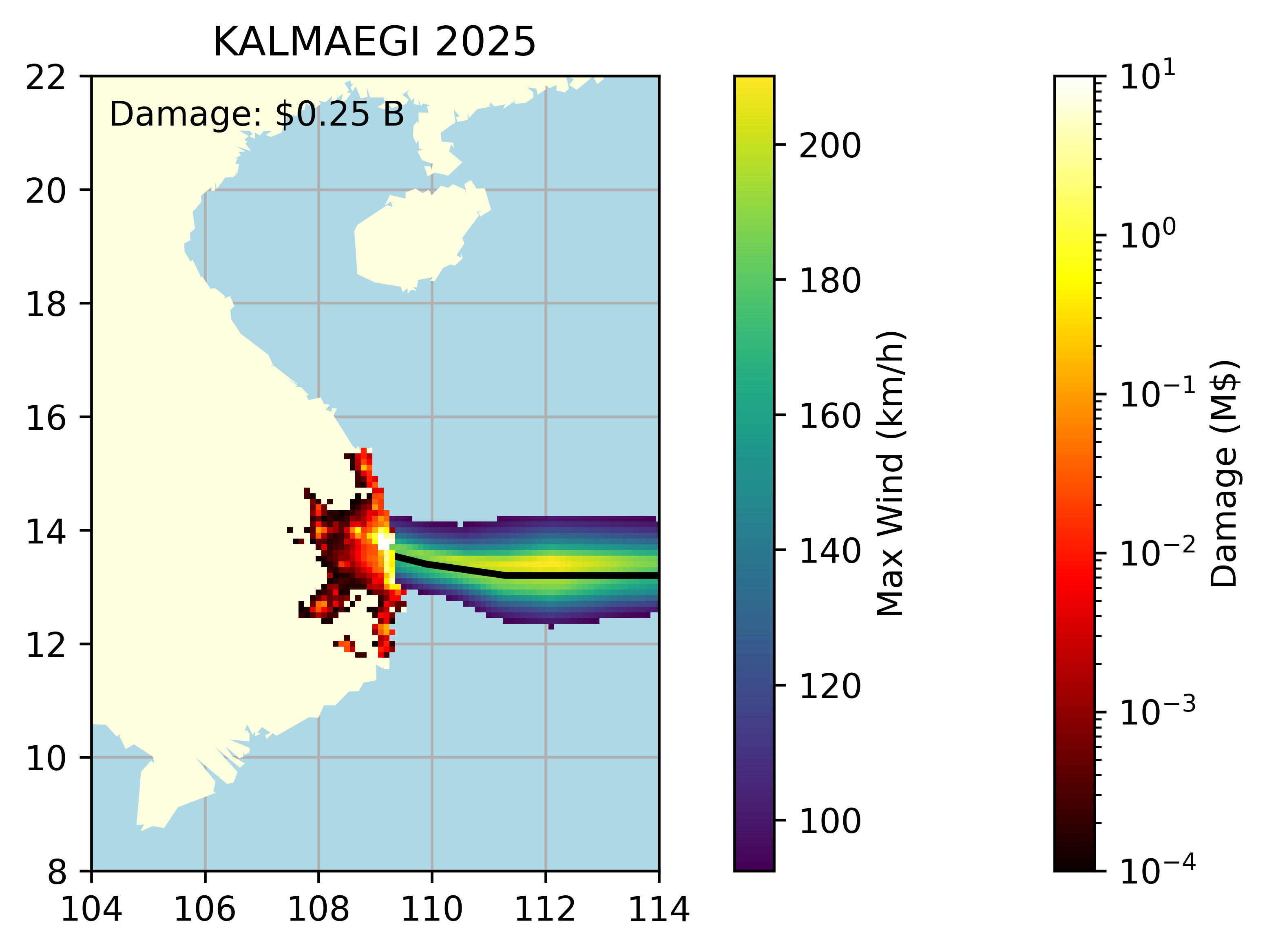
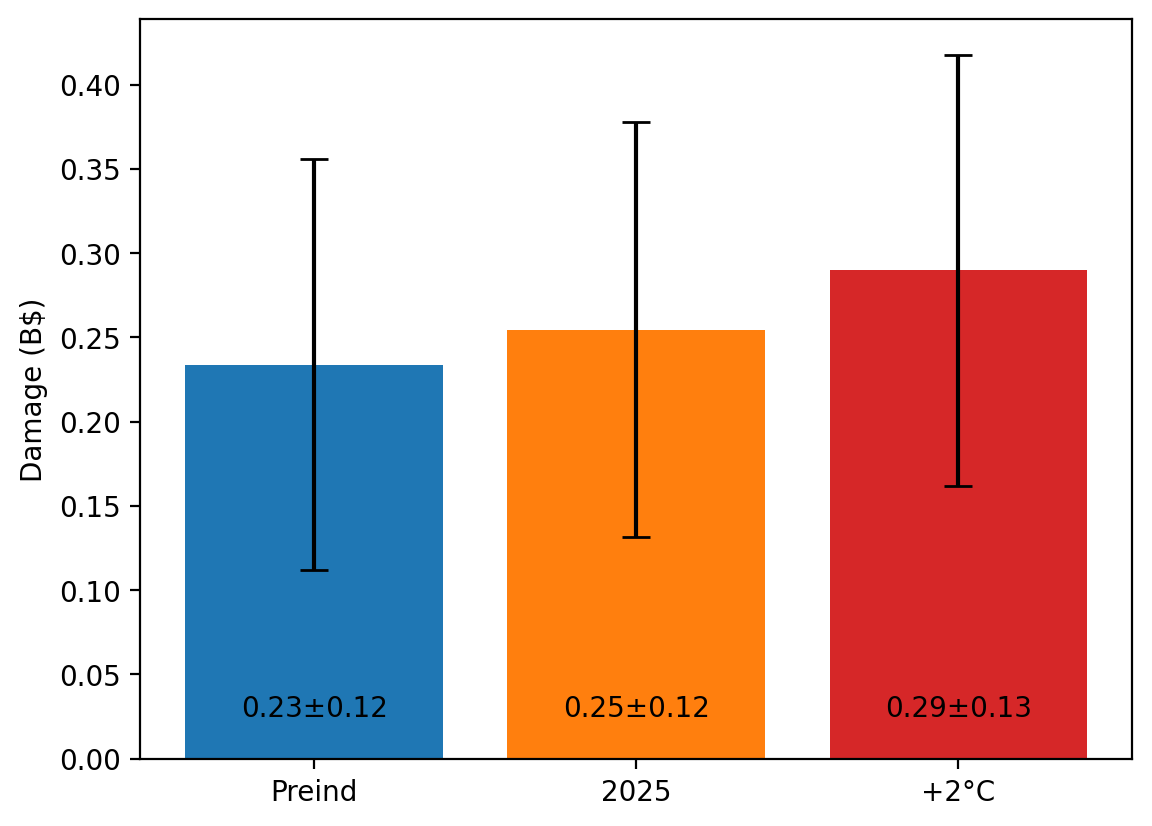
Figure 4 shows the wind footprint and the mean economic damages estimated. We then apply the landfall wind speeds for pre-industrial conditions and for a +2 °C global warming (see Figure 2). The pre-industrial and +2 °C simulations are for counterfactual scenarios assuming the current exposure and vulnerability and that only the wind speed is different. We find the wind speed increase makes substantially more damage. To communicate the effect of climate change on loss we define the fractional attributable loss, FAL:
| FAL = (Lnow-LPre-Ind)/Lnow | (2) |
|---|
where L is the economic loss for the current (now) and pre-industrial climate (Pre-Ind). For the mean damage, we estimate the FAL is 0.08. This means about 8% of the economic damage can be attributed to climate change compared to the pre-industrial baseline. The damage was increased by +9%. In a +2°C degree warmer world the damage would increase by 26% compared to preindustrial as shown in Figure 5.
Eberenz, S., Stocker, D., Röösli, T., and Bresch, D. N.: Asset exposure data for global physical risk assessment, Earth Syst. Sci. Data, 12, 817–833, https://doi.org/10.5194/essd-12-817-2020, 2020.
Eberenz, S., Lüthi, S., and Bresch, D. N.: Regional tropical cyclone impact functions for globally consistent risk assessments, Nat. Hazards Earth Syst. Sci., 21, 393–415, https://doi.org/10.5194/nhess-21-393-2021, 2021.
Lau, K.H, Czernichow, S., Sparks, N., Toumi, R., A parametric rain model for landfalling tropical cyclones: A case study for the U.S., submitted Natural Hazards, 2025.
Sparks, N., Toumi, R. The Imperial College Storm Model (IRIS) Dataset. Sci Data 11, 424. https://doi.org/10.1038/s41597-024-03250-y, 2024.
Sparks, N., Toumi, R., The impact of global warming on U.S. hurricane landfall: a storyline approach. Environ. Res. Lett. 20 114006 https://doi.org/10.1088/1748-9326/ae0956, 2025.