
For the future of environmental sciences
The MSc Environmental Data Science and Machine Learning at Imperial College London will train students in fundamental computational and data science skills for application across the environmental sciences.
The course is led by expert computational scientists in the Department of Earth Science and Engineering. The programme offers a focus on environmental big data in addition to established modules in machine learning, Artificial Intelligence, computational science and modern programming skills that run in the Applied Computational Science and Engineering MSc.
Find the most recent course information and specifications on the Imperial MSc EDSML course page.
/filters:format(webp)/prod01/channel_3/media/imperial-college/faculty-of-engineering/earth-science-and-engineering/earth-science-general/2000-x-2000.png)
Join this 1 year MSc program, where you will learn to use AI and data science to solve real-world environmental challenges and shape the future of the planet! Dr Rossella Arcucci MSc EDSML Course Director
Course Information
The study programme consists of eight taught modules, and one individual research project which accounts for one third of the study programme.
Term 1
Modern programming methods and Cloud Computing
Computational Mathematics
Environmental Data
Term 2
Applying Computational/Data Science (several short group projects)
Advanced programming
Big Data Analytics
Inversion and Optimisation
Term 3 (summer)
Machine Learning
Independent Research Project.
Some representative research project titles include:
- Deep Learning applied to the interpretation of subsurface data
- A GNSS Satellite Selection Scheme based on Line-of-Sight and Satellite Geometry with a Machine Learning Approach
- A Machine Learning Approach to the Prediction of Tidal elevation
- Applying Novel Data-Driven Techniques to Wind Turbine Predictive Maintenance
- ARGO Trainer: Developing of a new software platform to annotate, visualize and analyze ARGO float data.
- Assessing the environmental sentiments of the public using Twitter data
- Automated crater detection based on the YOLOv3 architecture and its application to CTX imagery
- Machine learning based bathymetry derivation from high-resolution satellite imagery
- Machine Learning for Automatic Facies Classification from 3D Geophysical Models
- Mapping coastal wetlands with Google Earth Engine and Machine Learning
- Multi-scale tsunami inundation and sea defence modelling
- Optimal Drone Recharging Scheduling for Wireless Sensor Power Transfer and Data Collection
- The assessment and optimisation of CO2 storage in the UK for climate change mitigation
- Machine Learning-based Classification of Europa’s Fractures
Students will have the chance to participate in individual and group research projects as well as to write reports and present technical work, developing the project management and numerical skills that are desired by employers.
You can see the teaching schedule represented visually below. If you would like an accessible version of this information, please contact ESE webmaster.
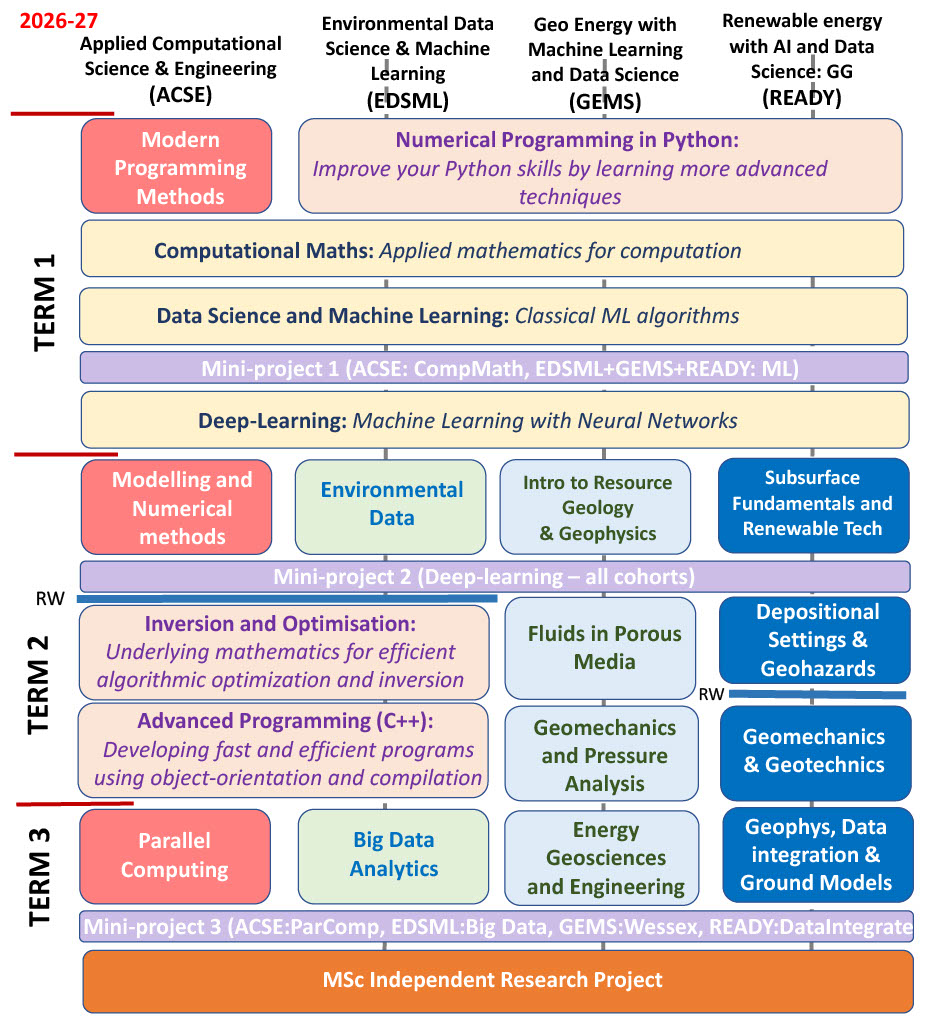
Graduates of this course will be well placed to fill the significant market demand for those with applied, hands-on computational and data science experience.
Many of the skills you learn are applicable broadly across all of science and engineering and so potential career paths are hugely diverse. The additional knowledge of environmental science and associated engineering solutions you will be exposed to in this course will make you particularly attractive to anything from relatively small environmental and engineering consultancies to large multi-national organisations including those in the energy and big tech sectors.
The skills gained on this course are also important in research and will be of value for jobs in R&D or future PhD studies. See for example previous skills gaps reviews in the Environment Sector.
Aziz Foundation / Imperial Environmental Data Science and Machine Learning Scholarship
The scholarship offers a unique opportunity for an exceptional Muslim student active in British Muslim communities and keen to build bridges with all parts of British society. The student will have the commitment and intelligence to support and represent Muslim communities in wider society, as well as the credibility to bring and explain new learning experiences back to the community, and will thus create mutual understanding between Muslims and others and contribute to the creation of a more cohesive society.
The scholarship will cover the full home tuition fee.
Applicants should meet the following requirements:
- Have submitted a complete application to the MSc Environmental Data Science and Machine Learning programme.
- Be active within your local and/or faith community and demonstrate a desire to develop intellectual skills within a multi-faith/secular environment.
- Be able to demonstrate long-term commitment to community/societal development and good relations work through public leadership.
- Be Zakat eligible/ in financial need and therefore cannot cover the costs of tuition.
- Have an excellent understanding of the environmental science and/or data science industries and how to progress within it, with relevant, prior experience and/or achievements in the field.
- Have knowledge of how the programme will enable you to generate social impact.
- Be a UK national and eligible for Home fee status at the University.
Submit a statement of no more than 1,000 words setting out how you meet the criteria above, addressing also how you hope to use this scholarship for your future work.
Please submit the statement to adalovelace-admissions@imperial.ac.uk by 1st May 2026. Remember to include your full name and your CID in your email.