Information for clinicians and trialists

Contact the trial team
Trial email: warriors@imperial.ac.uk
Chief Investigator
Colin Bicknell: colin.bicknell@imperial.ac.uk
Co-Chief Investigator
Anna-Louise Pouncey: a.pouncey@imperial.ac.uk
Trial Manager
Rebecca Ruiz: r.ruiz@imperial.ac.uk
Funders
British Heart Foundation, with additional support from Medtronic, Terumo Aortic and internationally from Finnish Heart Foundation, Swedish Heart & Lung Foundation, Novo Nordisk, Denmarks Frie Forskningfond, and Vascular Foundation Australia.
Research aim
To assess whether women with small abdominal aortic aneurysm (AAA) currently are treated too late in their clinical course.
Primary aim: For women with small abdominal aortic aneurysm (AAA, 4.0-5.4 cm diameter), to assess whether early endovascular aneurysm repair (EVAR) compared to routine surveillance decreases the composite outcome of AAA rupture and aneurysm-related mortality over five years.
Secondary aim: For women with small abdominal aortic aneurysm (AAA, 4.0-5.4 cm diameter), to assess whether early endovascular aneurysm repair (EVAR) compared to routine surveillance increases quality-adjusted-life-years (QALYs) over five years.
Other aims: to compare operative mortality, major cardiovascular events (MACE), all-cause mortality, costs and cost-effectiveness between the two randomised groups. Also, in the surveillance group to assess the rate of losing eligibility for EVAR as the AAA expands.

Trial information
Women have smaller arteries and lower AAA population prevalence, but this is disputed and dependent on diagnostic threshold. AAA is ~5 times more common in men if a 3 cm diameter threshold is applied but only ~1.3 times greater when an increase of >1.5 times the normal infrarenal aortic diameter is used. Women were under-represented in the four major randomised trials of small asymptomatic AAA repair, comprising on average only 4.3% of participants. These trials have defined the risk-benefit and intervention threshold for AAA in men, but do not represent women. This is highly pertinent, as women have 4 times greater rupture risk of small AAA. Individual patient meta-analysis (15475 people) demonstrated that in women the rupture risk at 4.2cm diameter was the same as at 5.5cm for men. Increased AAA size is also associated with increased operative complexity and peri-operative mortality. Every 1 cm increase in diameter is associated with an 18% increase in adjusted odd of 30-day mortality for open repair. For endovascular aneurysm repair (EVAR or keyhole surgery), increased size is also significantly associated with a reduction in both 30-day and 5-year survival. Systematic review with meta-analysis demonstrates that women have higher operative mortality and complications rates than men - 30-day mortality following elective open repair is 6% and for EVAR 2.3% (odds ratio versus men 1.49 and 1.86 respectively even after adjustment for co-morbidities). These disparities are consistent worldwide and have not ameliorated with time. With a 30-day mortality of 6% open repair cannot be considered a safe elective procedure for women. EVAR is the preferred treatment modality among most AAA patients. Eligibility for EVAR by anatomical criteria declines at significantly lower AAA diameter for women compared to men. At the 5.5 cm diameter threshold, women are less likely to be selected for endovascular repair than men (34% vs 54%) and more likely to be selected for conservative management (34% vs 19%). Overall, women are 25% less likely to receive elective AAA repair, but increasingly likely to present with AAA rupture, which carries >10-fold increased mortality. Therefore, it is possible that the opportunity for effective AAA treatment in women is being missed. While various retrospective analyses have called for sex-specific criteria for AAA repair, without dedicated prospective research, uncertainty regarding the risk-benefit threshold and sex-specific disparity in AAA repair remain.
Randomised controlled trial with parallel registry for women ineligible for the trial. The intervention is early keyhole surgery. The standard care group is surveillance, with delayed repair when the AAA diameter reaches 5.5 cm.
WARRIORS is an international multicentre, open label, superiority RCT, randomly allocating consenting women with small AAA, morphologically suitable for EVAR in a 1:1 ratio to either early EVAR or routine ultrasonographic surveillance. This will be an international trial anchored in the UK, where there will be 15-18 recruiting sites, each aiming to randomise 10 patients. There will be a further ~100 recruiting sites from across the world, including North America, Europe and Australasia. In total the trial plans to randomise 1112 women in 1:1 ratio of either early EVAR or routine surveillance with delayed repair for either AAA rupture or reaching the threshold diameter of >5.4 cm. There will be a Vanguard phase, enrolling 250 patients internationally, of 250 patients to confirm both the feasibility of recruitment, and that the safety of the policy of early EVAR is within the range reported by observational studies from the USA. The primary composite outcome of aneurysm-related mortality and aneurysm rupture will be assessed at 5 years after randomisation.
Sample size
1112 women with small AAA, identified from trial vascular centres in 8 or more countries.
Setting
Vascular centres across the UK and worldwide. Recruitment is due to start in mid-2025.
Timelines
All patients will be followed up for a minimum of 5 years.
Inclusion criteria
- Female sex (including transgender men assigned female at birth)
- Age ≥50 years
- Infra-renal abdominal aortic aneurysm with a maximum infrarenal aortic anterior- posterior diameter 4.0-5.4 cm, aneurysm, measured on ultrasonography (maximum anterior–posterior (AP) diameter of the aorta measured outer anterior wall to the outer posterior wall OR inner anterior wall to inner posterior wall) or the outer-to-outer centreline orthogonal diameter on Computed Tomography (CT) scan when this is the discovery imaging mode,
- Local assessment that arterial morphology is suitable for EVAR within manufacturer’s IFU for any licensed infrarenal endograft, with or without the use of adjuncts, and including those with concomitant common iliac aneurysm(s), provided the device is landed in the iliac arteries, without coverage of patent internal iliac arteries.
- Rockwood frailty score <7.
Exclusion criteria
- Male sex (including transgender women assigned male at birth)
- Aneurysm of the infrarenal aorta of <4.0 or >5.4cm
- Infrarenal aneurysm not meeting IFU, with or without the use of adjuncts, for any specific licensed endograft for standard EVAR
- Inability to give informed consent
- Previous abdominal aortic surgery
- Age <50 years
- Concomitant thoracic aortic aneurysm of >4.0cm diameter
- Excessive frailty (Rockwood score ≥7)
- Life expectancy <2 years in the opinion of the investigator
- Severe contrast allergy not amenable to pretreatment with steroids/antihistamines (e.g. anaphylaxis)
- Those considered unlikely to comply with follow-up
- Concomitant common iliac artery aneurysm unless: a) the arterial morphology is within the IFU for standard infrarenal EVAR; or b) the arterial morphology is suitable for a licensed iliac branch device; or c) the internal iliac artery is occluded and the stent limb can be landed in the external iliac artery without embolisation of a patent internal iliac artery.
These women (or men assigned female at birth) deemed ineligible but with AAAs ≥4.0 cm diameter will still be eligible for inclusion in a parallel registry.
Chief Investigators at Imperial College London
- Janet Powell
- Colin Bicknell
- Anna-Louise Pouncey
Also from Imperial College London
- Statistician Emanuela Falaschetti
- Cardiologist Darrel Francis
- Imperial Clinical Trials Unit
Health Economists
- Manuel Gomes, University College London
- Rikke Sorgaard, University of Southern Denmark
Qualitative health research
- Rachel Evley, University of Leicester.
Patient representative
- Sara Bosely
UK co-investigators
- Olivia McBride, Dundee
- Rachel Bell, Newcastle
- Matthew Bown, Leicester
- Ian Loftus, Core Laboratory St George’s Hospital London.
- WARRIORS Protocol
- WARRIORS Patient information sheet main trial
- WARRIORS GP letter
- WARRIORS Consent 3.0
- WARRIORS Decision aid for main trial
- WARRIORS 2UK ethical approval
- WARRIORS QRI Study - Staff Participant Information Sheet
- WARRIORS HRA Approval
- WARRIORS QRI Study - Patient Participant Information Sheet
- WARRIORS QRI Study - Patient Consent
- WARRIORS Staff CONSENT for QRI study
- WARRIORS Favourable opinion of substantial amendment
- WARRIORS Associate PI Scheme slides
- WARRIORS Trial - December 2023 Newsletter
- WARRIORS Trial - January 26 Newsletter
- WARRIORS Trial - February 26 Newsletter
- WARRIORS Trial - March 26 Newsletter
- WARRIORS Trial - April 26 Newsletter
- WARRIORS Trial - May 26 Newsletter
- WARRIORS Trial - June 26 Newsletter - UK
- WARRIORS Trial - June 26 Newsletter - Global
- WARRIORS Trial - July 26 Newsletter - UK
- WARRIORS Trial - July 26 Newsletter - Global
WARRIORS Frequently Asked Questions
- What is the difference between the "Paper Consent eCRF" and the "Electronic Consent eCRF"?
- What should you do if your paper ICF does not record or match the items in the database?
- Who is eligible for the parallel WARRIORS Registry?
- How should the Rockwood Clinical Frailty Scale be rated when a patient falls between two scores?
- How should the inclusion criterion "within instructions for use (IFU)" be applied?
- What does the exclusion criterion "concomitant thoracic aneurysm >4.0 cm diameter" refer to?
- Can women with an aorto-uni-iliac (AUI) configuration be included in the trial?
- Can patients who were previously enrolled in the MAT trial be enrolled in WARRIORS?
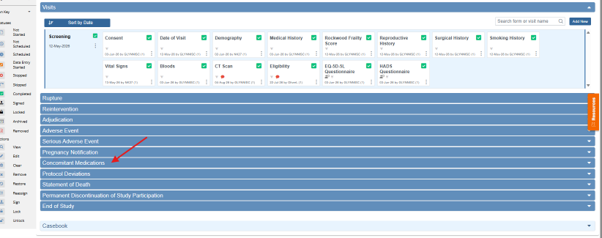
- Where and when should concomitant medications (con meds) be recorded?
- What is the required timeframe between consent/CT scan and randomisation?
- If a patient has a CT scan within the 6-month window but has also had a more recent ultrasound, which measurement should be used for randomisation?
- What is the target timeframe for EVAR following randomisation in the early EVAR arm?
- Are both CT and ultrasound scans uploaded to the core laboratory?
Paper Consent eCRF: This is a set of generic consent statements used to record that the patient has agreed to participate in the trial and/or registry. It is important to note that this is not a source document. The original signed paper informed consent form (ICF) must be retained and filed in the local Investigator Site File.
Electronic Consent eCRF: This has been confirmed to 100% replicate your locally approved ICF and can be completed and signed electronically by both the participant and trial staff directly within the system. Unlike the Paper Consent eCRF, this is the source document, meaning no separate paper ICF is required.
Note: If you would like to enable eConsent for your centre, please contact us.
If your local Informed Consent Form (ICF) does not include certain items (for example, the storage of identifiable information such as date of birth), then you should mark "No" for that item. Please do not leave any items blank in the consent eCRF. If you have not explicitly obtained consent for any statement in the eCRF, the default assumption is that consent is "No".
Women (or transgender men assigned female at birth) who are ineligible for the main trial but have an AAA of ≥4.0 cm diameter are eligible for inclusion in the parallel registry. This includes those excluded due to anatomy not meeting IFU, Rockwood score ≥7, or other exclusion criteria.
When a patient does not clearly meet the criteria for a specific score, the recommended approach is to round down to the lower score — i.e., rate the patient on their best possible score. For example, if a patient is near a 7 but does not fully meet those criteria, they should be rated as a 6.
Note: There is currently no explicit guidance on this in the original Rockwood literature. This approach aligns with standard clinical practice within our OPH service and represents an agreed pragmatic convention for the purposes of this trial.
Given the pragmatic nature of this trial, some degree of clinical interpretation is expected. A patient should be included in the trial if the investigator is satisfied that all three of the following conditions are met after reviewing the CT scan:
- The EVAR device can be placed within the strict anatomical criteria specified in the device IFU (e.g., neck length, neck diameter).
- There are no other anatomical or pathological characteristics that would preclude a safe and durable EVAR.
- The investigator remains in equipoise regarding whether early EVAR would be of benefit to the participant.
If all three conditions are satisfied, the patient should be included in the trial
This criterion refers specifically to the descending thoracic aorta (DTAA). Patients with a concomitant descending thoracic aneurysm exceeding 4.0 cm in diameter should be excluded, as failure to do so could result in aneurysm-related mortality in the EVAR group that is unrelated to true treatment failure.
Note: The literature suggests that approximately 18% of women may have a concomitant DTAA, making this an important consideration during screening.
Yes. Women with an AUI configuration may be included, provided the occlusion is chronic in nature.
Yes. Patients who were previously enrolled in the MAT trial and are no longer active in that trial are eligible for consent and enrolment into WARRIORS. Medical history and concomitant medications should be recorded as per standard trial procedures.
Concomitant medications should be recorded at the screening visit and then reviewed and updated at every follow-up visit (Years 1, 2, 3, 4, and 5), as specified in the Schedule of Activities (Table 6 of the protocol).
Key points to note:
- The concomitant medications form is a standing form (similar to the Adverse Event form) meaning it can be completed at both scheduled and unscheduled visits. For this reason, it appears separately in the database rather than being embedded within each individual visit window.
- At baseline/screening, all concomitant medications should be recorded to ensure data completeness.
- At follow-up visits, the form should be reviewed and updated to capture any new medications or changes.
- The protocol requires that CT scans are performed within 6 months of screening. Investigators must ensure the scan does not expire prior to randomisation.
- In line with ESVS guidelines, which recommend CTA be performed as close to the intervention as practically possible, it is strongly advised that randomisation occurs within 3 months of the CT scan.
CT Scan should be used if it is within past 6 months
EVAR should be performed within a target of 8 weeks of randomisation. Delays for medical reasons are anticipated in a small number of patients.
No. Only CT scans are uploaded to the core laboratory. Ultrasound scans are not required to be submitted.