Dennis Gabor Fund
The Dennis Gabor Fund was established to honour and preserve the legacy of Dennis Gabor CBE FRS.
Managed by the Department of Electrical and Electronic Engineering, the fund serves as a discretionary resource supporting ongoing commitments, such as the Maria Petrou PhD Scholarship.
As the fund supports existing department scholarships, it is not offered as a standalone award and is not open to applications.
About Dennis Gabor
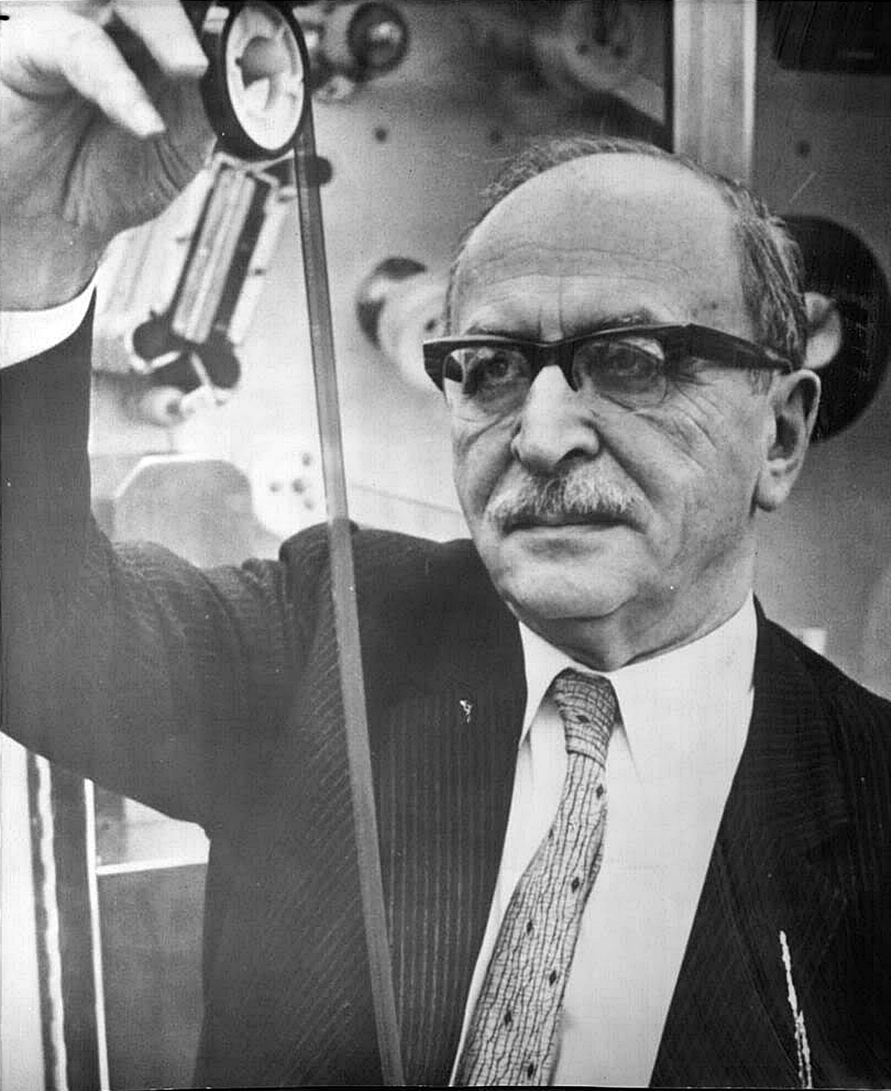 Hungarian-born electrical engineer Dennis Gabor won the Nobel Prize for Physics in 1971 for his invention of holography, a system of lensless, three-dimensional photography that has many applications.
A research engineer for the firm of Siemens and Halske in Berlin from 1927, Gabor left Germany in 1933 and worked with the Thomson-Houston Company in England, later becoming a British subject.
In 1947 he conceived the idea of holography and by employing conventional filtered-light sources, developed the basic technique. Conventional light sources generally provided either too little light, or light that was too diffuse, so holography did not become commercially feasible until the 1960s with the demonstration of the laser, which amplifies the intensity of light waves.
In 1949 Gabor joined the Department of Electrical and Electronic Engineering at Imperial, where in 1958 he became Professor of Applied Electron Physics. His other work included research on high-speed oscilloscopes, communication theory, physical optics, and television. Gabor was awarded more than 100 patents.