Written copy of the JTU pay claim 2025/26 below (or download PDF: Revised JTU Pay Claim 2025-26.pdf)
In previous years the Joint Trades Unions have focussed our pay claims on maintaining, at a minimum, the value of pay at Imperial since we left national bargaining in 2005. We also conducted a survey (open to both members of the Joint Trade Unions and staff at Imperial). From this we were able to gain understanding of staff perspectives on pay and benefits. It is clear from the survey results that staff are still feeling the impact of the cost-of-living crisis, and indeed a large number are considering alternative employment.
Context
2025 Cost of living
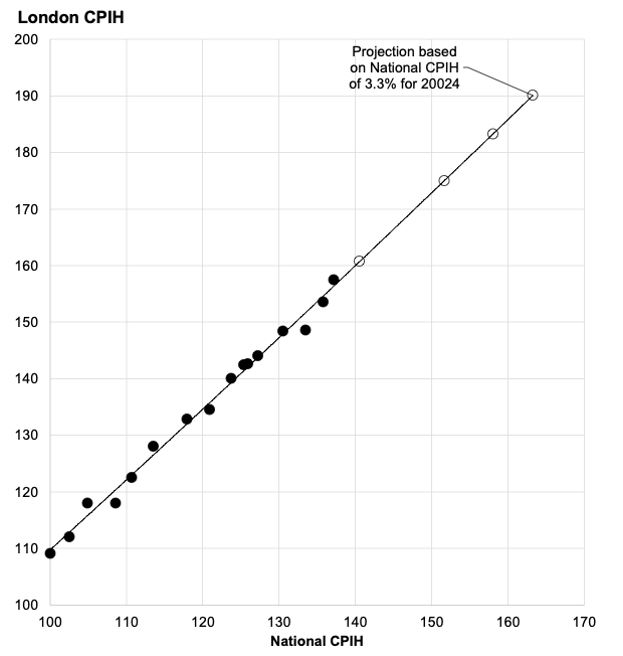
In the figure below we show the update of the value of pay at Imperial compared to 2005, based on the estimated London CPIH at the end of 2024. We estimate this based on the established relationship between London CPIH and national CPIH between 2005 and 2020 (see appendix 1). Note, we will update this element once we receive the latest London CPIH calculation. It should be noted that only a small proportion of the erosion of pay that occurred in 2022 has been made up in the settlements of the last two years.

Affordability
finances were very healthy in 2024. This is evidenced by the University looking for a very significant expansion in the next five years, in contrast to much of the rest of the higher-education sector. There is therefore an opportunity to make up to staff for the loss of pay they have suffered.
Survey results
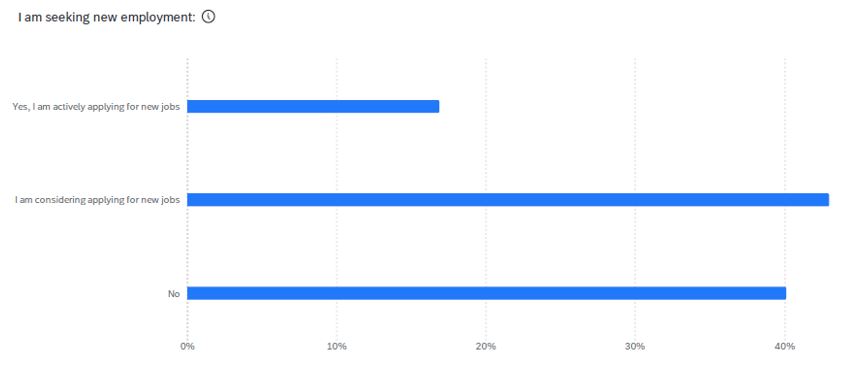
Our survey, which covered staff across all three unions and received a strong response from several hundred members, showed that staff are still struggling: 60% agreed that financial concerns had affected their work, and 70% agreed that this had affected their well-being. 60% of respondents were also actively seeking or considering other employment:
This is backed up by text comments:
Over the last nine years, I have been a Senior Lecturer and Reader at Imperial, and I have seen my pay fall relative to colleagues at other universities and especially in industry, whilst costs such as food (on campus) and travel have increased above inflation. Whilst I love working at Imperial, I cannot afford to live in central London, and I am actively seeking other employment across the UK.
My salary is not keeping up with the average London costs of living, especially the housing costs. With my current salary, I have no choice but to keep living in a house in disrepair (leaks, rats) just to make ends meet, which is severely impacting both my mental and physical health. Currently, I can't afford any better accommodation.
The survey asked additional questions about working conditions and benefits. A recurring theme was workload, which many of the respondents felt was, after pay, the priority:
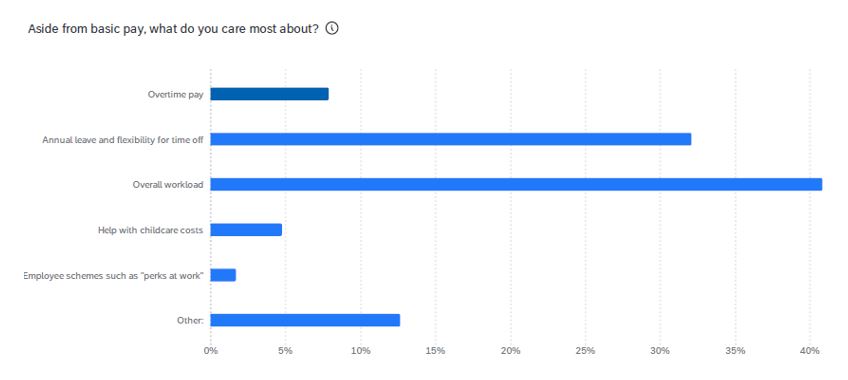
Note that “perks at work” is considered a significant benefit by only a small minority of respondents. Respondents were particularly keen on working towards a 4-day working week and an increased annual leave allowance.

Claim
In the context of pay value at Imperial, affordability and staff concerns, as revealed in our members' survey, our claim has four elements.
- Pay claim
Given both the long-term erosion of pay that staff at Imperial have suffered, and the healthy state of University finances, our pay claim consists of two parts
- a 7.2% pay increase
- a £2000 lump sum
The lump sum will particularly benefit those on lower incomes who have been disproportionately affected by recent inflation.
These are clearly affordable in terms of both current and anticipated University finances. Our pay claim is modest: management should regard it as shocking that pay has fallen in value, given the increases in staff productivity and student-staff ratios, more than 20% higher than just ten years ago. There is now an opportunity for those who work at Imperial to be properly compensated.
- Annual leave
Imperial employees receive 25 days of annual leave, plus up to six closure days, in addition to public holidays. While this exceeds the statutory minimum, it is not generous in HE. In post-1992 universities, employees receive either 30 or 35 days of annual leave in addition to closure days and public holidays; increasingly in pre-1992 universities, the norm emerging is for 30 days’ leave. In London, King’s College, Queen Mary, SOAS, City, St George’s, LSE, and UCL, as well as all post-1992 universities, provide more than Imperial does, either in days of annual leave or in closure days. Among survey respondents, increasing annual leave was the second most popular goal.
Since, for many employees, productivity would rise to cover the additional days of leave, it is unclear that increasing annual leave allowances would have substantial financial implications for the University.
The joint trade unions are therefore asking:
- That annual leave increases from 25 days to 30 days as of 1 August 2025.
- Paid Carers leave
Since April 2024, employees have had the statutory right to take up to one week’s carer’s leave in any calendar year to attend to the needs of a person (or people) dependent on them because of disability, illness, injury or old age. Leave may be taken in any multiple of half a day, up to a full working week, provided the correct notice is given.
While this flexibility is welcome to those with dependants, its utility has been severely curtailed by the absence of a statutory right to pay during this period. Most employees cannot afford to take carer’s leave, especially given the ongoing effects of the cost-of-living crisis. This is particularly true in Greater London, where costs are so much higher. It also has a differential impact on women and older employees who are more likely to be responsible for dependants. Offering only unpaid carers’ leave therefore has an effect on gender pay gaps and hits older workers harder.
Imperial can certainly afford to provide employees with pay during this period and to extend it to up to two weeks for those who really need it. Since take-up is unlikely to be extensive, the overcall cost is unlikely to be problematic for Imperialc; at the same time, the reduction in stress and worry for many employees will make the University a much more pleasant working environment.
The joint trade unions are therefore asking:
- that the statutory minimum carer’s leave is extended to two weeks where needed and is paid leave;
- that the University advertises its availability to employees.
- Four-day week
The current five-day workweek pattern is over 100 years old and outdated. A growing number of employers are investigating reductions in order to improve productivity and employee satisfaction. A number of pilots have been conducted since COVID, reporting: clear rises in productivity (the link is well established: Germany, with one of the lowest average working hours in Europe, also has some of the highest productivity rates); fewer absences; lower ‘churn’ of staff; greater employee satisfaction, especially among women; dramatically lower rates of burnout among staff and much lower rates of workplace stress. The results were so clear that, in the 2022-23 pilot, 92% of participating employers decided to continue.
In 2025, the Guardian reported that another 200 employers are participating.
The advantages for Imperial are obvious, given the high levels of reported workplace stress. In our survey of members and non-members at Imperial, a significant majority (57%) reported that a four-day week was an important issue for them; it was the most popular issue by a long way.
The JTU are therefore asking:
- that we establish a small working party with members from HR and the JTU to discuss how this will be effected.
- that we agree to negotiate a move to a four-day working week without loss of pay for all who work at Imperial.
Appendix
Source: NIESR, ONS with projection by log-log regression, IC JTU