Pay Review Framework for Managers.
Guidance Documents for Managers
- Overview
- Equity Pay Review
- Achievement Pay Review
- Responsibility of managers
- Funding for Equity and Achievement Pay awards
- Types of awards
Imperial’s annual Equity and Achievement Pay Review processes allow managers to:
- Ensure salaries remain fair, consistent, and aligned with comparable roles
- Address internal pay disparities, including gender and ethnicity differentials
- Reward individuals and teams who have demonstrated exceptional contribution
These processes apply to all staff on Imperial terms and conditions, except those with a live Employee Relations sanction or those who have not completed their Imperial Essentials training.
Both processes will commence in May, and awards will be implemented in the January payroll, with consolidated increases backdated to 1 October.
Managers should work closely with their Head of People throughout the process to ensure that all recommendations are appropriately justified, consistent with institutional expectations, and supported by clear evidence.
IMPORTANT CONFIDENTIALITY REQUIREMENT
Please note: recommendations as part of this process must not be discussed with employees until these are formally agreed. This requirement is essential to avoid any misunderstanding or premature expectations. Managers should respond neutrally if asked about recommendations, explaining that the review process is ongoing and that outcomes will be communicated once final decisions have been made.
An FAQ document on the Pay Review processes is available on the main Pay Review web page.
Department pay review recommendations will be subject to an Equality Impact Assessment prior to review by Local Decision-Making Boards (at Faculty/Business School/Support Service area level), to ensure the recommendations meet the criteria and that sufficient evidence to support them has been provided. This is in line with Imperial’s commitment to reducing its gender, ethnicity and disability pay gaps while ensuring equity and a consistent application of achievement pay review awards.
The purpose of the Equity Pay Review is to ensure that staff performing roles of similar size, scope, and responsibility are positioned fairly relative to one another. Equity awards address structural pay differences that arise where, despite equivalent roles, some staff have become misaligned due to legacy decisions, historical pay patterns, or other non‑role‑related factors. It is important to note that Equity Awards apply only to staff on fixed salaries. Staff who progress through incremental spine points will naturally move through their grade each year and therefore should not be included within the Equity Review. The Equity Pay Review is the process used to ensure our pay is consistent, fair, and balanced across roles so that staff receive equal pay for work of equal value. Equal pay is different from the gender pay gap, which measures the difference between the average earnings of male and female employees, irrespective of job role or seniority. By law, employers must also not pay an employee less because of their disability, race, religion, sexual orientation, or another protected characteristic.
When reviewing equity considerations, managers should be mindful that Imperial’s pay gap and benchmarking data show that the misalignment disproportionately affects some groups more than others, particularly women and colleagues from ethnic minority backgrounds. While Equity Awards can be made for any individual where clear evidence of misalignment exists, managers are encouraged to pay particular attention to patterns of structural disadvantage highlighted in the dashboards. All Equity recommendations must be grounded in evidence drawn from like‑for‑like role comparison and internal benchmarking, rather than personal characteristics alone.
When considering an Equity recommendation, managers must compare employees only with colleagues whose roles are genuinely comparable. This means selecting individuals who share the same grade and whose responsibilities, job family, decision‑making expectations, and scope of role closely align. Comparisons should not be drawn across the whole team or between roles with differing levels of autonomy, complexity, or functional purpose.
Example: gender analysis
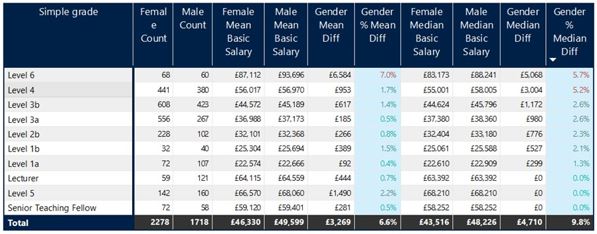
The table below shows an example (using dummy data) from the Gender Analysis resource in Power BI. This table has been sorted to show the median percentage difference by gender, from greatest to smallest. In this example, we can see
that the largest gaps for median salaries by gender occur at levels 4 and 6.
Internal Benchmarking
Pay benchmarking compares an employee's salary to the grade's midpoint (median) and mean (average). From an equity perspective, managers should consider whether the pay differential is fair, equitable, and justified. Within the Power BI dashboards, managers can access resources to identify current pay equity issues within their department or team.
▪ Mean, Med, Min, Max: this sets out the minimum, median, mean (average) and maximum salaries for each grade (by team/department).
▪ Gender analysis: this sets out pay analysis by grade by team/department. You can see the number of male and female employees in each grade, along with median and mean salaries, and the gender-based salary differentials. The largest gaps are highlighted red (i.e., those furthest from zero), and the smallest gaps are highlighted in green. Gaps in favour of women will be presented as a minus (negative) figure, while gaps in favour of men will be shown as a positive figure.
▪ Ethnic group analysis: this sets out pay analysis by grade by team/department. You can see the number of Black, Asian and minority ethnic (BAME) and white employees in each grade, along with median and mean salaries, and the percentage differentials by ethnicity. The largest gaps are highlighted red (i.e., those furthest from zero), and the smallest gaps are highlighted in green. Gaps in favour of BAME employees will be presented as a minus (negative) figure, while gaps in favour of white employees will show as a positive figure.
Together, these resources enable managers to identify current pay equity issues and determine where pay awards should be focused to address them. These resources will also assist in determining an average increase or payment amount to help reduce equity differentials.
All the tables mentioned above are interactive and can be drilled down by grade, gender, and ethnicity. The columns in each table can be sorted to show percentage differences, grouped by colour (red and green), in descending order.
Differences in pay for similar roles
Everyone brings unique skills and abilities to a role, and not all roles are the same, even if they share the same job title.
Jobs with similar duties can be paid differently, and jobs involving more complex tasks or greater responsibility may attract higher salaries. There may be various circumstances which have led to variations in pay, which might include
the employee’s previous salary, their previous experience, and previous contribution and achievement awards whilst at Imperial (and within the same grade).
When reviewing the provided internal pay benchmark information, managers are asked to proactively assess whether the pay difference is due to the above. If this is not the case, they should consider, including discussing with their
Strategic People Partner, if a case should be submitted against one of the two criteria below.
Criteria for equity pay review awards
- To address a significant misalignment of a salary when compared to others within the organisation who have a similar role size and profile
- To address equal pay differentials
Managers will be expected to submit a supporting statement as part of the recommendation process, and Equity justifications must be detailed. A strong justification will clearly identify the colleagues whose roles are comparable and explain why these roles have been selected as comparators. It will describe the nature of the misalignment and summarise the evidence drawn from the dashboards. The statement should explain why role‑related factors cannot justify the difference in positioning and how the recommended award would support fair alignment. Reviewers should be able to understand the rationale without prior knowledge of the team or its structure.
Types of Achievement Award
Achievement Awards may take two forms: consolidated increases and one-off payments.
A consolidated increase is awarded where exceptional contribution has been sustained over time, reflecting consistently high performance across the review period.
A one-off payment is appropriate where the contribution is time-limited, linked to a specific project, event, or defined period of exceptional work. All team awards are made as one-off payments.
When determining the most appropriate type of award, managers should consider the achievement's duration, nature, and impact, as well as the individual’s salary position within the grade. For individuals near the top of their grade, a one-off payment may be more appropriate.
One-Off Achievement Awards
A one-off award recognises significant, time-limited contributions that exceed the expectations of the role but are not sustained across the full review period.
A one-off award should be recommended when:
- The achievement relates to a single project, event or distinct period of exceptional work.
- The contribution represents short-term leadership, innovation or problem-solving that exceeds the expectations of the role.
- The impact is clear and meaningful, but does not represent an ongoing change in responsibilities.
- The individual is already positioned at the upper end of the grade, making consolidation inappropriate.
- The contribution occurred during exceptional or unforeseen circumstances, rather than as part of a long-term pattern.
- The recommendation relates to a team award, as team awards are always one-off payments.
Consolidated Achievement Awards
A consolidated award recognises sustained exceptional performance that is consistently demonstrated over a significant portion of the review period and is clearly beyond the expectations of the role.
A consolidated award should be recommended when:
- The exceptional performance has been sustained, consistent, and clearly evidenced throughout the review period.
- The contribution has resulted in lasting or strategic improvements to services, processes, teaching, research or operations.
- The individual has demonstrated increased autonomy, leadership, or responsibility beyond their grade expectations.
- The level of performance aligns with ARC indicators of sustained exceptional performance.
- The impact is broad, long-term and materially beneficial to the department, faculty or institution.
Criteria for Achievement Pay Review awards
- To recognise substantial and sustained exceptional ongoing individual achievement beyond the usual expectations of the role.
- To recognise substantial and exceptional one-off individual achievement beyond the usual expectations of the role.
Note on Imperial Values: Assessments of exceptional contribution and achievement must be made in line with Imperial's Values. More details on our Imperial Values are available online.
Exceptional contribution and achievement
Exceptional contribution and achievement should be in addition to the usual expectations and contributions of the role as outlined in the job description. For further guidance on what constitutes an exceptional contribution, please refer to the Pay Review Framework.
Managers will be expected to submit a supporting statement as part of the recommendation process, with specific, detailed evidence of how the employee has demonstrated exceptional contributions and achievements, in line with Imperial values and remit for the grade.
Please ensure your statement is easy to understand without needing prior or additional knowledge of your area.
Internal benchmarking data
Achievement Pay Review award recommendations should be based on an employee’s contribution and achievement, but consideration of the employee’s current internal benchmarking position is also important.
Pay benchmarking compares an employee's salary to the midpoint (median) and/or upper quartile of their grade. This enables a manager to support pay progression by awarding larger increases to those on lower salaries and restricting increases to those on higher salaries or near the top of pay scales.
However, it is also important to recognise when it may be appropriate for an employee to be placed at the start of the grade – for example, if they have recently been promoted to a new grade. Managers should review internal salary data and benchmarking data for their area to assess where employees stand relative to the internal market.
Use the Power BI Dashboards (Pay Review tables tab and Pay Review tables for Extract tab) to determine this. For example:

If a staff member in the above example earns a basic salary of £68,000, their salary is above the median and very close to the maximum for other employees on the same grade. Consideration must be made on whether there is sufficient justification demonstrated through the employee’s exceptional achievement to apply a consolidated pay review award (a permanent increase in the employee’s base salary).
In the Power BI dashboards, salaries can be sorted from highest to lowest, and the highest salaries are coloured dark blue. Salaries closest to the average are coloured pink/ purple, and the lowest salaries are coloured orange. The colour coding changes depending on the filters applied (i.e., staff group, grade, position, gender, ethnic group).
- Employees for whom the benchmarking indicates they are paid at the upper quartile or higher should typically be awarded a one-off (non-consolidated) payment.
- If employees are meeting role expectations, pay is at or above the market median (or higher), and there are no pay gaps relative to peers, it is appropriate to keep pay as is (i.e., the employee should not be considered for a pay award).
ARCs and regular feedback
Managers are encouraged to use the Annual Review Conversation (ARC) process to support informed decisions on contribution pay, with staff achievements clearly evidenced in support of managers’ achievement pay review submissions.
Outcomes of ARCs are one element used to inform decisions on pay review award recommendations. Outside of the ARC process, other conversations and feedback, including regular one-to-ones with employees, should be considered as part of the overall review of an employee’s achievement.
As a manager, you are actively encouraged to review and consider the contributions of all your team members over the past 12 months. The criteria set out in the Pay Review Framework.pdf can be used to identify individuals who have demonstrated exceptional and sustained contribution beyond the requirements of the role over a continuous period.
Line managers need to make evidence-based, fair judgments about employees' achievements. All managers are expected to apply equal treatment and fairness when making pay decisions. Decisions must be free from bias in relation to age, ethnic origin, gender, gender identity, gender reassignment, disability, religious belief, sexual orientation, marriage and civil partnership and pregnancy or bias on any other grounds. Part-time staff, staff on family-friendly leave, and staff on fixed-term contracts should be treated fairly and given equal consideration. Please note that colleagues who have not completed their Imperial Essentials training should not be put forward for an award.
When managers are not familiar with the contributions or achievements of individual staff members or groups, they should proactively seek feedback from other managers and supervisors to ensure everyone in their area has been fairly considered.
(For any staff who also hold the role of Global Institute Co-Director, the Vice-Provost (Research and Enterprise) will provide input to the Department to provide extra context for the individual’s annual review. Any recommendations should be discussed with the VPRE).
For team achievement awards, where individuals are recommended for one-off payments may have different line managers, it is important that managers discuss and agree on the recommendations and how the awards will be funded (which budget/cost centre they will be paid from). For example, if awards are being recommended for a whole project team, consideration should be given to which individuals have performed exceptionally above the normal expectations of their roles.
Pay awards should not be discussed with employees until they are formally agreed.
When considering awards for members of your team/department, please note that any charges will be billed back to the applicable budget/cost centre. It is imperative to ensure sufficient funds are available to cover these awards.
For staff members funded by Research Grants - under the terms and conditions of the UK Research and Innovation body (UKRI), salary increase and one-off payments as part of the Pay Review process are not eligible to be charged to research council awards and other externally funded research projects/grants. These increases/payments are also an ineligible cost for the university's other core funders, including:
- European Commission
- CRUK
- Royal Society
- Welcome Trust
Therefore, departments must ensure that the relevant budgets/cost centres can cover these payments for externally funded Research staff, as they cannot be charged back to the external grant/funds.
For substantial, sustained, and exceptional contributions and achievements, individuals may be awarded a consolidated pay increase.
For a one-off exceptional achievement, employees will receive a one-off payment (non-consolidated and non-pensionable). Team awards can only be awarded as one-off payments. Both consolidated increases to pay and one-off payments will be prorated accordingly for part-time staff.
Individual pay data/employee information can be viewed on the ‘Pay Review Table’ and ‘Pay Review Table for Extract’ pages on the Power BI dashboard. The ‘Progression status’ column demonstrates where an employee currently sits within their grade as of 1 October (i.e. after the expected October spine point has been applied).
| Progression status | Type of award that can be recommended |
|---|---|
| Automatic | The employee is within the automatic spine points for their grade; therefore, they can be awarded an additional increment within this same grade |
| Contribution (non- automatic) | The employee is within the contribution spine points for their grade; therefore, they can be awarded an additional increment within this contribution section of the grade |
| Top of automatic | The employee has reached the top spine point for the automatic range of their grade; therefore, if there are contribution points available, they can be awarded an additional increment to take them into the contribution range for the grade |
| Reached max | The employee has reached the maximum spine point for their grade and/or contribution range (if applicable) and cannot proceed further. In this instance, they can be awarded a one-off payment only |
Employees on fixed salaries can be awarded either a consolidated pay award or a one-off payment.
The following grades have no salary cap, and employees progress to fixed salaries above the value of the top spine point for the grade:
- Lecturer
- Senior Lecturer
- Senior Teaching Fellow
- Principal Teaching Fellow
For more information, please see our salary web pages.