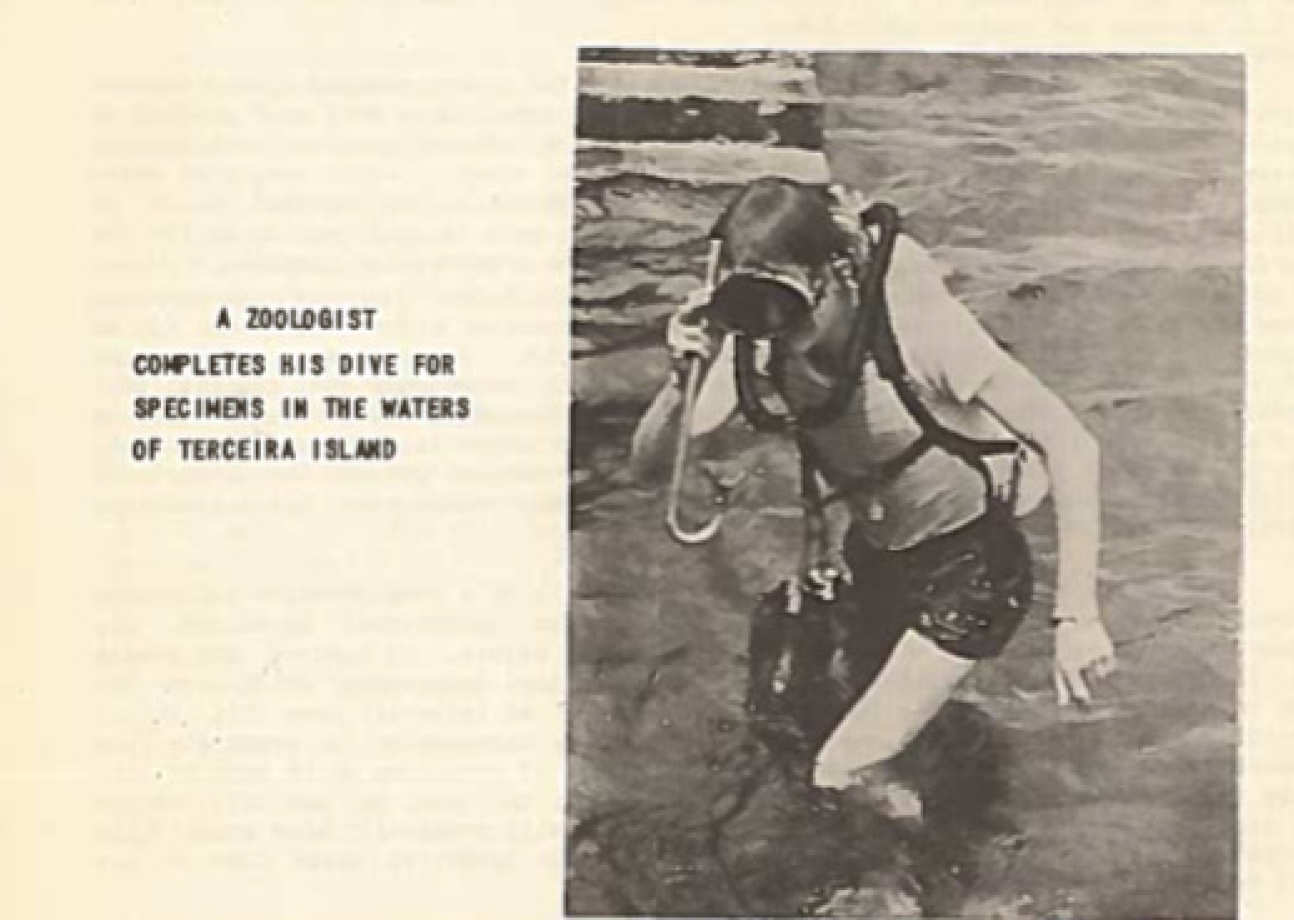
We don't have the full report of the 1959 Azores Diving Expedition, but a summary is available in the 1960 Expedition Review, of which an extract is presented here:
Just three years before this expedition the Imperial College Underwater Club was born. Like all new clubs it was nurtured in its first year by a few enthusiasts and gained recognition in 1958. A year later nine divers from the club set out on an ambitious and yet well-founded expedition to the Azores. This marked a significant development, reflecting the rapid rise of underwater activities during the last decade.
The invention of the aqualung in 1942 revolutionized underwater exploration, allowing divers to move freely beneath the waves. This opened vast possibilities for science, industry, and recreation. Biologists could now study marine ecosystems in their natural environment, archaeologists could examine submerged relics, and geologists could investigate oceanic formations. The Azores expedition aimed to apply these opportunities to scientific research. In July 1959, nine members disembarked on Terceira Island. The Azores, volcanic peaks rising from the mid-Atlantic, offered clear, warm waters teeming with life. The team established a base near an ideal bay, aided by local support and the U.S. airbase for compressed air supplies.
Underwater work included pioneering biological and geological studies. Zoologists and a botanist conducted transects along a 120-foot underwater cliff, scraping and cataloging organisms to analyze zonation patterns. Geologists mapped lava flows and used aqualungs and an echosounder to trace submerged rock formations—a novel technique at the time. The team also discovered Spanish cannons on the seabed, remnants of an old fort. Marine life was abundant: groupers, barracuda, moray eels, stingrays, and vibrant seaweeds. Despite setbacks, such as a broken cine camera, the expedition captured striking still photographs and collected extensive specimens. Their work represented some of the earliest attempts at underwater geology and biology, paving the way for future research.