Credits and citation
RSE Team contribution to scholarly outputs and other research products must be credited appropriately. The RSE Team will adopt the following practices when working on a software project. Different points will be applicable to different projects, depending on their nature:
Reference in the software
A reference to the RSE Team’s website and the names of RSE Team members and their roles in the project will be included in the following places during the development process:
- In an ‘About’ page or section in the project’s website, if any. The RSE Team will request researchers to do this if they do not have access to such a page.
- In the footer of web applications, an ‘About’ page of the web or graphical interface applications, or in an ‘about’ command in command line interface applications.
- In the ‘Authors’ section of the relevant project file, e.g. `pyproject.toml’, `Cargo.toml’, etc.
Authorship of scholarly outputs
For publications, the members of the RSE Team working on a piece of software must:
- Be included as co-authors in conference papers, posters or articles describing the technical development or other aspects of the software to which they have contributed.
- Be included in the Acknowledgments section of publications related to the software if the RSE Team are not the core developers of the software but have supported it in relation to the publication.
- Publications using the software should cite the software as instructed in the CITATION.cff file (see below).
Software repository
The following features are recommended for the code repository:
- Mint a DOI for the software, for example using a service like Zenodo.
- A CITATION.cff file, including RSE Team members names, to inform other users how to correctly cite the software.
- Enable the All Contributors bot in the code repository to acknowledge the contributions of everyone involved in the software's design, creation and documentation.
Creation of impact
Finally, the RSE Team will support the creation of impact by the software by:
- Writing a Case Study about the software as part of the closure of the engagement. The RSE Team will expect some collaboration from the researchers when writing it (e.g. a quote)
- Volunteering to lead the publication of articles about the software on the Journal of Open Source Software or similar journals.
- Featuring the software as the Research Software of the Month in the Imperial Research Software Community Newsletter.
REF2029
Note that REF2029 specifically mentions software and code as valid research outputs, stating that “all forms of research output and research practice will be assessed on a fair and equal basis”. Please ensure that you submit the software output of this engagement to the REF2029 and that the contribution made by the RSE Team is appropriately acknowledged.
Software ownership
Any software developed by the RSE Team will follow the standard Imperial College IP’s Policy, detailed in the Research Office webpage and summarised as:
- College’s IP Policy and Reward to Inventor Scheme applies to all Imperial staff including those employed in support services.
- Software and code written by Software Engineers from Research Computing Services (RCS) are written in the course of their normal duties as employees of Imperial College and would be owned by Imperial College under College's IP Policy.
- RCS Software Engineers should be named as authors and IP generators when software has been developed for an Imperial College research group and the software is disclosed to the IPC Team as software with potential commercial use.
- RCS Software Engineers are eligible for a share of future income under College's Reward to Inventors Scheme if the software they write or develop generates commercial income from an IPC Team managed licence.
- (Not included in the IP’s Policy) If the software is the founding IP for a future IP start-up, RCS Software Engineers waive any benefit to an equity share in the IP start-up.
The RSE Team must be involved in the conversations with Enterprise in relation to the disclosure of the invention when it relates to software they have been involved in from the start of the process.
Licensing
The Research Software Engineering (RSE) Team recognises research software as a first-class research output and is committed to obtaining maximum value from it via sharing. Options for licensing software should be considered at the earliest opportunity in collaboration with the Research Office and the Industry Partnerships and Commercialisation (IPC) team.
The default position of the RSE Team is that code should be made available under a permissive open-source licence as it is developed, in keeping with the Imperial College London policy on Open Access and Open Research, and guidance on making your research software open and sharable, however, that might not always be possible or be the best option to create sustainable impact.
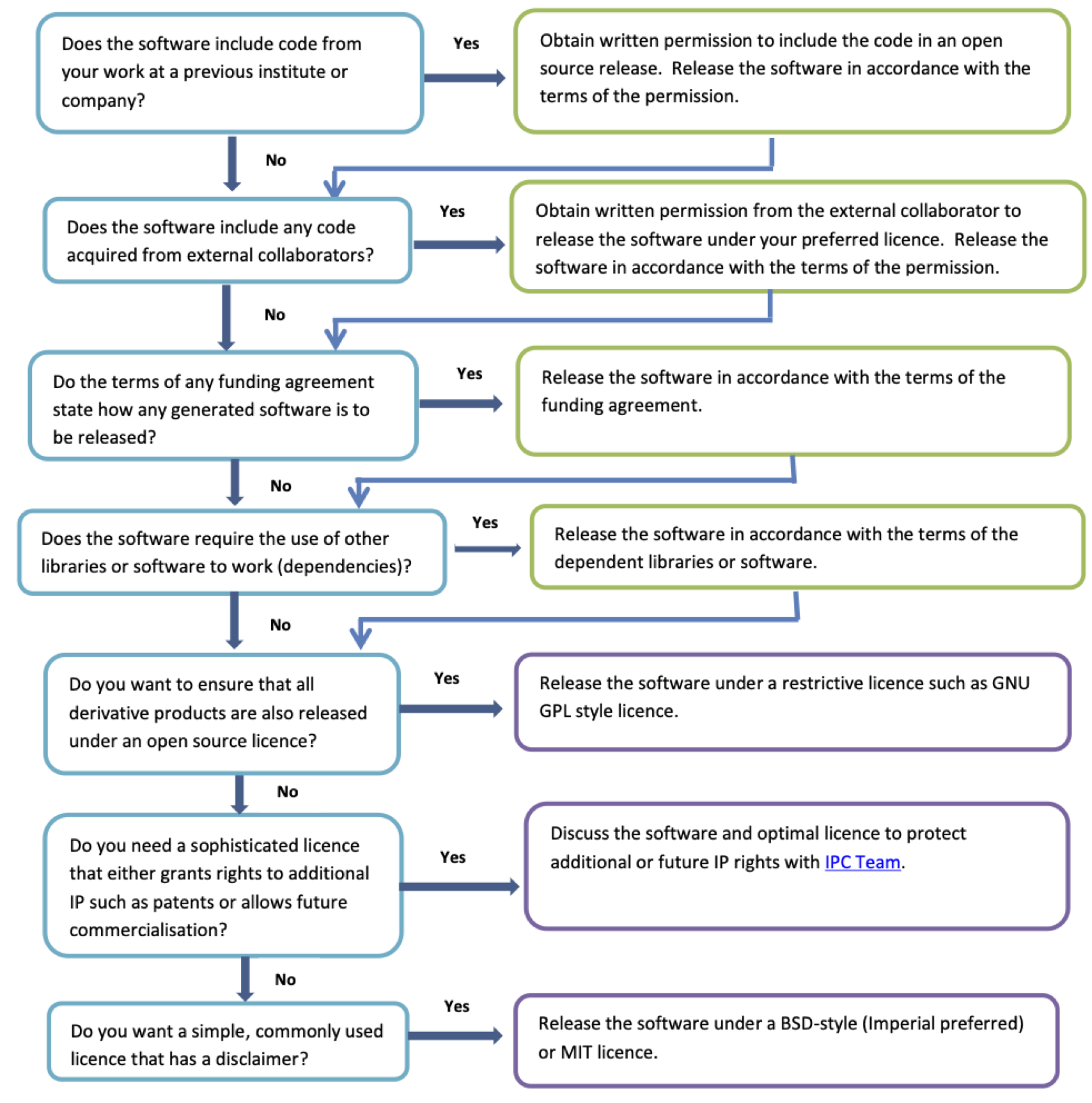
Even within open source, there are many types of licenses for software. The Imperial Enterprise webpage contains detailed information about the topic. If you opt for an open-source, Imperial's preferred software licence is the BSD licence (either 2-Clause or 3-Clause).
Use the following chart created by the IPC Team to help you decide on the matter: