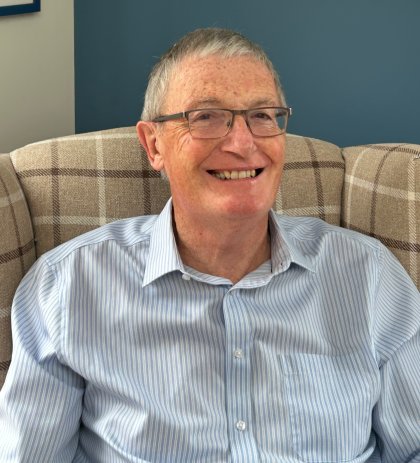
We recently caught up with Dr Harvey Sampson BEM (St Mary's Hospital Medical School 1976), a retired GP from Burnham-on-Sea and graduate of St Mary’s Hospital Medical School, to reflect on his student days and career. Dr Sampson was awarded the British Empire Medal (BEM) in the 2025 King’s Birthday Honours, in recognition of his dedication to supporting the delivery and development of GP services in Somerset. Read more about this outstanding achievement in this Burnham & Highbridge Weekly News article.
We asked Dr Sampson to share some of the memories and milestones that have shaped his journey.
What did you learn during your time at Imperial, in class or out?
On qualifying I felt I’d learned very little that equipped me for life as a doctor! I learnt much more after qualifying, but in hindsight I accept that must have been on the back of what medical school had taught me. I certainly learnt resilience, work ethic and coping mechanisms - though that was not specifically taught! Medical student training has evolved hugely. In my time it was haphazard and not monitored in any formal way – it largely relied on students just turning up. Having trained numerous students from Bristol Medical School in the early 2000s, I've seen how much things have changed, particularly with the introduction of competency-based assessments, where every skill now needs to be formally signed off.
I do wonder, though, whether this process makes for better doctors.
Tell us a bit about the work you’re doing now, and your journey to this point.
I fully retired last year at the age of 71. After qualifying in 1976, I had hoped to pursue a career in surgery. However, for personal reasons, this wasn't to be. Instead, I settled on general practice and joined a partnership in Burnham-on-Sea, Somerset, in April 1982 – where I remained for the next 33 years.
My leadership journey began following a life change in 1997 – I became involved in many county-wide projects as Somerset LMC Chairman and Somerset PCT Executive Committee Vice-Chairman, and helped develop a large health campus in Burnham.
Which extra-curricular Imperial activities you were involved in?
Anything sporting – I played first team football, cricket, hockey, rugby, golf and water polo. I also played table tennis and basketball, and was awarded the Roger Bannister trophy for best all-round sportsman at St Mary's Hospital Medical School in 1976.
I was also treasurer of the summer ball committee for two years, helping to organise the hugely successful annual fundraising balls.
Who did you find inspiring at Imperial and why?
Oscar Craig. His famous Freshers' lecture helped to cement the ethos of the medical school and the pride of the students in being ‘Mary's men/women’. I also think being part of a small college with a year group of just over 100 was in itself inspiring and garnered great loyalty and cohesion.
What is your fondest memory of your time here?
There are so many highlights, but spending several weeks on elective at Chogoria Mission Hospital in Kenya stands out, it was such a fantastic opportunity and a very steep learning curve towards becoming a doctor.
What have been your career highlights and lowlights?
Highlights: Approximately three months into my first house job I successfully carried out an appendectomy - the first of several unsupervised – unthinkable in today’s climate. Years later, as a GP, I had an extra patient squeezed in at the end of a busy morning surgery – a 15 year old girl who had been brought in by her mother complaining of tummy pain.
On examination, I discovered the girl was carrying a hidden pregnancy, now full term and 8cm dilated. This was before the day of mobile phones or even a bleep so, along with one of my GP partners we prepared for delivery, which turned out to be a footling breech. We managed, the child was delivered safely and mother and baby were sent off to hospital when the ambulance eventually arrived. The new grandmother was still in shock!
Whilst Local Medical Committee (LMC) Chairman, from 2000 to 2004, I served as lead negotiator for the introduction of the new GP contract in 2004. This involved numerous face-to-face meetings with Sir Ian Carruthers, then head of the Somerset & Dorset Strategic Health Authority, who later briefly led NHS England. I felt that we eventually arrived at a meeting of minds after many hours of tough negotiations and a developing of mutual respect.
In recent years, after stepping down from my partnership and expecting to spend the final part of my career doing occasional locums, I was invited by Symphony Healthcare Services (a local at-scale primary care provider) to step in as clinical lead at a local GP practice. The practice had received two ‘Inadequate’ ratings from the CQC and was at risk of closure. Closure would’ve meant a crisis for the 14,000 registered patients, and the wider local health community. I took on the challenge and, with the help of a large team, we turned things around – just one year later, the practice was rated ‘Good’ by the CQC.
Lowlights: Receiving a letter from the General Medical Council informing me that the relatives of an elderly patient with whom I had been peripherally involved, were accusing me – along with a number of colleagues – of the attempted murder of their relative. Even in today’s litigious climate, this was a huge and unpleasant shock. I am pleased to report that after many months of investigation, their case was dismissed and my colleagues and I were completely exonerated, but I can certainly attest to the considerable strain that it placed on all of us.
What would be your advice for current students?
To try and understand that medicine is not simply an academic exercise in passing exams, acquiring knowledge and gaining competencies. It is about people and their fears of becoming ill, and it is about treating patients as individual people not just as medical problems to solve. I would also advise avoidance of the politicisation, opportunism, and polarisation that I see emerging in today’s medics.
Vocation has become a rather old fashioned concept but I feel reconnecting with the values of service to one’s patients will stand today’s students in good stead and will, perhaps, restore some of the faith that the general public used to feel towards the profession and which I fear is in danger of being completely lost. I would also advise that Professor Robert Winston’s recent podcast on this subject should be mandatory listening!
What makes you proud to be an Imperial alumnus?
Imperial has a global reputation for excellence in learning, and I am proud that part of that is the former independent college of St Mary's, a place where students could grow and develop into doctors who have, I believe, served their patients and communities with grace and distinction over the last 50 years.