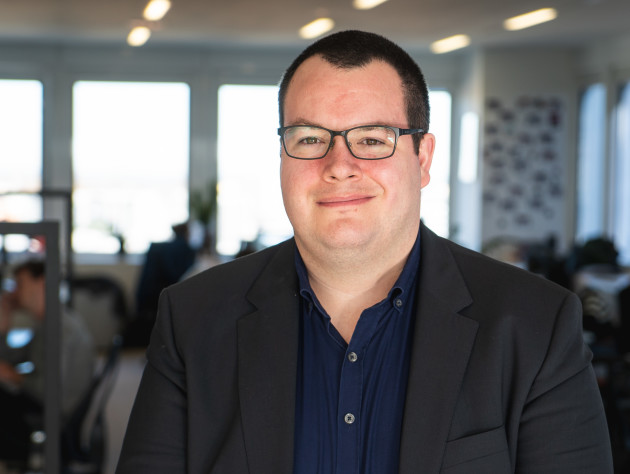
 Patrick Glauner graduated from Imperial with an MSc in Computing (Machine Learning) in 2015. At the age of 30, he was appointed full professor of artificial intelligence at Deggendorf Institute of Technology in Bavaria, Germany in 2020, specialising in machine learning, computer vision, quantum computing and innovation management. Since then, he has advised multiple parliaments as an expert witness. During his time at Imperial, he was a course representative for his master's programme and a President's Ambassador.
We spoke to him about his studies at Imperial and his career.
Who did you find inspiring at Imperial and why?
I found Professor Murray Shanahan's class on Computational Neurodynamics most rewarding. Murray provided us with a fantastic framework that enabled us to (somewhat) understand how the human brain works. We also learned how to simulate interactions between groups of neurons in a computer. I strongly believe that his approach will prove to be crucial to the future of the field of artificial intelligence.
What is your favourite place at Imperial and why?
ħ-bar, I really miss their drinks and tapas! I often had dinner there with my classmates during our night shifts doing coursework assignments.
Tell us a bit about the work you're doing now.
At age 30, I became Full Professor of Artificial Intelligence at Deggendorf Institute of Technology in Bavaria, Germany. I established a bachelor's programme in artificial intelligence. In my classes, I teach our students how to apply artificial intelligence models to solving real-world problems in industry. You can watch the recordings of my lectures at https://www.glauner.info/teaching. I have also published 6 books.
However, I have also noticed that having great ideas in R&D and commercialisation is not enough, because a lot depends on the political and regulatory environment. That’s why I am happy that I was invited by the European Parliament, the parliaments of France, Germany, and Luxembourg, and the Inter-Parliamentary Union as an expert witness since I started my professorship. I enjoy working closely with policymakers and helping them understand how artificial intelligence works, its potential and how to foster innovation.
How has what you learnt at Imperial helped you in your career so far?
The master's programme at Imperial provided me with a very solid foundation, both in breadth and in depth, in artificial intelligence. That foundation proved to be very helpful for my PhD research. I also built a great network at Imperial and made many new friends here.
What have been your career highlights and lowlights?
I got hired by the European Organization for Nuclear Research (CERN) when I was completing my bachelor's degree. After two years at CERN, I wanted to learn more about artificial intelligence and attended Imperial in order to do my master's degree. Next, I did a PhD in artificial intelligence at the University of Luxembourg.
Towards the end of my PhD, I joined Krones Group, a major mechanical engineering corporation in Germany. I led a competence centre that was in charge of the corporate AI strategy and its implementation.
In Germany, there are only a very limited number of positions between the levels of postdoc and full professor. However, there are opportunities for industry executives to become full professors directly. Looking back, I am glad I switched to a full-time managerial role in industry at the time I was finishing my PhD. That experience then helped to make a quick transition to a full professorship.
What does a typical day look like for you now?
I split time between university (teaching classes and doing research) and my own company skyrocket.ai, an artificial intelligence consulting company. I enjoy advising companies on how to solve real-world challenges using artificial intelligence. Consulting also allows me to work at the forefront of modern artificial intelligence. As the field of artificial intelligence is evolving very rapidly, this enables me to keep my classes at university cutting-edge.
What are your plans for the future?
I am currently working on two more books: one on artificial intelligence in the construction sector and one on artificial intelligence in practice from a management, IT and legal perspective. The field of artificial intelligence is evolving rapidly, and I look forward to working with my customers on exciting new artificial intelligence applications and teaching many new students how to do so, too.
What would be your advice for current students?
If you are planning to do a PhD, make sure to get some additional training in a more industry-related field. PhD-level research is usually extremely narrow. Therefore, you should be prepared to build a career in industry in case you are unable or unwilling to stay in academia upon graduation. There are plenty of opportunities, be it undergoing patent attorney training, doing an LLM or doing an MBA, just to name a few opportunities. For example, I did an MBA alongside my PhD, which proved to be very helpful for becoming an executive in industry upon graduation.
What makes you proud to be an Imperial alumnus?
I met my wife at Imperial. We got married two years after graduation.
What one word or phrase would you use to describe Imperial alumni?
We never ever give up.
Do you have a favourite quote or saying?
Think big, dream bigger!