
“Representation influences capital allocation” says Professor of Finance at Imperial’s third annual Women in Finance event
Imperial Business School’s event showcased female leaders driving sustainable investing, ESG innovation and long-term value creation.

Once characterised as a “boys’ club”, the finance sector is undergoing a cultural shift that is reshaping how decisions are made. Greater representation at senior levels is increasingly recognised as influencing how capital is allocated.
Imperial Business School’s third annual Women in Finance event explored how women are influencing capital markets and redefining leadership across sustainable finance.
An investment narrative that is rooted in embracing change
The keynote address was delivered by Hortense Bioy, former Head of Sustainable Investing Research at Morningstar Sustainalytics, who focused on building a more sustainable and inclusive financial future. She explored how geopolitical uncertainty has reshaped sustainable investing strategies, creating both complexity and opportunity.
“The media often debates whether ESG is dead,” Bioy observed. “What we are witnessing right now is an evolution of practices, a recalibration by businesses and investors alike. What’s fading is a version of ESG that relied heavily on labels and was often disconnected from financial outcomes, to make room for pragmatism and realism.”
Her message underscored the importance of data-driven research and thoughtful analysis in navigating rapidly changing markets. She also offered advice to young women entering the sector, encouraging attendees to embrace opportunity: “Step beyond your comfort zone. Visibility and persistence matter. No is rarely the end.”
“Through events like Women in Finance, Imperial Business School reaffirms its commitment to advancing women across the financial sector, creating space for leadership, visibility and meaningful dialogue.”
Improving gender inclusion in sustainable finance
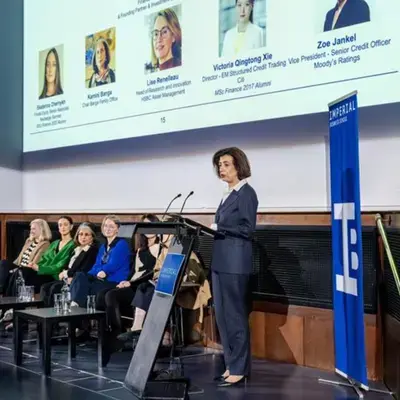
The panel discussion, moderated by Fiona Frick, Finance Advisory Board Member and Founding Partner at Circe Invest, examined how female voices are shaping sustainable finance, impact investing and fintech.
Lise Renelleau, Head of Research and Innovation at HSBC Asset Management, reinforced the importance of measurable impact. She expressed optimism that greenwashing is becoming harder to sustain as access to high-quality data improves. ESG, once perceived as a top-down imposition, is increasingly integrated into portfolio construction and reporting. While AI and advanced technologies enhance data analysis, she stressed that human judgement remains essential in translating information into meaningful insight.
Kamini Bagga, Chair of the Banga Family Trust, reflected on her experience working in India, where workplace equity was less established when she began her career. From identifying public healthcare investment needs in rural communities to overseeing family enterprise, she highlighted the importance of a just transition in emerging markets.
Zoe Jankel, Vice President and Senior Credit Officer at Moody’s Ratings, spoke about cultural change within organisations. She noted a shift away from expectations that women must conform to traditionally masculine leadership styles. Increasingly, authenticity is recognised and valued at senior levels.
The evening concluded with remarks from Lara Cathcart, Academic Director for MSc Finance, MSc Financial Technology, and MSc Risk Management & Financial Engineering. Acknowledging the significant evolution in the finance industry, she reflected that there are still male-dominated pockets, especially at the senior leadership level:
“Representation is not simply about equity; it directly influences how capital is allocated, how risk is assessed, and how innovation is fostered. Through events like Women in Finance, Imperial Business School reaffirms its commitment to advancing women across the financial sector, creating space for leadership, visibility and meaningful dialogue.”
Subscribe for research and events from the Business School
Share


