Across our Outreach programmes, we are looking to work with young people from groups which tend to be underrepresented in university.
When you fill in an application for our programmes we use the information you provide to help us understand more about you, as well as your wider household, school and neighbourhood contexts. This gives us the widest possible picture of who you are and where you come from and allows us give priority selection for our programmes to the young people most likely to benefit.
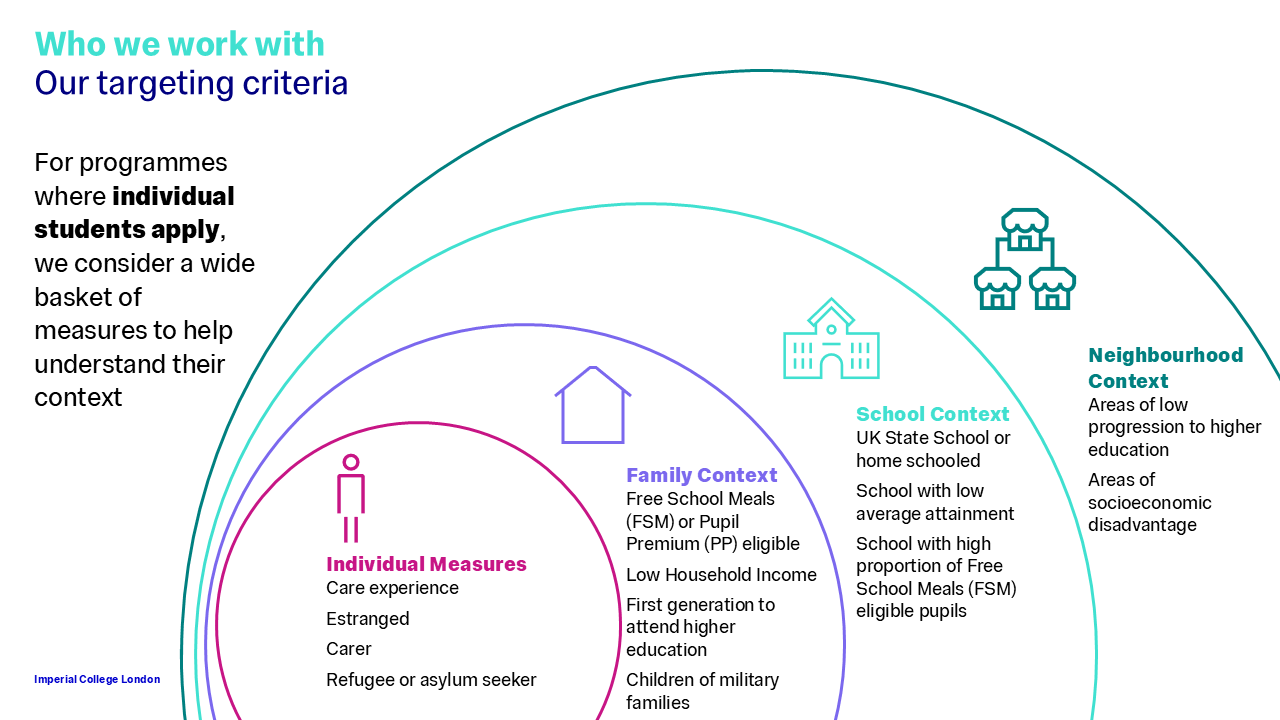
You can find more information below about what we ask in your application, what we ask your parent or guardian and teacher contacts to share, and how we will use this information to consider applications to Outreach programmes.
We have an eligibility checker that you can use, too, to assess your suitability for our programmes.
If you are starting to consider applying to university, you may also be interested to see if you are likely to qualify for contextual admissions at Imperial. While we look at many of the same bits of information, Imperial’s contextual flag for admission to undergraduate courses is a little different. Find our more about Imperial's contextual admissions.
Who you are as an individual
We understand that you might face unique additional challenges that impact your ability to thrive, including academically. For example, if you have spent time in care, are estranged from your family, or are a refugee or asylum seeker, you are likely to be experiencing turbulent and challenging circumstances. Similarly, if you have your own caring responsibilities, this may affect your ability to engage in school or keep up with other regular commitments.
On applications to Outreach programmes, we will ask you if you are care experienced, estranged, a refugee or asylum seeker, or a carer. We understand that this information is often highly personal, but anything that you can tell us about your personal circumstances through the application questions or your personal statement will help us to consider your application in context. If your parent/guardian or teacher contact for your application is able to confirm or add additional detail in their own statements, this will be useful as well.
We may also use information about your personal circumstances to help connect you with relevant resources or opportunities, or to give you an opportunity to speak with student ambassadors from similar backgrounds.
Who you are as an individual
You would be considered care experienced if…
You have spent any time in care arrangements or as a looked after child. This would include any time spent:
- living with foster carers or under local authority care
- In a residential children's home,
- Being looked after at home under a supervision order
- Living with friends or relatives in kinship care.
This care arrangement would usually be put in place because of abuse or neglect, or a risk of possible abuse or neglect.
You would not be considered care experienced based on…
- Time spent in boarding school
- Working in care or a healthcare setting
- Time spent overnight in a hospital
- Being a carer yourself
- Staying with a grandparent while your parents travel for work.
You may also see the term “care leaver” used. This is a narrower definition, meaning that if you would be considered a care leaver, you would definitely also be care experienced.
It’s also useful to note that care experienced students qualify for contextual admissions at Imperial. To be considered, you would need to tick the box for care experience on your UCAS application.
Care experienced students at Imperial also qualify for additional bursary support.
UCAS information for students: Care Leavers | Applying To University | UCAS.
You would be considered estranged if…
- You no longer have the support of your family. This means you no longer live with or have contact with your biological, adoptive, or step-parents or wider family who, until recently, had responsibility to support you.
You would likely not be considered estranged if…
- You are estranged from one parent, but still have support from another parent
- You are estranged from your biological parents, but have an ongoing relationship with your adoptive parents (see also care experience)
- You are still living with your family
- You are still receiving financial support from your family.
You would be considered a refugee if…
- The UK government has granted you official refugee status
- The UK government has granted you humanitarian protection.
You would be considered an asylum seeker if…
- You left your home country due to persecution, violence or war, and are currently in the process of seeking official refugee status
- You have applied for refugee status and are awaiting a decision, possibly with limited leave to remain in the UK
- You are submitting an appeal to a request for refugee status.
You would not be considered a refugee or asylum seeker based on:
- Your family relocated to the UK for work or study and you are now living here permanently with dual citizenship.
- One or both of your parents are on a UK visa with a limited time frame, for example a spouse visa.
You would be considered a carer if…
- You provide unpaid care for a family member or friend, usually due to their long-term illness, disability, mental health, or addiction
- This person would not be able to cope without your support
- This caring responsibility impacts your ability to complete school work, have a job, or engage in extra curriculars. This may be because you regularly spend time (10+ hours per week) on this responsibility, or because this responsibility may unexpectedly take up a lot of time in a short burst.
You would not be considered a carer based on…
- Time spent with a sibling after school
- Time spent doing household chores.
Your household and family
Understanding your household context helps us to understand the opportunities and information you may have access to. While your household income and parent’s educational status can never tell the whole story, it gives us a useful starting point.
Your household and family
On your Outreach application, we may ask if you have ever been eligible for free school meals. It doesn’t matter if you have actually received these meals or not, only if you have been eligible. If you’re not sure, it may be helpful to ask your parent/guardian or someone at your school.
In your application to an Outreach programme, we may ask your household income. If you can, check with a parent/guardian to confirm.
Your household income refers to the combined total income of your parents or guardians for the current tax year before tax. If you do not live with both of your parents, your household income would be the income of your primary parent or guardian.
You would be considered a first-generation university student if…
- Your parents, step-parents, adoptive parents, or guardians have not completed a university degree.
If you have siblings, step-siblings or cousins who have started or completed university, this has no impact on you being first-generation. You are first generation (or not) based only on your parents’ or guardians’ previous education.
You would not be considered first generation if…
- Your parent, step-parent, or guardian have completed a university degree
- You have a parent who completed university outside of the UK.
You would be considered to be from a military family if…
- Your parent or guardian currently serves in the UK armed forces or as a reservist
- Your parent or guardian served in the UK armed forces or as a reservist at any point during the first 25 years of your life
- You qualify for Service Pupil Premium.
Your school environment
In your application to an Outreach programme, we will ask for the details of your current school. We will then use additional information that we have about schools across the UK to help us understand your school’s academic and socioeconomic context.
Your school environment
In most cases, you will only be considered for an Outreach programme if you attend a UK state school which is not fee-paying. Exceptions to this may be made for care experienced students, estranged students, or refugee or asylum seekers.
To help us understand your own educational experience in context, we will look at your school’s average GCSE or A-level attainment. We will also look to see if your school has a high proportion of pupils who are eligible for free school meals.
Your neighbourhood setting
Finally, in reviewing your application, we will use your postcode to find some additional information about the neighbourhood where you live. We will look at the wider socioeconomic context of your neighbourhood (IMD) as well as how many young people in your neighbourhood typically continue on to higher education (POLAR4). We’ll use the postcode that you provide in your home address for this. If you have multiple home addresses where you spend time, for example because your parents are separated, this should be the address where you spend most of your time.
Parent or guardian and teacher contacts for your application
If you apply to one of our programmes, we will ask you to nominate a parent or guardian as well as a teacher who can each provide a bit more information for your application. This is to help us confirm some of the information that you provide, as well as giving the opportunity for us to hear more about you.
References
The person that you nominate for your parent or guardian contact will be asked about the following information to support your application:
- Whether you are care experienced
- If you are a refugee or asylum seeker
- Whether you have ever qualified for free school meals (FSM)
- Any caring responsibilities you may have
- Your household income
- Whether you would be a first-generation higher education student.
They will also have the opportunity to complete a short written statement, which might be useful if there is further detail that they were not able to provide elsewhere in the reference,. This written statement is not required, but can be a useful way to share about wider circumstances that impact your educational journey, for example:
- Further context around your schooling, including if you need to travel long distances to get to school
- Recent bereavement or significant events which may be affecting you
- If you are on a scholarship or bursary at your current school
- Further information if you are currently home educated.
If you are in care or estranged from your family, you may wish to ask your social worker or another adult who can confirm the information above to complete this reference for you. If you are not sure who should complete this reference in your case, please do contact us.
The teacher that you nominate for your teacher contact will be asked about the following:
- Whether you are care experienced
- If you are a refugee or asylum seeker
- Whether you have ever qualified for free school meals (FSM) or Pupil Premium (PP)
- Any caring responsibilities you may have
- Your GCSE results or subjects you have studied, depending on which programme you have applied for.
They will also be able to complete a short written statement. As in the parent or guardian reference, this statement is not required, but may be a useful opportunity to add information that your teacher was not able to include elsewhere, for example:
- Disruptions to your schooling, like changes in teacher or school moves
- If you are on a scholarship or bursary at your current school.
Outreach Newsletter
Sign up to our newsletter and mailing list for updates about Outreach events and activities.