
An opportunity for Faculty of Natural Sciences students to explore how technology shapes teaching and learning while building skills employers and researchers value
About the programme
Established in 2019, our Student Internship Programme is an annual, six-to-ten-week full-time opportunity designed to give students hands-on experience within the FoNS EdTech Lab team. We recruit students from across all departments, creating a diverse cohort that reflects the breadth of our academic community. The internship mirrors the working patterns of our full-time team members and is delivered in a hybrid format, combining on-campus and remote working.
“I think I gained a greater appreciation for what working as part of the FONS EdTech team entails, as well as all the effort put into making our learning experience what it is. It was always very fun to have a sneak peek at the back-ends of technologies.” - Eugenia, Year 3 Chemistry, 2025 Intern
The programme is structured to support interns’ professional development and aligns with the Imperial Learning and Teaching Strategy through an emphasis on authentic learning, student development, and reflective practice. Interns are supported to understand and demonstrate Imperial’s values, behaviours, and expectations, and to embed these in how they collaborate, communicate, and contribute across the placement.
All interns complete a set of core activities designed to build confidence, communication skills, and professional awareness. Activities included interviewing and delivering presentation on staff roles and responsibilities, complete professional development modules e.g., Attributes and Aspirations (AA), and attend specialist masterclasses e.g., sessions by our AV team members.
Alongside these shared activities, interns contribute to live projects that vary each year according to team priorities and user needs. This may include testing new tools, supporting pilots, responding to academic requests, or contributing to enhancements that improve the learning and teaching experience.
To encourage a reflective-practitioner mindset, interns maintain an individual learning journal throughout the internship, supporting reflection against the STAR Framework and their ongoing professional development. This supports ongoing reflection on tasks and project work, including what went well, what could be improved, and what they would do differently in future—helping students build confidence, self-awareness, and professional habits they can carry forward.
Each year, we welcome two cohorts of up to eight interns, offering a collaborative, structured experience that combines professional skills development with meaningful project work.
"I have had the privilege of working alongside the lovely interns who are not only deeply knowledgeable and visionary in their approach, but who also balance their professionalism with a great sense of humour."
- FoNS Faculty Staff member
Students as Partners: Impact in Action
At an institutional level, the internship programme strengthens student partnership and enhances the alignment between educational development and student needs. By embedding student voice directly into project work and innovation, the programme supports more responsive, inclusive, and effective learning environments.
It contributes to capability-building, values-led practice, and the development of future graduates who understand professional standards, reflective practice, and collaborative working. The programme also fosters a culture of shared responsibility for educational enhancement, reinforcing the principles of the Imperial Learning and Teaching Strategy.
The internship programme creates meaningful opportunities for staff to work in partnership with students. By collaborating directly with interns, staff gain first-hand insight into how students experience learning, how they engage with technology, and what supports or hinders their academic progress.
Interns bring fresh perspectives on digital tools, learning design, and communication approaches. Their input helps inform improvements, pilots, and enhancements, ensuring developments are grounded in real student experience. The programme also supports a culture of dialogue, co-creation, and continuous improvement across the team.
For students, the internship offers authentic experience within a professional environment. Working full-time in a hybrid model, interns develop practical skills in communication, collaboration, presentation, negotiation, and project delivery.
Through structured activities, reflective journaling, professional development modules, and live project work, students build confidence and self-awareness. They gain insight into institutional processes, digital innovation, and cross-team working, while strengthening the transferable skills that support future employment and career planning.
The programme encourages students to see themselves not only as learners, but as contributors and partners in shaping educational experiences.
Interested in applying?
Programme Highlights and Stats
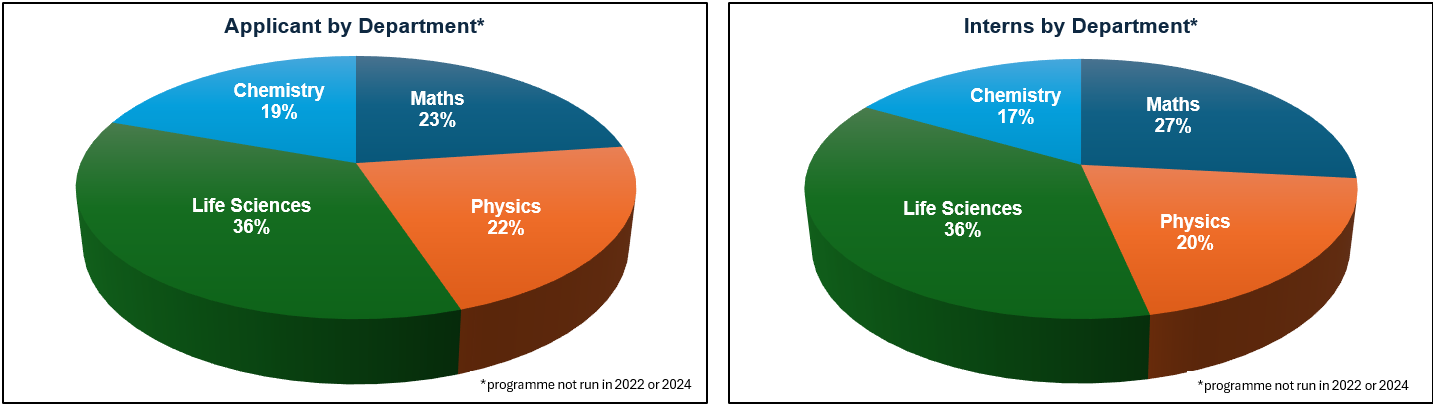
The charts show a broadly consistent departmental spread between applicants and appointed interns, with Life Sciences representing the largest share in both groups. Maths shows a slightly higher proportion among interns than applicants, while Physics and Chemistry are slightly lower.
Please note: these figures exclude 2022 and 2024, as the programme did not run in those years.
Projects
Projects
In 2025, interns explored the use of Generative AI as a "critical friend," examining how AI tools can support academic work while encouraging critical evaluation, ethical use, and reflective judgement. Students tested prompts, interrogated data outputs, and evaluated AI-generated responses against marking criteria and quality standards, supporting an evaluation of Imperial's new GenAI course.
Alongside this, they contributed to live team priorities, including user testing and performance testing for the Safe Exam workspace, which was being piloted by the faculty to facilitate computing exams. They also supported data validation for the Assessment Data Analytics (ADA) project and reviewed internal wiki documentation to identify gaps and areas for improvement.
The students attended a test session with the Business School and provided a structured tool evaluation by using an established framework, of the VR Escape Room Experience, designed to support team-building. Escape from Space Case Study
Over the course of the six-week programme, interns contributed to a varied portfolio of projects spanning design, testing, content migration, and evaluation.
Interns took on a creative brief to produce branded assets for the VLE virtual learning environment, designing bespoke Blackboard banners tailored to individual module leads and departments. This gave them hands-on experience translating institutional branding into practical, audience-specific visual materials used directly within the teaching platform.
They also played a key role in testing an algorithm in the tool What's Best, developed to support fairer and more efficient group work allocation. Interns worked through test scenarios, assessing the algorithm's outputs and helping to identify how well it performed against real-world requirements.
One of the most substantial pieces of work across the programme was supporting the migration of an MSc programme from Coursera to Blackboard. Spanning several weeks, interns worked through the transfer of course content, helping to ensure materials were accurately reproduced and appropriately structured within the new platform.
Interns participated in user testing for a Chemistry VR laboratory experience, providing structured feedback on usability and learning design. Their responses contributed to the ongoing evaluation of how immersive technology can be used to support practical science teaching.
Finally, interns evaluated a set of code scripts used for similarity checking, assessing their accuracy, consistency, and suitability for academic use.
Contact Information
For any enquiries regarding the internship programme please contact FoNS EdTech Lab via email: fonsedtech@imperial.ac.uk
Contact us
Get in touch with the EdTech Lab and AV Support Team: